

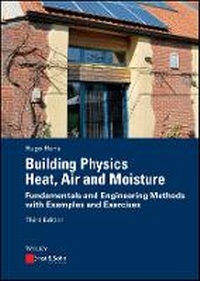
Building Physics - Heat, Air and Moisture Fundamentals and Engineering Methods with Examples and Exercises 3e
Erschienen am 8. September 2017
Software
Software-Medium
348 Seiten
978-3-433-60854-8 (ISBN)
Beschreibung
Bad experiences with construction quality, the energy crises of 1973 and 1979, complaints about "sick buildings", thermal, acoustical, visual and olfactory discomfort, the need for good air quality, the move towards more sustainability - all these have accelerated the development of a field that, for a long time, was hardly more than an academic exercise: building physics (in English speaking countries sometimes referred to as building science). The discipline embraces domains such as heat and mass transfer, building acoustics, lighting, indoor environmental quality and energy efficiency. In some countries, fire safety is also included. Through the application of physical knowledge and its combination with information coming from other disciplines, the field helps to understand the physical phenomena governing building parts, building envelope, whole buildings and built environment performance, although for the last the wording "urban physics" is used. Today, building physics has become a key player on the road to a performance based building design.
The book deals with the description, analysis and modeling of heat, air and moisture transport in building assemblies and whole buildings with main emphasis on the building engineering applications, including examples. The physical transport processes determine the performance of the building envelope and may influence the serviceability of the structure and the whole building. Compared to the second edition, in this third edition the text has partially been revised and extended.
The book deals with the description, analysis and modeling of heat, air and moisture transport in building assemblies and whole buildings with main emphasis on the building engineering applications, including examples. The physical transport processes determine the performance of the building envelope and may influence the serviceability of the structure and the whole building. Compared to the second edition, in this third edition the text has partially been revised and extended.
Weitere Details
Sprache
Englisch
Verlagsort
Berlin
Deutschland
Verlagsgruppe
Wiley-VCH Verlag GmbH
Zielgruppe
Für Beruf und Forschung
Maße
Höhe: 250 mm
Breite: 150 mm
Dicke: 15 mm
Gewicht
666 gr
ISBN-13
978-3-433-60854-8 (9783433608548)
Copyright in bibliographic data and cover images is held by Nielsen Book Services Limited or by the publishers or by their respective licensors: all rights reserved.
Schweitzer Klassifikation
Weitere Ausgaben
Andere Ausgaben
Hugo Hens
Building Physics: Heat, Air and Moisture
Fundamentals and Engineering Methods with Examples and Exercises
E-Book
08/2017
3. Auflage
Ernst & Sohn
61,99 €
Als Download verfügbar
Hugo Hens
Building Physics: Heat, Air and Moisture
Fundamentals and Engineering Methods with Examples and Exercises
E-Book
08/2017
3. Auflage
Ernst & Sohn
61,99 €
Als Download verfügbar
Person
Prof. em. Dr.-Ing. Hugo S. L. C. Hens, Universitat Lowen (K.U. Leuven/Belgien), lehrte Bauphysik von 1975 bis 2003, Baukonstruktion von 1975 bis 2005 und Technische Gebaudeausrustung von 1975 bis 1977 sowie von 1990 bis 2008. Bis 1972 war er als Tragwerksplaner und Bauleiter fur Wohnhauser, Buro- und Geschossbauten in einem Architekturburo tatig. Er hat als Autor bzw. Koautor ca. 70 wissenschaftliche Aufsatze und ca. 170 Tagungsbeitrage veroffentlicht und hunderte Schadensgutachten erstellt. In der Zeit von 1983 bis 1993 koordinierte er die internationale Arbeitsgruppe CIB W40 "Heat and Mass Transfer in Buildings". Von 1986 bis 2008 war er im Rahmen des Forschungsprogramms "Energy Conservation in Buildings and Community Systems" der Internationalen Energieagentur IEA fur die Erarbeitung von Annex 14, Annex 24, Annex 32 und Annex 41 verantwortlich. Er ist Mitglied der American Society of Heating, Refrigeration and Air Conditioning Engineers (ASHRAE).
Inhalt
VORWORT THEORIE DES WARMETRANSPORTS Einleitung Warmeleitung Konvektion Strahlung Anwendungsbeispiele und Aufgaben Literatur THEORIE DES STOFFTRANSPORTS Einleitung Luftstromung Wasserdampftransport Feuchtetransport Anwendungsbeispiele und Aufgaben Literatur GEKOPPELTER WARME-, WASSERDAMPF- UND FEUCHTETRANSPORT Einleitung Annahmen Losung Erhaltungssatz Stromungsgleichungen Stationare Berechnung Anfangs-, Rand- und Grenzbedingungen Beispiele fur vereinfachte Modellbildung Literatur