

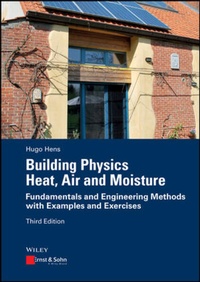
Building Physics: Heat, Air and Moisture
Beschreibung

Bad experiences with construction quality, the energy crises of 1973 and 1979, complaints about "sick buildings", thermal, acoustical, visual and olfactory discomfort, the need for good air quality, the move towards more sustainability - all these have accelerated the development of a field that, for a long time, was hardly more than an academic exercise: building physics (in English speaking countries sometimes referred to as building science). The discipline embraces domains such as heat and mass transfer, building acoustics, lighting, indoor environmental quality and energy efficiency. In some countries, fire safety is also included. Through the application of physical knowledge and its combination with information coming from other disciplines, the field helps to understand the physical phenomena governing building parts, building envelope, whole buildings and built environment performance, although for the last the wording "urban physics" is used. Today, building physics has become a key player on the road to a performance based building design.
The book deals with the description, analysis and modeling of heat, air and moisture transport in building assemblies and whole buildings with main emphasis on the building engineering applications, including examples. The physical transport processes determine the performance of the building envelope and may influence the serviceability of the structure and the whole building.
Compared to the second edition, in this third edition the text has partially been revised and extended.
Weitere Details
Weitere Ausgaben
Nachauflagen
Andere Ausgaben
Person
Inhalt
0.1 Subject of the book
0.2 Building physics
0.3 Importance
0.4 History
0.5 Units
0.6 Symbols
1 Heat transfer
1.1 Overview
1.2 Conduction
1.2.1 Conservation of energy
1.2.2 The conduction laws
1.2.3 Steady state
1.2.4 Transient
1.3 Heat exchange at surfaces
1.4 Convection
1.4.1 In general
1.4.2 Typology
1.4.3 Quantifying the concevtive surface film coefficient
1.4.4 Values for the convective surface film coefficient
1.5 Radiation
1.5.1 In general
1.5.2 Definitions
1.5.3 Reflection, absorption and transmission
1.5.4 Radiant bodies
1.5.5 Simple Formulae
1.6 Building-related applications
1.6.1 Surface film coefficients and reference temperatures
1.6.2 Steady state: flat assemblies
1.6.3 Local inside surface film coefficients
1.6.4 Steady state: two and three dimensions
1.6.5 Heat balances
1.6.6 Transient
1.7 Problems and solutions
2 Mass Transfer
2.1 Generalities
2.1.1 Quantities and definitions
2.1.2 Saturation degrees
2.1.3 Air and moisture transfer
2.1.4 Moisture sources
2.1.5 Air and moisture in relation to durability
2.1.6 Link to energy transfer
2.1.7 Conservation of mass
2.2 Air
2.2.1 Overview
2.2.2 Air pressure differentials
2.2.3 Air permeances
2.2.4 Airflow in open-porous materials
2.2.5 Airflow across assemblies with air-open layers, leaky joints, leaks and cavities
2.2.6 Air transfer at the building level
2.2.7 Combined heat and air flow in open-porous materials
2.3 Vapour Transfer
2.3.1 Water vapour in the air
2.3.2 Water vapour in open-porous materials
2.3.3 Vapour transfer in the air
2.3.4 Vapour flow by diffusion in open-porous materials and assemblies
2.3.5 Vapour flow by diffusion and convection in open-porous materials and assemblies
2.3.6 Surface film coefficients for diffusion
2.3.7 The surface film coefficient for diffusion applied
2.4 Moisture
2.4.1 Overview
2.4.2 Water flow in a pore
2.4.3 Vapour flow in a pore that contains water isles
2.4.4 Moisture flow in a pore that contains water isles
2.4.5 Moisture flow in materials and assemblies
2.4.6 Simplified moisture flow model
2.5 Problems and solutions
3 Combined Heat, Air and Moisture Flow
3.1 Introduction
3.2 Material and assembly level
3.3 Whole building level
3.4 Problems and solutions
Postscript
0
Introduction
0.1 Subject of the Book
This is the first volume in a series of four books:
- - Building Physics: Heat, Air and Moisture, Fundamentals and Engineering Methods with Examples and Exercises
- - Applied Building Physics: Ambient Conditions, Building Performance and Material Properties
- - Performance Based Building Design 1: From Below Grade Construction to Outside Walls with Transparent Insulation
- - Performance Based Building Design 2: From Low-Slope Roofs to Finishes and Risk.
This volume discusses the physics behind the heat, air and moisture, also called hygrothermal response of materials, building assemblies and whole buildings. The second volume on applied building physics deals with the ambient conditions indoors and outdoors, the performance rationale, and the heat, air and moisture metrics at the levels of the whole building and the building assembly. In addition, extended tables with material properties are added. The third and fourth volumes on performance-based building design use these metrics and the requirements related to structural mechanics, acoustics, lighting, fire safety, economics and sustainability, to design and construct whole buildings and their composite parts.
Note that the term 'building physics' is hardly used in the English-speaking world, where 'building science' is more common. Yet building science differs as, on the one hand it does not encompass acoustics and lighting, while on the other hand it includes more practice-related topics ranging from HVAC issues to organizational concerns.
0.2 Building Physics
0.2.1 Definition
As an applied science, building physics studies the hygrothermal, acoustic and visual performance of materials, building assemblies, spaces, whole buildings and, be it under the name urban physics, the built environment. The constraints faced are the user demands related to overall comfort, health and safety, together with architectural facts and figures, durability issues, economic restrictions and sustainability-related requirements.
The term 'applied' indicates the field is a tool directed towards problem solving. Topics tackled in the heat, air and moisture subfield are air-tightness, thermal insulation, transient thermal response, moisture tolerance, thermal bridging, salt transport, temperature and humidity-related stress and strain, net energy demand, gross energy demand, end energy use, primary energy consumption, ventilation, thermal comfort and indoor air quality. In the building acoustics subfield, the topics discussed include the air- and structure-borne noise transmission by outer walls, floors, partition walls, party walls, glazing and roofs, room acoustics and the abatement of installation and ambient noise. The lighting subfield includes day-lighting, artificial lighting, and the impact that both have on human wellbeing and primary energy consumption. Urban physics finally looks to the thermal, acoustic, visual and wind comfort outdoors, wind and rain patterns in cities, the spread of air pollution in cities, the heat island effect, and all aspects related to energy management at the city level.
0.2.2 Constraints
0.2.2.1 Comfort
Comfort is typically defined as a condition of mind that expresses satisfaction with the surroundings. Attainment of comfortable conditions depends on what humans need to feel thermally, acoustically and visually at ease: not too cold, not too warm, not too noisy, no large contrasts in luminance, and so on.
Thermal comfort engages physiology and psychology. As exothermal creatures with a constant core temperature of about 37 °C (310 K), humans must be able to lose heat to the environment under any circumstance, whether by conduction, convection, radiation, perspiration, transpiration or breathing. Air temperature, its gradient, the radiant temperature, radiant asymmetry, contact temperatures, relative air velocity, air turbulence and relative humidity in the direct environment will fix the heat exchanged. For a given activity and clothing, humans will quote certain combinations of the named ambient parameters as comfortable, and others not, although adaptation influences satisfaction.
Acoustic comfort strongly relates to mental awareness. Physically, young adults can hear sounds with frequencies between 20 and 16 000 Hz. In terms of sound intensity, however, humans scale logarithmically with better hearing for higher frequencies. Acoustics therefore uses the logarithmic unit the decibel (dB), with 0 dB for audibility and 140 dB for the pain threshold. Undesired noises such as neighbours, traffic, industry and aircraft will disturb people, generate complaints and often create long-lasting disputes.
Visual comfort combines mental with physical aspects. Physically, the eye sees electromagnetic waves with wavelengths between 0.38 and 0.78 µm. The maximum sensitivity lies near 0.58 µm, the yellow-green range. But overall sensitivity adapts to the average luminance. When dark it increases 10 000 times compared with daytime, but the eyes perceive that change logarithmically. Great differences in brightness will disturb, while well-adapted lighting creates a feeling of cosiness.
0.2.2.2 Health and Wellbeing
Wellbeing is determined not only by the absence of illness, but also an absence of neuro-vegetative complaints, psychological stress or physical unease. Dust, fibres, (S)VOCs, radon, CO, viruses and bacteria, moulds and mites, too much noise, thermal discomfort and great luminance contrasts are all disturbing to the users of buildings.
0.2.2.3 Architecture and Materials
Building physics faces architectural and material restrictions. Façade and roof form, aesthetics pursued and the materials chosen will all shape the building, while their design engages a multitude of metrics and requirements. Conflicting structural and physical issues often complicate solutions. Necessary thermal cuts interfere with the strength and stiffness of the connections required. The creation of waterproof and vapour-permeable structures are not always compatible. The necessary acoustic absorption could interfere with vapour tightness, for example.
0.2.2.4 Economy
Not only must the building costs respect budget limits, but the total expenditure over the timespan a building is owned or used should be the lowest achievable. The initial investment, energy used, maintenance, future necessary upgrades and replacements play a decisive role. A building designed and constructed according to the metrics of building physics and all other advanced fields of study will generally incur lower costs than if done without consideration of fitness for purpose.
0.2.2.5 Sustainability
The environmental impact of human activity has increased substantially over recent decades with worrying consequences. Locally, building use produces solid, liquid and gaseous waste. Countrywide, construction and occupancy accounts for 35-40% of the end energy used. Fossil fuels still deliver the major part, meaning that the CO2 produced by their burning overwhelms all other greenhouse gas releases.
The increasing impact of life-cycle inventory and analysis (LCIA) and the use of certification tools reflect the pursuit of sustainability. In LCIA, buildings are evaluated in terms of environmental impact from 'cradle to cradle', that is, from material production through construction and occupancy to demolition and re-use. For each stage, all material, energy and water inflows and polluting outflows are quantified, and the impact on human wellbeing and the environment is assessed. Certification programmes in turn focus on fitness for purpose that new buildings, retrofitted buildings and urban environments should offer.
0.3 Importance
The necessity of creating a comfortable indoor environment protected from the weather gave birth to the field now called 'building physics'. As various ambient loads such as sun, rain, wind and noise, but also temperature, vapour and air pressure differentials, burden the building enclosure, an appropriate design should annihilate their impact when needed and use it when aiding comfort and wellbeing, while lowering source energy use as far as possible.
In earlier days, experience was the guide. Former generations disposed of a limited range of materials - wood, straw, loam, brick, natural stone, lead, copper, cast iron, blown glass - for which uses increased over the centuries. Standard solutions for roofs, roof edges and outer walls existed. From the size and orientation of the windows to the overall layout, everything was conceived to limit heating in the winter and overheating in summer. Because noise sources outside urban centres were scarce, acoustics was not a consideration, while a lifestyle adapted to the seasons saved energy.
That era ended with the industrial revolution. New materials flooded the market, such as steel, reinforced and pre-stressed concrete, nonferrous metals, synthetics, bitumen and insulation materials. More advanced technologies turned existing materials into innovative products: cast and float glass, rolled metal products and pressed bricks, for example. Advances in structural mechanics allowed designs of any form and span. Due to the widespread exploitation of fossil fuels such as coal, petroleum and natural gas, energy became cheap. Construction exploded and turned into a demand/supply market. The result was mass building of too often minimal quality.
The early...
