

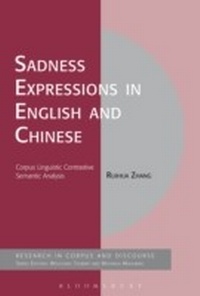
Sadness Expressions in English and Chinese
Corpus Linguistic Contrastive Semantic Analysis
1. Auflage
Erschienen am 25. September 2014
256 Seiten
978-1-4725-0767-9 (ISBN)
Beschreibung

Winner of the Tianjin Social Science Outstanding Achievement Award.
This book reports on the contrastive-semantic investigation of sadness expressions between English and Chinese, based on two monolingual general corpora and a parallel corpus. The exploration adopts a unique theoretical approach which integrates corpus-linguistic theories on meaning (as a social construct, usage and paraphrase) with a corpus-linguistic lexical model. It employs a new complex but workable methodology which combines computational tools with manual examination to tease meaning out of corpus evidence, to compare and contrast lexical items that do not match up neatly between languages. It looks at sadness expressions both within and across languages in terms of three corpus-linguistic structural categories, i.e. colligation, collocation and semantic association/preference, and paraphrase (both explicit and implicit) to capture their subtle nuances of meaning, disclose the culture-specific conceptualisations encoded in them, and highlight their respective cultural distinctiveness of emotion.
By presenting multidisciplinary original work, Sadness Expressions in English and Chinese will be of interest to researchers in corpus linguistics, contrastive lexical semantics, psychology, bilingual lexicography and language pedagogy.
This book reports on the contrastive-semantic investigation of sadness expressions between English and Chinese, based on two monolingual general corpora and a parallel corpus. The exploration adopts a unique theoretical approach which integrates corpus-linguistic theories on meaning (as a social construct, usage and paraphrase) with a corpus-linguistic lexical model. It employs a new complex but workable methodology which combines computational tools with manual examination to tease meaning out of corpus evidence, to compare and contrast lexical items that do not match up neatly between languages. It looks at sadness expressions both within and across languages in terms of three corpus-linguistic structural categories, i.e. colligation, collocation and semantic association/preference, and paraphrase (both explicit and implicit) to capture their subtle nuances of meaning, disclose the culture-specific conceptualisations encoded in them, and highlight their respective cultural distinctiveness of emotion.
By presenting multidisciplinary original work, Sadness Expressions in English and Chinese will be of interest to researchers in corpus linguistics, contrastive lexical semantics, psychology, bilingual lexicography and language pedagogy.
Weitere Details
Reihe
Auflage
1. Auflage
Sprache
Englisch
Verlagsort
London
Großbritannien
Verlagsgruppe
Bloomsbury Publishing PLC
Zielgruppe
Für Beruf und Forschung
Für höhere Schule und Studium
ISBN-13
978-1-4725-0767-9 (9781472507679)
Copyright in bibliographic data and cover images is held by Nielsen Book Services Limited or by the publishers or by their respective licensors: all rights reserved.
Schweitzer Klassifikation
Weitere Ausgaben
Andere Ausgaben
Ruihua Zhang
Sadness Expressions in English and Chinese
Corpus Linguistic Contrastive Semantic Analysis
Buch
01/2016
Bloomsbury Academic
56,20 €
Versand in 15-20 Tagen
Ruihua Zhang
Sadness Expressions in English and Chinese
Corpus Linguistic Contrastive Semantic Analysis
Buch
07/2014
Bloomsbury Academic
177,20 €
Versand in 15-20 Tagen
Person
Ruihua Zhang is Associate Professor at the School of Foreign Languages, Tianjin University of Science and Technology, China.
Inhalt
Acknowledgements
List of Tables
List of Figures
Abbreviations and typographical conventions
1. Introduction
2. Emotions
3. Contrastive lexical semantics
4. Corpus linguistics, parallel corpora and cross-linguistic research
5. The corpus linguistics framework
6. Methodology
7. Contrastive analysis of sadness expressions in English and Chinese
8. Implications
9. Conclusions
Appendix
References
Index
List of Tables
List of Figures
Abbreviations and typographical conventions
1. Introduction
2. Emotions
3. Contrastive lexical semantics
4. Corpus linguistics, parallel corpora and cross-linguistic research
5. The corpus linguistics framework
6. Methodology
7. Contrastive analysis of sadness expressions in English and Chinese
8. Implications
9. Conclusions
Appendix
References
Index
