

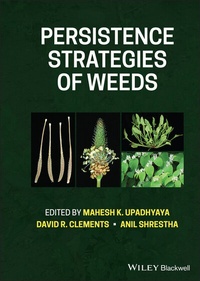
Persistence Strategies of Weeds
Beschreibung

Weeds negatively impact crop yields, the quality of agricultural produce, the health of livestock and ecosystems, and various aspects of human life. Despite significant expenditures of time, money, and resources by agricultural producers, land managers, and the general public, weeds persist. Developing new methods for protecting crops and the environment requires a thorough understanding of the persistence mechanisms of weeds.
In Persistence Strategies of Weeds, an international team of expert authors provide detailed information on weed seed biology, identify the vulnerabilities of different weeds, and address the underlying issues behind the problem of weed persistence despite various management methods including herbicides. Presenting a comprehensive approach to the subject, the authors describe what is already understood about weed persistence and what yet needs to be determined. Topics include the role of seed production, dissemination, seed banks, the physiology and genetics of seed dormancy, the influence of agronomic practices, seed longevity, vegetative propagation, allelopathy, predation, soil microbes, weed evolution, and more. This authoritative volume:
* Examines the genetic flexibility of weeds to adapt to changes in agricultural practices and management strategies
* Discusses the release of allelochemicals by certain weeds that inhibit the growth of competing plant species
* Explores the influence of climate change on weed persistence and how the efficacy of herbicides will be affected
* Emphasizes the importance of sustainable crop production and reducing dependence on synthetic herbicides
* Provides extensive coverage of the roles of genetic, environmental, and morphological factors in the regulation of weed seed dormancy
* Includes an overview of persistence strategies of weeds, detailed case studies, and numerous illustrative examples
Persistence Strategies of Weeds is an ideal textbook for all upper-level undergraduate and graduate students of weed and pest biology, agroecology, or organic agriculture, and a must-have reference for weed scientists and weed management professionals.
Weitere Details
Weitere Ausgaben
Andere Ausgaben
Personen
Mahesh K. Upadhyaya, Professor Emeritus, Applied Biology, Faculty of Land and Food Systems, University of British Columbia, Vancouver, BC, Canada
David R. Clements, Professor, Biology and Assistant Dean, Faculty of Natural and Applied Sciences, Trinity Western University, Langley, BC, Canada
Anil Shrestha, Professor, Weed Science and Chair, Dept. of Viticulture and Enology, California State University, Fresno, CA, USA
Inhalt
Chapter 1 Persistence Strategies of Weeds
Chapter 2 Seed Production, Dissemination, and Weed Seedbanks
Chapter 3 Weed Seed Dormancy and Persistence of Weeds
Chapter 4 Seed Dormancy Genes and Their Associated Adaptive Traits Underlie Weed Persistence
Chapter 5 Environmental Regulation of Weed Seedbanks and Seedling Emergence
Chapter 6 Longevity of Weed Seeds in Seedbanks
Chapter 7 Evolution and Persistence of Herbicide-Resistant Weeds
Chapter 8 Seed Predation and Weed Seedbanks
Chapter 9 Modelling the Persistence of Weed Populations
Chapter 10 Influence of Agronomic Practices on the Persistence of Weed Seedbanks
Chapter 11 Clonal Growth, Resprouting, and Vegetative Propagation of Weeds
Chapter 12 Climate Change and the Persistence of Weeds
Chapter 13 Soil Microbial Effects on Weed Seedbank Persistence
Chapter 14 The Potential Role of Allelopathy in the Persistence of Invasive Weeds
Chapter 15 Weed Adaptation as a Driving Force for Weed Persistence in Agroecosystems
Chapter 16 Persistence Strategies of Weeds
Index
1
Persistence Strategies of Weeds: Introduction
Anil Shrestha1, David R. Clements2, and Mahesh K. Upadhyaya3
1 Department of Viticulture and Enology, California State University, Fresno, CA, USA
2 Department of Biology, Trinity Western University, Langley, BC, Canada
3 Faculty of Land and Food Systems, University of British Columbia, Vancouver, BC, Canada
1.1 Introduction
Since time immemorial, humanity has been plagued by weeds. Today weeds infest almost every environment on earth that is managed. These environments include wilderness areas where the ideal is a "pristine habitat" free of non-native weeds, expansive rangeland habitats where weeds threaten forage quality for livestock, more intensively managed cropping systems where weeds threaten yields, and even our urban yards where weeds negatively impact "the perfect lawn," which is the goal of many home owners. In any case, by now the reader is probably asking the question every weed scientist gets asked repeatedly - "what is a weed?"
In 1912, Blatchley defined a weed as "a plant out of place or growing where it is not wanted." Although this seems like a pretty all-encompassing definition, there is room for many other perspectives, such that of renowned American transcendentalist and writer Ralph Waldo Emmerson, also in 1912, who referred to a weed as a "plant whose virtues have not yet been discovered" (as quoted in Zimdahl 1999). If a weed is determined to be "out of place" (regardless of any potential virtues), in practical terms the weed is often very difficult to "weed out," especially because biologically weeds have evolved tremendous persistence strategies, which greatly affect human endeavors, especially agriculture.
Agriculture is an important component of the world's economy and an important means of livelihood, especially in developing countries (Alston and Pardey 2014). However, there is a lot of risk involved in crop production, much of which comes from insect pests, weeds, and pathogens. Weeds compete with crops and cause huge economic losses, estimated at an annual yield loss of 9% to global agriculture (Oerke 2006) and in economic terms, about US$ 27 billion to US agriculture alone (Pimentel et al. 2005). Similarly, weeds are also a problem in non-crop systems (e.g. roadsides, waterways, etc.) and natural ecosystems (e.g. forests, landscapes) where invasions of undesirable plants can cause aesthetic and economic losses and reduce biodiversity (Neve et al. 2018). They have continued to evolve and persist, despite humankind's efforts to control them.
1.2 Persistence of Weeds
Merriam-Webster's dictionary defines the word "persist" as "to continue to exist especially past a usual, expected, or normal time" or "to go on resolutely or stubbornly in spite of opposition" ("Persist" Merriam-Webster.com Dictionary n.d.). In this book we refer to "weed persistence" as "the ability of undesirable plant species to continually evolve, survive, thrive, and reproduce under a variety of natural and anthropogenic selection pressures." Weed scientists, farmers, and land managers continue to be baffled by the persistence of these species despite a wide variety of management techniques developed to eliminate them. In this context, some questions that can be raised include the following: (i) What makes a weed so persistent? (ii) Why are the natural and human-developed selection pressures failing to eliminate them? (iii) What lessons can we learn from the strategies that they have developed to persist in the various ecosystems? (iv) How can we use this knowledge of weed persistence to minimize the damage they cause to agroecosystems and other human-managed ecosystems?
Although Baker (1965) listed the factors that enable a species to become a weed, the plants continue to persist despite our knowledge of these factors. For decades, we have tried to manage weeds with the so-called four corners of weed management, i.e. biological, chemical, cultural, and mechanical weed control, and yet weeds have persisted. Therefore, it is essential to revisit this list to discuss weed persistence.
Baker (1965) listed the following characteristics that make a plant successful as a weed: no special environmental requirements for germination, discontinuous germination, longevity of seeds, rapid seedling growth, short vegetative periods, ability to maintain seed production as long as growing conditions permit, self-compatible but not necessarily self-pollinated or apomictic, cross-pollinated types that can be pollinated by various methods, ability to produce numerous seeds even under unfavorable environments, good mechanisms for short- and long-distance dispersal, vigorous and multiple methods of vegetative reproduction in asexually reproducing species, and having good competitive mechanisms. Some very persistent weeds may have only one or two of these characteristics, whereas others may have nearly all; the point is that this set of characteristics represent key characteristics that make weeds so successful. In summary, we are dealing with plants that have very successful persistence mechanisms despite of above- and belowground natural and human-induced selection pressures and management methods (Figure 1.1). In the following text, some of these mechanisms will be discussed briefly to give an overview of the persistence strategies of weeds.
In this chapter, we discuss persistence of weeds in terms of (i) seed dormancy, germination, seedling emergence, seed production, and seed return, (ii) soil seedbank and longevity of seeds in the soil seedbank, and (iii) ability to persist against natural and human selection pressures and management methods. The other chapters in the book will describe these phenomena in detail and provide valuable insights to understand the persistence strategies of weeds.
Figure 1.1 Cycle of above- and below-ground natural and human selection and management pressures, continued adaptation, evolution, and persistence of weeds that reproduce by seeds in agroecosystems and other human-managed ecosystems.
1.2.1 Seed Dormancy, Germination, Seedling Emergence, Seed Production, and Seed Return
Seed dormancy has been defined generally as the failure of a seed to germinate despite favorable conditions (Bewley and Black 1994; Benech-Arnold et al. 2000). There are two main types of seed dormancy - primary and secondary (induced) (e.g. Karssen 1982; Bewley and Black 1994). Many weed seeds are known to possess the ability to remain dormant, but viable, in the soil for extended periods of time. For example, the classic, pioneer experiment of W.J. Beal who studied seed dormancy and viability of buried weed seeds in Michigan has been cited in numerous publications (e.g. Kivilaan and Bandurski 1981; Baskin and Baskin 1985; Burnside et al. 1996; Telewski and Zeevart 2002). These and other studies have demonstrated that seeds of some weeds can retain viability and remain dormant for up to more than 100 years. Therefore, seed dormancy can be considered as a primary factor contributing to weed persistence, and knowledge of and a sound understanding of this phenomenon is of prime importance for weed management.
Once dormancy is broken, seeds germinate (emergence of radicle) when the necessary environmental conditions for water, temperature, oxygen, and, in some species, light are met. The range of favorable environmental conditions to stimulate germination depends on the plant genotype (Baskin and Baskin 2001). Seed germination occurs when these factors are present at or above the minimum threshold but below the species-specific maximum levels (Bewley and Black 1994; Baskin and Baskin 2001).
Unlike crop seeds that have a narrower range of optimum conditions for germination, studies have shown that weed seeds can adapt and germinate under a wide range of environmental conditions (e.g. Grundy et al. 2000; Steinmaus et al. 2000; Leon et al. 2004). Whitney and Gabler (2008) suggested that many invasive plant species do not have specialized germination requirements and are highly flexible, making it possible for them to adapt to a wide range of environments. Even under projected climate change scenarios, weed seed persistence is an area of concern. Walck et al. (2011) emphasized the importance of conducting research on seed ecology because they believed that seeds of weedy species could evolve relatively quickly to keep pace with climate change. Furthermore, germination of a few weed seeds and seed production from the resulting plants can add thousands of seeds to the soil seedbank, ensuring the persistence of the weeds.
Since germination is a process primarily driven by a combination of temperature and moisture, researchers have modeled weed seed germination based on the combination of these two factors, i.e. hydrothermal time (e.g. Gummerson 1986; Roman et al. 2000; Bradford 2002). Although these models have enhanced the knowledge of the parameters of weed seed germination, how to use this information from a management standpoint and reduce persistence of weeds in our ecosystems remains a challenge. Nevertheless, modeling is an...
