

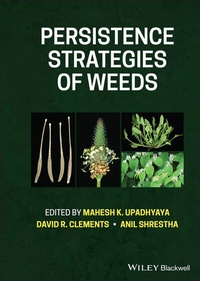
Persistence Strategies of Weeds
Beschreibung

Weeds negatively impact crop yields, the quality of agricultural produce, the health of livestock and ecosystems, and various aspects of human life. Despite significant expenditures of time, money, and resources by agricultural producers, land managers, and the general public, weeds persist. Developing new methods for protecting crops and the environment requires a thorough understanding of the persistence mechanisms of weeds.
In Persistence Strategies of Weeds, an international team of expert authors provide detailed information on weed seed biology, identify the vulnerabilities of different weeds, and address the underlying issues behind the problem of weed persistence despite various management methods including herbicides. Presenting a comprehensive approach to the subject, the authors describe what is already understood about weed persistence and what yet needs to be determined. Topics include the role of seed production, dissemination, seed banks, the physiology and genetics of seed dormancy, the influence of agronomic practices, seed longevity, vegetative propagation, allelopathy, predation, soil microbes, weed evolution, and more. This authoritative volume:
* Examines the genetic flexibility of weeds to adapt to changes in agricultural practices and management strategies
* Discusses the release of allelochemicals by certain weeds that inhibit the growth of competing plant species
* Explores the influence of climate change on weed persistence and how the efficacy of herbicides will be affected
* Emphasizes the importance of sustainable crop production and reducing dependence on synthetic herbicides
* Provides extensive coverage of the roles of genetic, environmental, and morphological factors in the regulation of weed seed dormancy
* Includes an overview of persistence strategies of weeds, detailed case studies, and numerous illustrative examples
Persistence Strategies of Weeds is an ideal textbook for all upper-level undergraduate and graduate students of weed and pest biology, agroecology, or organic agriculture, and a must-have reference for weed scientists and weed management professionals.
Weitere Details
Weitere Ausgaben
Andere Ausgaben
Personen
Mahesh K. Upadhyaya, Professor Emeritus, Applied Biology, Faculty of Land and Food Systems, University of British Columbia, Vancouver, BC, Canada
David R. Clements, Professor, Biology and Assistant Dean, Faculty of Natural and Applied Sciences, Trinity Western University, Langley, BC, Canada
Anil Shrestha, Professor, Weed Science and Chair, Dept. of Viticulture and Enology, California State University, Fresno, CA, USA
Inhalt
Chapter 1 Persistence Strategies of Weeds
Chapter 2 Seed Production, Dissemination, and Weed Seedbanks
Chapter 3 Weed Seed Dormancy and Persistence of Weeds
Chapter 4 Seed Dormancy Genes and Their Associated Adaptive Traits Underlie Weed Persistence
Chapter 5 Environmental Regulation of Weed Seedbanks and Seedling Emergence
Chapter 6 Longevity of Weed Seeds in Seedbanks
Chapter 7 Evolution and Persistence of Herbicide-Resistant Weeds
Chapter 8 Seed Predation and Weed Seedbanks
Chapter 9 Modelling the Persistence of Weed Populations
Chapter 10 Influence of Agronomic Practices on the Persistence of Weed Seedbanks
Chapter 11 Clonal Growth, Resprouting, and Vegetative Propagation of Weeds
Chapter 12 Climate Change and the Persistence of Weeds
Chapter 13 Soil Microbial Effects on Weed Seedbank Persistence
Chapter 14 The Potential Role of Allelopathy in the Persistence of Invasive Weeds
Chapter 15 Weed Adaptation as a Driving Force for Weed Persistence in Agroecosystems
Chapter 16 Persistence Strategies of Weeds
Index
