

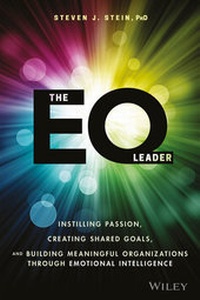
The EQ Leader
Beschreibung

The EQ Leader provides an evidence-based model for exceptional leadership, and a four-pillar roadmap for real-world practice. Data collected from thousands of the world's best leaders--and their subordinates--reveals the keys to success: authenticity, coaching, insight, and innovation. By incorporating these methods into their everyday workflow, these leaders have propelled their teams to heights great enough to highlight the divide between successful and not-so-successful leadership. This book shows you how to put these key factors to work in your own practice, with clear examples and concrete steps for improving skills and competencies. New data from the author's own research into executive functioning describes the neurological aspects of leadership, and a deep look at the leaders of tomorrow delves into the fundamental differences that set them apart--and fuel their achievement.
Leadership is changing, both in look and practice; strictly authoritative approaches are quickly losing ground as today's workers discover the power of collaboration and the importance of interpersonal awareness. This book provides step-by-step guidance for leading from within this space, with evidence-based approaches for success.
* Lead authentically to inspire and motivate others
* Support employee's needs and nurture development
* Communicate with purpose, meaning, and vision
* Foster ingenuity, imagination, and autonomous thinking
An organization's success rests on the backs of its leadership. At all levels, true leadership is about much more than management and task distribution--it's about commitment, collaboration, nurturing talent, developing skills, fostering relationships, and so much more. The EQ Leader integrates the essential factors of successful leadership into a concrete blueprint for the future's leaders.
Weitere Details
Weitere Ausgaben
Andere Ausgaben
Person
Inhalt
Chapter 1 Leadership: What Do We Really Know about Leadership? 1
The Leadership Explosion 2
Leadership: What's the Status? 4
Promoting Leaders from Within 5
Yesterday's Leaders 6
Today's Leaders 7
Tomorrow's Leaders 9
Good Leader, Bad Leader 9
Chapter 2 What Have We Learned about Leadership? 13
Defining Leadership 14
Measuring Leadership 15
Political Leaders 16
Understanding the Ideal Political Candidate 16
How Researchers Have Looked at Leadership 20
Chapter 3 Leadership: Why Emotional Intelligence? 25
The Evolution of Intelligences 26
What Is IQ? 28
What Is Emotional Intelligence? 28
How Does the MSCEIT Relate to Leadership? 33
The Self-Report of Emotional Intelligence 35
Other Models 38
Can Self-Reporting Emotional Intelligence Be Valid? 38
Self-Report Emotional Intelligence, IQ, Personality, and Work Performance 39
Chapter 4 Emotional Contagion 43
Spreading Emotions @work 45
Emotional Temperature 46
A Tale of Two Leaders 47
What Does the Research Say about Emotional Contagion? 51
How Does a Leader's Emotional Intelligence Affect Others? 53
Part I The Building Blocks of Emotional Intelligence 55
Chapter 5 Self-Perception: Know Thyself 57
Emotional Self-Awareness: Know Your Feelings 59
Changing Your Perception of Stress 61
Looking at Self-Awareness and Self-Regard 62
How Does Self-Regard Relate to Leadership? 63
Self-Regard and Toxic Leadership 66
Does Leader Self-Perception Relate to Subordinates' Performance? 67
Discovering Your Self-Regard 68
Emotional Self-Regard: What to Do about It 69
Know Thyself-Self-Actualization 70
Gauging Self-Actualization 72
Part II Self-expression and Leadership 75
Chapter 6 Self-Expression: Communication through Words and Action 77
Your Emotional Expression 79
What Emotions Motivate Your Staff? 83
How Can You Better Express Yourself? 85
Asserting Yourself 85
How Assertiveness Impacts Leaders across Cultures 87
Becoming More Independent 90
Part III Interpersonal Abilities and Leadership 95
Chapter 7 Interpersonal: Creating the Bonds of Trust 97
Developing Your Interpersonal Skills 99
The Importance of Influence 100
What Leaders Need to Know about Empathy 104
How Important Is Empathy in a Leader? 107
Empathy and Emerging Leaders 107
Empathy and Gender 109
Empathy around the World 110
Empathy: What Can We Do about It? 111
Social Responsibility and Work 115
What about the Bottom Line? 117
Social Responsibility Internationally 118
Increasing Your Social Responsibility 119
Part IV Decision Making and Leadership 123
Chapter 8 Making Better Decisions: Emotionally 125
Trusting Your Instincts 125
Problem Solving 126
The Mood You're In 128
The Mood You Create 129
How Those "Incidental" Emotions Can Affect You 130
The Influence of Positive Emotions 132
The Direct Effects of Emotion 136
What about the Object of the Decision? 137
Making Decisions: Feelings versus Calculations 140
How Subjective Are Our Feelings? 141
Deciding with Feelings or Logic 142
Emotional Decision Making and the Brain 143
Making Strategic Business Decisions 144
Decision Making and Reality Testing: Which Emotions When? 145
Impulse Control and Decision Making 147
Part V Stress Management and Leadership 151
Chapter 9 Stress Management and Leadership 153
Stress Tolerance and Leadership 157
How Can You Better Manage Your Time? 159
The Half-Full Glass 160
Part VI
Chapter 10 THE Four PILLARS OF SUCCESSFUL
Leadership:development of the Model 165
The Four Pillars of Successful Leadership: Developing the Model 167
Developing the Four-Pillar Model: Theories of Leadership 168
Developing the Four-Pillar Model: Collecting and Analyzing the Data 170
The Four Pillars 174
Emotional Intelligence and Derailers 177
Chapter 11 Pillar I: Developing Authenticity 181
Authenticity 181
Becoming a More Authentic Leader 182
Becoming More Authentic 184
Summary 193
Example of Authentic Leadership 194
Being Real and the Culture of Reality TV 195
Why Is This Relevant to Leadership? 196
Chapter 12 Pillar II: Developing Leader Coaches 199
Coaching 199
What Is a Coaching Leader? 201
Better Conversations 202
Develop Strengths 203
Emotional Skills 204
Example of Coaching Leadership 209
Chapter 13 Pillar III: Developing Insight 213
Insight 213
Discovering Your Purpose 215
Communicating the Purpose 216
What Is an Insightful Leader? 217
Self-Actualization 217
Chapter 14 Pillar IV: Developing Innovation 227
Innovation 227
Examples of Innovative Leaders 229
What Is an Innovative Leader? 231
Self-Actualization 231
Case Example: The MHS Hackathon 238
What Do Participants Produce? 240
Developing the Ideas 242
Chapter 15 What 360s Can Tell Us about Leaders and Potential Leaders 243
How Can We Better Assess High Potentials or Emerging Leaders? 243
How Do Self versus Others Leadership EQ 360
Ratings Compare? Or Do Leaders Overrate Themselves? 248
International Trends in Leadership 254
How the Countries Ranked 257
Emotional Intelligence and the GLOBE Theory 258
Leadership Orientations and Emotional Intelligence 261
Chapter 16 Entrepreneurial Leadership and EQ 265
The EQ Leader: Entrepreneurial CEOs 265
Succeeding in a Small Enterprise: Success Running a Dentist Office 270
What Does It Take to Be an Entrepreneur? 272
Musician Entrepreneurs 274
Chapter 17 Some New Things We're Learning about Leadership 283
This Chapter 283
Neuroscience and Leadership 284
How Do We Manage Change? 287
How Gen Zers Will Impact the Workplace 290
How Does the Servant Leader Model Relate to Emotional Intelligence? 293
Leading from the Top: Effective Boards of Directors 297
What Can We Learn from Unusual Leaders? 302
Using the Four Pillars 306
Investing in Improving Leaders' Emotional Intelligence 306
A Study Increasing Leaders' Emotional Intelligence 308
Emotional Intelligence Training in Organizations 310
Notes 311
Acknowledgments 333
About the Author 335
Index 337
Chapter 1
Leadership
What Do We Really Know about Leadership?
If the highest aim of a captain were to preserve his ship, he would keep it in port forever.
-THOMAS AQUINAS
What do we really know about leadership? There's been a lot of talk about leadership lately. Judging from the vast number of books, articles, blogs, TED Talks, and more, you would think we have a treasure trove of information about the subject. A quick search on Amazon.com returned 192,136 books dedicated to leadership. In addition, there are hundreds of theses, thousands of articles in journals as well as thousands more research papers on the web. They have been written by a variety of professionals that not only include psychologists but also management theorists, historians, politicians and political scientists, theologians, philosophers, journalists, and other social commentators. Their contributions include scientific analyses, scholarly biographies, and popular accounts of leaders' lives. Knowing how to most effectively lead others can be pretty confusing with that amount of knowledge swirling around. In fact, it's hard to imagine that anyone could think of themselves as an expert in leadership in today's world when there's so much information available.
The Leadership Explosion
How do you deal with so many books on a single subject? Well I have to admit there's no way I was going to go through that many publications. But as I started doing my research, I found that most books fell into one of three categories.
Leader's View
The first group of books are written (or cowritten) by successful leaders. These include biographies of Bill Gates,1 Steve Jobs,2 Rudi Giuliani,3 Jack Welch,4 Carly Fiorina,5 Michael Dell,6 Richard Branson,7 and many others. These books can be very enlightening and educational, and the insights gained by the experiences of these successful people can guide others along certain pathways.
However, the downside I find is that the views presented tend to be idiosyncratic to those leaders. It's how the individual leader sees the world, which, unfortunately, doesn't always match events as they actually happened.
Having interviewed direct reports of some notable leaders, I can assure you that there are often discrepancies between a leader's reality and that of their direct reports. Anyone who has been involved in 360-degree evaluations of leaders, in which performance reports are taken from subordinates, peers, supervisors, and clients, will also know that the leader can see herself or himself somewhat differently than those around her or him. Therefore, although we can learn from each leader's perspective, these perspectives should not be misinterpreted as universal truths.
Observer's View
The next set of books I would classify as the observer's view. The observer is usually a consultant, a professor, a business writer, a business coach, or some variation of these. These people have had a lot of experience with one or more leaders (although they tend not to be leaders of organizations themselves). They bring a lot of insight out of their experiences working with leaders, theorizing about leaders, or studying leaders. Examples include books by John Maxwell,8 David Cottrell,9 Michael Useem,10 Peter Northouse,11 Simon Sinek,12 and others.
The caution with some of these books is that they may come out of preconceived theories with minimal empirical evidence, limited range of leadership settings, use of platitudes, and selective use of examples. There are often useful lessons from these books, but the recommendations are not always practical or easy to apply.
Researcher's View
The third group of books I call the researcher's view. These books tend to come from people with perhaps a few preconceived notions of what makes a good leader, and they approach the subject by evaluating data that encompasses both successful and unsuccessful leadership. Basically, these books use evidence-based procedures in interesting and enlightening ways to evaluate what truly differentiates successful and unsuccessful leaders. Examples include Kouzes and Posner13 and Jim Collins.14
Jim Collins, for example, in his book Good to Great15 started his work by practically discounting the importance of leadership and focusing on the structures, rules, and processes of large iconic companies that had been around for many years. By contrasting successful and unsuccessful companies, matched within the same industry, he came to the conclusion, which was contradictory to his expectations, that leadership does make a difference, in fact, a rather large one. He has championed the Level 5 Leadership in which humility and "fire in the belly" play a dominant role. As he states it:
The best CEOs in our research display tremendous ambition for their company combined with the stoic will to do whatever it takes, no matter how brutal (within the bounds of the company's core values), to make the company great. Yet at the same time they display a remarkable humility about themselves, ascribing much of their own success to luck, discipline and preparation rather than personal genius.16
In this book, I hope to borrow largely from the researcher's tradition. While I start out with the preconceived notion that emotional intelligence does make a difference in leadership, it has taken more than 20 years for me to reach the clarity of this position. When I started researching emotional intelligence and its importance in the workplace in the early 1990s, my focus was largely on individual performance and the enhancement of performance through emotional intelligence. I was interested in how emotional intelligence could help people better achieve their desired level of success-both at work and at home. Much of this work appears in the book I coauthored with Howard Book, The EQ Edge: Emotional Intelligence and Your Success.17 Then I went on to explore how organizations, as a collective whole, could be emotionally intelligent.18
Over the years, the pull toward my study of leadership increased. It was an area I consciously avoided at first, maybe because of what I didn't want to find out about mistakes in my own leadership. But as more articles, books, blogs, and talks came out about emotional intelligence and leadership, I eventually felt I had to join the conversation. Part of the motivation was some of the misconceptions out there about the connection. There were spurious reports of overly high estimates-85 percent or so-of effective leadership due to emotional intelligence and very few of the claims were based on good evidence. At the same time, at Multi-Health Systems (MHS), where we have been testing people's emotional intelligence since the early 1990s, we've built up a database of approximately 2 million people. Many thousands of these were currently leaders, emergent leaders, or identified as high potential future leaders. Not only do we have lots of data, but it's global. We've tested the emotional intelligence of people from all parts of the world; as a result, we are compelled to share our findings on how emotional intelligence influences leadership.
So while I've been committed to the importance of emotional intelligence in human performance for many years, I didn't start with any preconceived notions of how emotional intelligence might impact leadership. In fact, early on in this endeavor, I had radio and TV interviews in which commentators told me why they believed emotional intelligence was a detriment to good leadership. I was told that being "nice" would get you eaten for breakfast in some companies. Of course, I'd have to explain that emotional intelligence was not about being nice. We'll get to the definition in Chapter 3.
Leadership: What's the Status?
What does it take to be a successful leader in today's organizations? Everyone has his or her own image of who a great leader is or what a leader should be. To complicate matters even further, experts have developed hundreds of theories about leadership. We probably know more about leadership today than we have at any other time in our history. Yet, we continue to read about the poor state of leadership in organizations around the world.
In a recent report, the Deloitte Global Human Capital Survey (2014)19 questioned more than 2,532 leaders in 94 countries and found that the biggest workforce "readiness gap" was leadership. Over 38 percent of respondents rated this issue as "urgent" for their organizations (86 percent rated it as either important or urgent)-more than 50 percent higher than the next identified gap-retention and engagement. Interesting, these two issues are quite closely tied together.
The biggest leadership needs reported include developing new leaders faster, globalizing leadership programs, and building deeper bench strength for succession planning. As you will see in the following case study, finding great leaders is not always solved by promoting from within.
Promoting Leaders from Within
Demetri never felt so anxious before. It was worse than his first day at work at the exclusive menswear store. He had been the top salesperson for four years in a row and had fought hard...
