

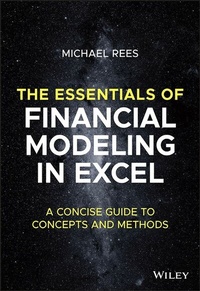
The Essentials of Financial Modeling in Excel
Beschreibung

In The Essentials of Financial Modeling in Excel: A Concise Guide to Concepts and Methods, veteran quantitative modeling and business analysis expert Dr. Michael Rees delivers a practical and hands-on introduction to financial modeling in Excel. The author offers readers a well-structured and strategic toolkit to learn modeling from scratch, focusing on the core economic concepts and the structures commonly required within Excel models.
Divided into six parts, the book discusses the use of models and the factors to consider when designing and building models so that they can be as powerful as possible, yet simple. . Readers will also find:
* The foundational structures and calculations most frequently used in modeling, including growth- and ratio-based methods, corkscrews, and waterfall analysis
* Walkthroughs of economic modeling, measurement, and evaluation, and the linking of these to the decision criteria. These include breakeven and payback analysis, compounding, discounting, calculation of returns, loan calculations, and others
* Structured approaches for modeling in corporate finance, including financial statement modeling, cash flow valuation, cost of capital, and ratio analysis
* Techniques to implement sensitivity and scenario analysis
* Core aspects of statistical analysis, including data preparation, manipulation, and integration
* The use of approximately 100 Excel functions within example modeling contexts
* Further Topics Sections, which introduce advanced aspects of many areas, in order to provide further benefit to more advance readers, whilst presenting the truly essential topics separately. Examples of these include introductions to PowerQuery and PowerPivot, as well as advanced waterfall structures
An invaluable, all-in-one blueprint for learning financial modeling in Excel, this book is ideal for beginning and intermediate financial professionals and students seeking to build and reinforce essential topics in financial modeling.
Weitere Details
Weitere Ausgaben
Person
Michael Rees is Professor of Finance at Audencia Business School in Nantes, France. He has over 30 years' experience in senior roles at leading firms in finance and strategy consulting, including JP Morgan, Mercer Management Consulting, and Braxton Associates. He has also worked as an independent consultant and trainer, advising clients in private equity, auditing and consulting, finance, banking, insurance, pharmaceuticals, and other industries.
Inhalt
About This Book
The Author
Dedication
PART I: INTRODUCTION TO MODELING
Chapter 1: Modeling and Its Uses
Chapter 2: Principles of Model Design
PART II: ESSENTIALS OF EXCEL
Chapter 3: Menus, Operations, Functions and Features
Chapter 4: Sensitivity and Scenario Analysis
PART III: GENERAL CALCULATIONS AND STRUCTURES
Chapter 5: Growth Calculations for Forecasting
Chapter 6: Modular Structures and Summary Reports
Chapter 7: Scaling and Ratio-driven Forecasts
Chapter 8: Corkscrews and Reverse Corkscrews
Chapter 9: Waterfall Allocations
Chapter 10: Interpolations and Allocations
PART IV: ECONOMIC FOUNDATIONS AND EVALUATION
Chapter 11: Breakeven and Payback Analysis
Chapter 12: Interest Rates and Compounding
Chapter 13: Loan Repayment Calculations
Chapter 14: Discounting, Present Values and Annuities
Chapter 15: Returns and Internal Rates of Returns
PART V: CORPORATE FINANCE AND VALUATION
Chapter 16: The Cost of Capital
Chapter 17: Financial Statement Modeling
Chapter 18: Corporate Valuation Modeling
Chapter 19: Ratio Analysis
PART VI: DATA AND STATISTICAL ANALYSIS
Chapter 20: Statistical Analysis and Measures
Chapter 21: Data Preparation: Sourcing, Manipulation, and Integration
