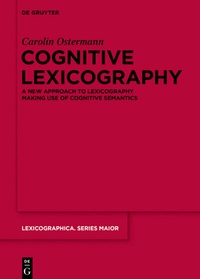
Cognitive Lexicography
Beschreibung

English lexicography and linguistics have always shared close ties, yet the potential of cognitive linguistics for lexicography has only been hesitantly acknowledged in the literature. This is what cognitive lexicography attempts to change by using insights gained in cognitive semantic research for the development of new dictionary features. After a short survey of the history and practice of English monolingual learner lexicography, as well as an outline of the relationship between linguistics and lexicography, three new dictionary features are developed. They cover three different cognitive semantic theories as well as three different parts of the monolingual dictionary entry, each time for a new set of lexemes. Frame semantics, conceptual metaphor theory, as well as cognitive conceptions of polysemy, are used to create a new example section for agentive nouns, a new defining structure for emotion terms and a new microstructural arrangement for particle entries. Dictionary analyses on all, as well as user studies on two of the features, complement these suggestions. The monograph thus presents a new approach to lexicography that incorporates into its description of lexical items how humans perceive and conceptualise language.
Weitere Details
Weitere Ausgaben
Andere Ausgaben