

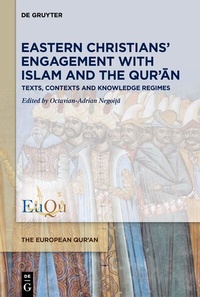
Eastern Christians' Engagement with Islam and the Qur'an
Beschreibung
This volume explores how Eastern Christians of various religious traditions engaged with Islam and its Holy Book. By employing a long durée perspective, the volume will explore both continuities and disruptions, as well as diverse ideological positions among the Eastern Christians in their approach towards Islamic tenets, religious practices and interpretations of the Qur'an. The essays included in the volume investigate texts written in Arabic, Armenian, Bulgarian, Ethiopian, Greek, Slavonic and Russian. The essays discuss the knowledge regimes of text production, and shed light on the Eastern Christians' conceptualization of Islam until the dawn of modernity.
This volume is a contribution to the entangled and cross-cultural history of Eastern Christians with Islam through the centuries, from the Mediterranean to Russia via the Balkans, and the Caucasus. Eastern Christians intellectual responses to the religious challenges posed by Islam were shaped by diverse multicultural and multi-confessional contexts, which ultimately played a significant role in defining their religious identity and the dynamics of communal life
Weitere Details
Weitere Ausgaben
Person
Inhalt
- Intro
- Acknowledgements
- Contents
- Abbreviations
- Prolegomena to Eastern Christians' Engagement with Islam and the Qur'an
- An Early Syriac Response to the Charge of Ta?rif in George of B?eltan's Commentary on the Gospel of Matthew
- Qur'anic Letter versus Spirit: Approaches to the Qur'an in Kitab Us?at al-rahib and Masa?il wa-ajwiba ?aqliyya wa-ilahiyya
- "Becoming All Things to All People": Positive Readings of Qur'anic Christianity in Arabic Christian Apologetics
- Continuities and Discontinuities in Byzantine Anti-Islamic Polemics from the Seventh to the Thirteenth Century: The Mount Athos, Great Lavra, MS gr. O 44
- Michael Synkellos and His Lost Refutation of Islam in the Medieval Byzantine-Slavic Literary Tradition
- The Qur'an in Ethiopia and Eritrea, Ethiopia and Eritrea in the Qur'an: Textual Connections and Circulation among Muslims and Christians of al-?abasha
- The Armenian Confutatio Alcorani and Its Polemical Function for the Armenian Communities in Pre-Modern Iran
- Anti-Islamic Polemics, Scholarship and Encyclopedism in the Greek Orthodox World: Nicholas Karatzas and His Summa Saracenica
- System and Muhammadan Religion by Sofroniy Vrachanski: The Bulgarian Translation of Dimitrie Cantemir's Kniga Sistima
- Russian Orthodox Qur'an Translations of the Eighteenth- and Nineteenth Century and Tatar-Muslim Responses
- Epilogue: Christian Reading of the Qur'an in the Islamic World
- List of Contributors
- Index of Manuscripts and Prints
- Index
