

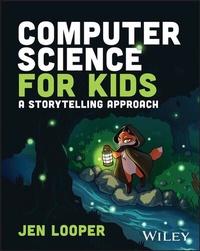
Computer Science for Kids
Beschreibung
In Computer Science for Kids: A Storytelling Approach, AWS Head of Academic Advocacy and Google Developer Expert Dr. Jen Looper delivers a colorful, fun, and exciting demonstration for young readers who want to learn the basics of computer science. Using a variety of technologies, the book covers the elements of computer science in concise detail and illustrates how to build projects to learn foundational concepts behind the technology powering the internet.
In the book, you'll find projects to build using both basic and emerging technologies--like SQL, game development, storytelling software, and 3D augmented reality--as well as:
* Chapter projects aligned to K-12 curriculum standards for grades 6-8 and a GitHub repo featuring open-source projects
* Lesson plans for teachers
* An online space for classrooms to showcase and discuss their work
An easy-to-follow and kid-friendly new resource for technology-curious middle school students, Computer Science for Kids is the fun and interesting web development resource that classroom teachers, parents, and homeschooling families have been waiting for.
Weitere Details
Weitere Ausgaben
Person
Inhalt
How to Contact Wiley or the Author xxi
Preface 1
I The Missing Fireflies 3
1. The Trapper 5
2. The Firefly Refuge 23
3. The Fireflies' Message 35
4. A Home for All 49
II the Glowing Moss 61
5. Goblin's Gold 63
6. Securing the Moss 83
7. The Whisper Network 97
8. A Well- Tested Solution 109
III Geode Quest 121
9. Searching for Geodes 123
10. Cleaning and Categorizing the Collection 137
11. The Stone Library 155
12. Hide or Seek 171
IV the Petrified Forest 183
13. The Petrified Forest 185
14. The Butterfly Brigade 201
15. Power of the Weak 215
16. The Written Artifact 227
V Legends of the Field Mice 241
17. The Field Mice 243
18. Lights, Sounds, Action 273
19. Unlocking the Vault 291
20. The Real World 307
Index 317
Introduction
When you think about computer science, what pops into your head? Someone crouched over a computer, typing code all night long? Someone in a room full of computers, messing around with wires? Someone solving long mathematical equations by writing a lot of hard-to-understand computer programs? Does that person look like you?
What if you thought about computer science in a different way-as a way to solve mysteries? Isn't it more fun to think about yourself as an intrepid explorer, out to solve challenging puzzles by writing clever bits of software? Can you see yourself as the hero or heroine of a story, ready to slay the dragons of slow, buggy, hard-to-read software and make the world a little more pleasant by means of great user design and well-functioning programs?
In this book, you'll be given the opportunity to become a helper-someone who is able to solve challenges by writing computer programs. Summoned by a mysterious figure who emerges from a forest and asks for your help, you are invited to participate in a series of tasks to make this forest a little safer and more hospitable for its native inhabitants.
Are you up to the task?
Computer Science Teachers Association Standards
This book is structured using the Computer Science Teachers Association standards for Grades 6-8, covering ages 11-14. These standards are available at https://csteachers.org
- Algorithms & Programming
- Computing Systems
- Data & Analysis
- Impacts of Computing
- Networks & the Internet
The standards help shape the projects that are used to drive home general concepts of computer science. This is not a book about programming languages, however. Rather than diving deep into JavaScript and Python, we focus on the standards that teach general concepts of computer science. The projects in each chapter are designed to be part of an evolving story line, rather than teaching a language in depth. A good computer scientist will eventually become skilled in many programming languages, however, so it's a good idea to pair this book with study of Python or JavaScript.
Although the book is structured to these standards, the content has not been reviewed, validated, or endorsed by CSTA.
Each chapter includes a story line, suggestions for angles to research, a "Think Like a Computer Scientist" section to introduce computer science concepts, a sketch of a project, a Project Recipe with detailed instructions on how to create a project to illustrate the computer science concept, a vocabulary review, a final quiz to help emphasize concepts, and an assignment. All the projects can be built in a web browser using free and open source tools, so you won't need any special installations or downloads to get started. This book can be used for self-study, as a textbook for homeschoolers, or in a classroom. Use it chapter by chapter, piece by piece, or section by section for a more modular learning experience.
What Does This Book Cover?
In the five sections of this book, you'll discover many aspects of computer science, presented as project-based stories:
- Part I: The Missing Fireflies - Using Microsoft micro:bit in a browser emulator, create a home for runaway fireflies.
- Part II: The Glowing Moss - Save the endangered moss by building a gamified enclosure for them using Microsoft MakeCode.
- Part III: Geode Quest - Conserve the rare geodes hidden in the riverbed by using data science techniques to categorize the forest's inventory of stones.
- Chapter 9: Searching for Geodes
- Chapter 10: Cleaning and Categorizing the Collection
- Chapter 11: The Stone Library
- Chapter 12: Hide or Seek
- Part IV: The Petrified Forest - Protect the fragile petrified wood in the forest grove by visualizing a 3D environment to simulate their preservation.
- Chapter 13: The Petrified Forest
- Chapter 14: The Butterfly Brigade
- Chapter 15: Power of the Weak
- Chapter 16: The Written Artifact
- Part V: Legends of the Field Mice - Using Twine, a free tool to tell winding stories, help the field mice unlock the secret of their underground realm.
- Chapter 17: The Field Mice
- Chapter 18: Lights, Sounds, Action
- Chapter 19: Unlocking the Vault
- Chapter 20: The Real World
Additional Resources
This textbook is paired with a full website found at https://cs4kids.club
Standards Map
Table I.1 includes a map of standards covered within this book along with the chapters where each appear.
TABLE I.1 Standards mapping
Identifier Standard Chapter 2-CS-01 Recommend improvements to the design of computing devices, based on an analysis of how users interact with the devices. 2 2-CS-02 Design projects that combine hardware and software components to collect and exchange data. 1 2-CS-03 Systematically identify and fix problems with computing devices and their components. 3 2-NI-04 Model the role of protocols in transmitting data across networks and the Internet. 5 2-NI-05 Explain how physical and digital security measures protect electronic information. 6 2-NI-06 Apply multiple methods of encryption to model the secure transmission of information. 7 2-DA-07 Represent data using multiple encoding schemes. 9 2-DA-08 Collect data using computational tools and transform the data to make it more useful and reliable. 10 2-DA-09 Refine computational models based on the data they have generated. 11 2-AP-10 Use flowcharts and/or pseudocode to address complex problems as algorithms. 13 2-AP-11 Create clearly named variables that represent different data types and perform operations on their values. 14 2-AP-12 Design and iteratively develop programs that combine control structures, including nested loops and compound conditionals. 15 2-AP-13 Decompose problems and subproblems into parts to facilitate the design, implementation, and review of programs. 17 2-AP-14 Create procedures with parameters to organize code and make it easier to reuse. 18 2-AP-15 Seek and incorporate feedback from team members and users to refine a solution that meets user needs. 19 2-AP-16 Incorporate existing code, media, and libraries into original programs, and give attribution. 13 2-AP-17 Systematically test and refine programs using a range of test cases. 8 2-AP-18 Distribute tasks and maintain a project timeline when collaboratively developing computational artifacts. 17, 18 2-AP-19 Document programs in order to make them easier to...