

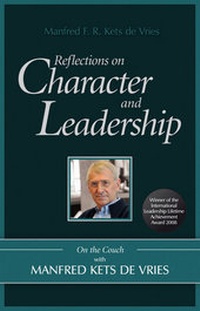
Reflections on Character and Leadership
Beschreibung

Weitere Details
Weitere Ausgaben
Andere Ausgaben
Person
Inhalt
PREFACE xv
Psychoanalysis and organizational life xv
First case: an entrepreneur xix
The clinical paradigm xxi
About this book xxii
PART I: LEADERS, FOOLS, AND IMPOSTORS 1
INTRODUCTION 2
Playing the organizational fool 4
1 THE ENTREPRENEURIAL PERSONALITY 6
Introduction 6
Entrepreneurship: views from other disciplines 8
Common psychological themes in the entrepreneurial personality 10
The effects of family dynamics 17
Case study: The entrepreneur's story 18
Falling into extremes 22
The Medusa women 24
The meaning of work 26
Competition and self-defeating behavior 28
The symbolic nature of the enterprise 29
The process of change 31
The entrepreneurial life cycle 33
Working effectively with entrepreneurs 39
Endnotes 42
2 THE HYPOMANIC PERSONALITY 43
Introduction 43
The Dionysian quality of charismatic leadership 44
Case study: Hypomania in action 46
Elation and its vicissitudes 50
Managing a hypomanic 53
Hypomania in the workplace 55
Possible interventions 56
Self-help measures 58
The plus side for organizations 60
Endnotes 61
3 THE ALEXITHYMIC PERSONALITY 62
Introduction 62
The 'dead fish' syndrome 62
Identifying alexithymia 63
Alexithymia as a communication disorder 64
Where do the origins of alexithymia lie? 66
Degrees of alexithymia 68
Alexithymics in the workplace 69
The Alexithymic CEO 70
Working with an alexithymic manager 72
Managing an alexithymic 73
Searching for solutions 75
Endnote 78
4 THE IMPOSTOR SYNDROME 79
Introduction 79
What makes an impostor? 82
The creative artist as impostor 85
The impostor as national leader 86
The impostor: a character sketch 89
Case study: The impostor as entrepreneur 92
Endnote 97
5 NEUROTIC IMPOSTORS: FEELING LIKE A FAKE 98
Introduction 98
What creates imposturous feelings? 99
The neurotic impostor in the workplace 103
How the fear can become a reality 105
How neurotic impostors can impact on businesses 108
Finding solutions 109
Endnotes 111
6 THE ORGANIZATIONAL FOOL: BALANCING A LEADER'S HUBRIS 112
Introduction 112
The role of the fool 112
The fool as cultural hero 114
The benefi ts of humor 115
What makes a fool? 117
The organizational fool 117
The value of the fool 123
Endnote 123
PART II: THE PATHOLOGY OF LEADERSHIP 125
INTRODUCTION 126
7 PRISONERS OF LEADERSHIP 130
Introduction 130
Case study: The case of Robert Clark 131
Case study: The case of Frederick the Great 132
Externalizing inner confl icts 135
The search for authority 136
Regressive group processes 139
Case study: The case of Ted Howell 141
Distance and aggression in leaders 142
Managing leaders' behavior in organizations 143
Endnotes 145
8 THE SPIRIT OF DESPOTISM: UNDERSTANDING THE TYRANT WITHIN 146
Introduction 146
Setting the scene for tyranny 149
What motivates tyrants? 150
How tyrannies operate 150
How despotic regimes are maintained 152
The despot's toolbox 153
The economic costs of tyranny 158
The need for democracy 159
The dangers of power 160
Why despotism must be fought 161
Unjust deserts 163
Judicial remedy 163
The International Criminal Court 165
Endnote 166
9 LEADERSHIP BY TERROR: FINDING SHAKA ZULU IN THE ATTIC 167
Introduction 167
The life and death of an absolute despot 168
Deconstructing the despot's inner theater 171
The colluding mind 179
A tyranny of self-deception 183
Leaders and followers 186
Shaka's legacy 190
Endnote 191
PART III: TRANSFORMING LEADERSHIP 193
INTRODUCTION 194
10 'DOING AN ALEXANDER': LESSONS ON LEADERSHIP BY A MASTER CONQUEROR 198
Introduction 198
The life of Alexander 199
Alexander's legacy 205
Lessons in leadership à la Alexander 206
Conclusions 210
Endnote 210
11 LEADERS WHO MAKE A DIFFERENCE 211
Introduction 211
The effects of leaders on their organizations 212
Different leaders, same results 213
The architectural aspect of leadership 214
The charismatic role of leaders 223
Conclusions 226
Endnote 226
12 REAPING THE WHIRLWIND: MANAGING CREATIVE PEOPLE 227
Introduction 227
Characteristics of creative people 228
Stimulating creativity 230
Playing in a transitional world 231
Two roads to creativity 233
Creative management 236
Watching for the danger signs 240
Endnote 241
PART IV: LEADERSHIP IN A GLOBAL CONTEXT 243
INTRODUCTION 244
13 THE DEVELOPMENT OF THE LEADER WITHIN THE GLOBAL CORPORATION 247
Introduction 247
A case study in internationalization 248
Forms of global organizations 249
Qualities needed in global leaders 253
Training, transfer, teamwork, and travel 260
A framework for analyzing the development of the
global leader 262
Conclusions 263
Endnote 264
14 IN SEARCH OF THE NEW EUROPEAN BUSINESS LEADER 265
Introduction 265
The challenge of diversity 267
Internal and external competition 270
Is a single model possible? 271
A middle path 272
Dealing with change 273
The making of the European leader 275
Leadership in Europe and beyond 277
Endnote 278
15 LESSONS FROM THE 'WILD EAST': RUSSIAN CHARACTER AND LEADERSHIP 279
The Russian character 279
Contextual factors in the formation of the Russian character 282
Russia's transition: from cooperatives to capitalism 295
New leaders and new followers 296
Eight leadership lessons 300
Challenges for global Russian business leaders 302
The end of the beginning 305
Endnotes 305
CONCLUSION: CREATING HIGH-COMMITMENT ORGANIZATIONS 307
The future of organizations 307
Meta-values for great companies 308
Motivational need systems 309
Leaders and meta-value creation 313
Concluding comments 314
Endnote 315
REFERENCES 317
INDEX 333
PSYCHOANALYSIS AND ORGANIZATIONAL LIFE
I am often asked why I have done so much work on entrepreneurs, when the world of work has always been under-studied in psychoanalytic literature, and the answer is very simple. I come from a family of entrepreneurs: my father is an entrepreneur and my brothers are entrepreneurs, all in different businesses. But I was never drawn that way myself, largely because, for mysterious reasons, my father thought that I was unsuited to the business world, which of course turned somewhat into a self-fulfilling prophecy. I decided to go in another direction. I began by studying chemical and mechanical engineering, both of which lasted an exceptionally short time. Then, making a rather negative choice, I decided to study economics, as a way of keeping my options open. I always felt, to quote the great economist John Maynard Keynes, that it really was a dismal science. The concept of the homo economicus always bothered me, the reason being that the assumptions made by economists about people were so far from the reality embodied by the entrepreneurs in my family. The way they made decisions was anything but rational. They were very talented, however, at rationalizing their decisions after the fact. When I was 16, my father had sent me to the Harvard Summer School, which was a fantastic experience-the diversity of people was very exciting, much more so than university life turned out to be in Holland. While studying, I told myself that I would go back to the States one day, and I did. I returned to the USA after I'd finished my doctoral examination in economics in Holland, by which time I had realized that I had the potential to be some kind of an academic. I decided to take time out traveling and booked a place on a Norwegian freighter. It was a very cheap way to cross the Atlantic-my father was a good client of the freight company-but also an extremely boring crossing of which the only highlight was a storm. When the boat docked in Boston I couldn't get off it quickly enough. Out of pure nostalgia I visited Harvard again, this time including the Business School. I was curious about the programs and courses they were offering. I discovered the school was running a sort of ' missionary' program-the International Teachers Program-intended to spread the Harvard case -method all round the world. I was still thinking vaguely about joining the corporate world-banking would be an option-at this stage but I saw this program as a chance to spend a year at Harvard. During the interview process, the program director of the International Teachers Program mentioned an unusual course being given by Abraham Zaleznik, who had a chair in what was then called Social Psychology of Management, something of a misnomer, given the strong psychoanalytic focus of the course. The seminar he suggested I should take was ' Psychoanalytic psychology and organizational theory.' I decided to enroll-and it changed my life. I still remember that our first assignment was to read Ernest Jones's biography of Sigmund Freud, which consisted of two pretty impressive tomes. In spite of my relatively poor English, I read all the material over one weekend and I was probably the only person on the seminar who bothered to do so. The course was quite exciting for a budding business economist as it included case studies such as 'The Wolfman, ' ' The Ratman,' and 'The Psychotic Dr Schreber,' quite different from the material you get in an economics course. With hindsight, I would now question the validity of some of Freud's case interpretations, but at the time they brought me into a completely different world and stimulated my fantasy life. Suddenly I saw a lot of new connections in literature, film, and art: it was like having an additional lens, moving from a two-dimensional to a three-dimensional world. In addition, I was living in a foreign country, with all the mental turmoil that accompanies that sort of temporary life, which deepened the experience. Certainly, it affected my dream life. Because my life experiences were so different, I paid a lot of attention to my inner world. I did a lot of dream analysis to get a better understanding of myself. It was during this time that I began to play with the idea of integrating the worlds of clinical psychology (i.e. psychoanalysis) and management. When Zaleznik offered me a position as his assistant, the direction I was heading in was confirmed. In addition, I was accepted into the doctoral program at the Harvard Business School, although I was also advised to do an MBA. The thinking was that if I didn't make it through the doctorate, I'd at least have the MBA to fall back on. It turned out that the International Teachers Program covered the second year of the MBA so, ironically, I did the first year's course of the MBA in my second year. Looking back, Harvard was an extremely important learning experience. Being in one class section with a hundred extremely competitive individuals helped me understand and learn to speak the language of executives. My doctoral dissertation under Zaleznik was on entrepreneurship; I finished it extremely fast and almost immediately my writing career started. Roland Christensen, a delightful man, and one of my thesis advisers, asked me to write a short excerpt on entrepreneurship from my thesis as a student note to use in his classes, and various articles followed. In addition, I was involved with Zaleznik in a very large research project on individual and organizational stress. At the same time, I became interested in starting some form of psychoanalytic training. As I became more familiar with psychoanalysis as a method of investigation, I experienced a need to deepen my clinical expertise. Without such exposure, I felt that the application of theoretical ideas to organizations would be a rather barren exercise. I decided I wanted to become a psychoanalyst. But with my background in economics and business administration I would be a very atypical candidate for a psychoanalytic training institute, particularly as the psychoanalytic world in the USA at the time was very medically oriented. And I had to deal with another problem: to be accepted at an institute was one thing, but I would also have to pay for the training. To do that, I needed a job. It wasn't so easy to get an interesting job in the Boston area. I knew that for a number of political reasons-Zaleznik not belonging to a specific area-there would be no offer forthcoming from the Harvard Business School. Joining Zaleznik was great as a learning experience but had not been a very smart political move. I decided to go to France where the Institut européen d'administration des affaires (INSEAD) was getting off the ground. A dean had been hired to build a faculty. I also felt that France would give me the chance to pursue my wish to become a psychoanalyst, as they were more relaxed about accepting people with more unorthodox backgrounds. At the same time, I started psychoanalysis with Joyce McDougall, one of the most famous, and original, psychoanalysts in the world. My stay at INSEAD lasted for two years. To put it bluntly, I was fired. The reasons were never made very clear to me, but the school's financial problems were one of them. It probably didn't help that I was not very subtle presenting my ideas about how the functioning of the school could be improved, suggestions that were not wholly appreciated. When I worked out that I was being fired-the dean was quite evasive about it-I protested about the reasons given for my dismissal and the way it was handled, which led to a protest by other faculty members (fearful who would be next in line, as there was no system of due process) and ultimately to the establishment of a faculty evaluation committee that ensured that hiring and firing would no longer be a flavor-of-the-week process. Ironically, INSEAD made me an offer a year after they sacked me, but I turned it down. Looking back, getting fired turned out to be a lucky experience for me, as it contributed to interesting learning opportunities. I returned to the Harvard Business School as a research fellow for one year, joining the Production and Operations Management area. I worked for a man called Wickham Skinner who wanted my help writing case studies with a human touch. I hoped, now that I was back at HBS, that I would be offered a longer-term appointment. But for a number of reasons it was not to be. Having received the highest teaching rating at the school may have been a black mark against me. Obviously, I could not be a researcher. But the most telling lesson was that the Organizational Behavior area was blocking Zaleznik from making tenure track appointments. In addition, the opinion of one of the power holders in the Organizational Behavior department was that I would never write anything. That particular person must have had a very good understanding of human behavior. One of the small pleasures in life is doing something people say you'll never do. I believe this is my twenty -ninth book. I have always thought that academics are masters in character assassination. Luckily, Henry Minzberg was more visionary than Jay Lorsch and had another view on the matter. At the time he was looking for faculty members who didn't fit the standard OB mold. I was certainly part of that group of misfits. He offered me a position at McGill in Canada. The Faculty of Management was relatively new and offered many growth possibilities. What also attracted me to Montreal was that it had a very open -minded psychoanalytic training institute. I was particularly attracted to Maurice Dongier, at the time the head of psychiatry and the director of the...
