

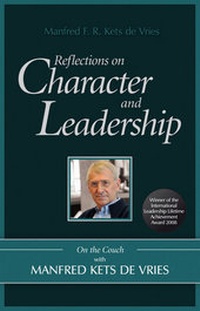
Reflections on Character and Leadership
On the Couch with Manfred Kets de Vries
Erschienen am 24. März 2009
Buch
Hardcover
366 Seiten
978-0-470-74242-6 (ISBN)
Beschreibung
Reflections on Character and Leadership is the first of the three books in the Manfred kets de Vries on the Couch series.
Here, Kets de Vries looks at entrepreneurship, the pathology of leadership, and the personality of the leader. The reader will visit the disturbed inner worlds of leaders like Alexander the Great, Shaka Zulu and Robert Maxwell, discover how to distinguish between a cold fish and a live volcano, and identify impostors, despots, organizational fools and global leaders.
The book highlights the basic principles of the clinical paradigm--the process of putting organizations and the individuals who lead them on the psychoanalyst's couch. It includes studies of personality archetypes and the effects they have on organizational life and culture--and the effects that organizations have on them. Referring frequently to key management concepts, Kets de Vries looks not only at what happens when things go wrong, but also at how to create the psychological and organizational space to make sure that things go right.
About the series:
The series offers an overview of Kets de Vries's work spanning four decades, a period in which he has established himself as the leading figure in the clinical study of organizational leadership.
The books in this series contain a representative selection of Kets de Vries' writings about leadership from a wide variety of published sources and cover character and leadership in a global context, career development and leadership in organizations. The original essays were all written or published between 1976 and 2008. Updated where appropriate and revised by the author, they present a digest of the work of one of the most influential management thinkers of the present day.
Weitere Details
Weitere Ausgaben
Andere Ausgaben
Manfred F. R. Kets de Vries
Reflections on Character and Leadership
On the Couch with Manfred Kets de Vries
E-Book
03/2010
Jossey-Bass
23,99 €
Als Download verfügbar
Manfred F. R. Kets de Vries
Reflections on Character and Leadership
On the Couch with Manfred Kets de Vries
E-Book
08/2009
Jossey-Bass
23,99 €
Als Download verfügbar
Person
Manfred Kets de Vries brings a much-needed fresh perspective to the subjects of leadership and change, drawing on his knowledge of economics, management, psychology and psychoanalysis.
He is Clinical Professor of Leadership at INSEAD where he holds the Raoul de Vitry d'Avaucourt Chair of Leadership Development. He has also held professorships at McGill University, the Ecole des Hautes Etudes Commerciales in Montreal and Harvard Business School, and has lectured at management institutions all over the world. He is the author, co-author, or editor of m ore than 30 books including The Leader on the Couch and Family Business on the Couch, and over 300 articles and papers.
In November 2008, Manfred Kets de Vries was honored with the Lifetime Achievement Award at the International Leadership Association in Los Angeles. He and six others were inducted into the leadership legacy project as "founding professionals of the development of leadership as a field and as a discipline." Previously, in 2005, he was the first non-American recipient of the ILA Leadership Award for his 'Contributions to the Classroom and to the boardroom." The Financial Times, Le Capital, Wirtschaftwoche and The Economist have also judged him one of the world's leading thinkers on leadership.
Inhalt
Acknowledgments.
Preface.
Psychoanalysis and organizational life.
First case: an entrepreneur.
The clinical paradigm.
About this book.
PART I: LEADERS, FOOLS, AND IMPOSTORS.
INTRODUCTION.
Playing the organizational fool.
1. THE ENTREPRENEURIAL PERSONALITY.
Introduction.
Entrepreneurship: views from other disciplines.
Common psychological themes in the entrepreneurial personality.
The effects of family dynamics.
Case study: The entrepreneur's story.
Falling into extremes.
The Medusa women.
The meaning of work.
Competition and self-defeating behavior.
The symbolic nature of the enterprise.
The process of change.
The entrepreneurial life cycle.
Working effectively with entrepreneurs.
Endnotes.
2. THE HYPOMANIC PERSONALITY.
Introduction.
The Dionysian quality of charismatic leadership.
Case study: Hypomania in action.
Elation and its vicissitudes.
Managing a hypomanic.
Hypomania in the workplace.
Possible interventions.
Self-help measures.
The plus side for organizations.
Endnotes.
3. THE ALEXITHYMIC PERSONALITY.
Introduction.
The 'dead fish' syndrome.
Identifying alexithymia.
Alexithymia as a communication disorder.
Where do the origins of alexithymia lie?
Degrees of alexithymia.
Alexithymics in the workplace.
The Alexithymic CEO.
Working with an alexithymic manager.
Managing an alexithymic.
Searching for solutions.
Endnote.
4. THE IMPOSTOR SYNDROME.
Introduction.
What makes an impostor?
The creative artist as impostor.
The impostor as national leader.
The impostor: a character sketch.
Case study: The impostor as entrepreneu.
Endnote.
5. NEUROTIC IMPOSTORS: FEELING LIKE A FAKE.
Introduction.
What creates imposturous feelings?
The neurotic impostor in the workplace.
How the fear can become a reality.
How neurotic impostors can impact on businesses.
Finding solutions.
Endnotes.
6. THE ORGANIZATIONAL FOOL: BALANCING A LEADER'S HUBRIS.
Introduction.
The role of the fool.
The fool as cultural hero.
The benefits of humor.
What makes a fool?
The organizational fool.
The value of the fool.
Endnote.
PART II: THE PATHOLOGY OF LEADERSHIP.
INTRODUCTION.
7. PRISONERS OF LEADERSHIP.
Introduction.
Case study: The case of Robert Clark.
Case study: The case of Frederick the Great.
Externalizing inner conflicts.
The search for authority.
Regressive group processes.
Case study: The case of Ted Howell.
Distance and aggression in leaders.
Managing leaders' behavior in organizations.
Endnotes.
8. THE SPIRIT OF DESPOTISM: UNDERSTANDING THE TYRANT WITHIN.
Introduction.
Setting the scene for tyranny.
What motivates tyrants?
How tyrannies operate.
How despotic regimes are maintained.
The despot's toolbox.
The economic costs of tyranny.
The need for democracy.
The dangers of power.
Why despotism must be fought.
Unjust deserts.
Judicial remedy.
The International Criminal Court.
Endnote.
9. LEADERSHIP BY TERROR: FINDING SHAKA ZULU IN THE ATTIC.
Introduction.
The life and death of an absolute despot.
Deconstructing the despot's inner theater.
The colluding mind.
A tyranny of self-deception.
Leaders and followers.
Shaka's legacy.
Endnote.
PART III: TRANSFORMING LEADERSHIP.
INTRODUCTION.
10. 'DOING AN ALEXANDER': LESSONS ON LEADERSHIP BY A MASTER CONQUEROR.
Introduction.
The life of Alexander.
Alexander's legacy.
Lessons in leadership à la Alexander.
Conclusions.
Endnote.
11. LEADERS WHO MAKE A DIFFERENCE.
Introduction.
The effects of leaders on their organizations.
Different leaders, same results.
The architectural aspect of leadership.
The charismatic role of leaders.
Conclusions.
Endnote.
12. REAPING THE WHIRLWIND: MANAGING CREATIVE PEOPLE.
Introduction.
Characteristics of creative people.
Stimulating creativity.
Playing in a transitional world.
Two roads to creativity.
Creative management.
Watching for the danger signs.
Endnote.
PART IV: LEADERSHIP IN A GLOBAL CONTEXT.
INTRODUCTION.
13. THE DEVELOPMENT OF THE GLOBAL LEADER WITHIN THE MULTINATIONAL CORPORATION.
Introduction.
A case study in internationalization.
Forms of global organizations.
Qualities needed in global leaders.
Training, transfer, teamwork, and travel.
A framework for analyzing the development of the global leader.
Conclusions.
Endnote.
14. IN SEARCH OF THE NEW EUROPEAN BUSINESS LEADER.
Introduction.
The challenge of diversity.
Internal and external competition.
Is a single model possible?
A middle path.
Dealing with change.
The making of the European leader.
Leadership in Europe and beyond.
Endnote.
15. LESSONS FROM THE 'WILD EAST': RUSSIAN CHARACTER AND LEADERSHIP.
The Russian character.
Contextual factors in the formation of the Russian character.
Russia's transition: from cooperatives to capitalism.
New leaders and new followers.
Eight leadership lessons.
Challenges for global Russian business leaders.
The end of the beginning.
Endnotes.
CONCLUSION: CREATING HIGH-COMMITMENT ORGANIZATIONS.
The future of organizations.
Meta-values for great companies.
Motivational need systems.
Leaders and meta-value creation.
Concluding comments.
Endnote.
References.
Index.