

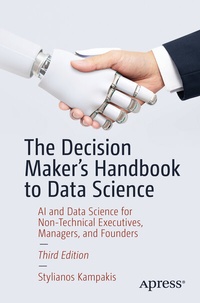
The Decision Maker's Handbook to Data Science
Beschreibung
Data science is expanding across industries at a rapid pace, and the companies first to adopt best practices will gain a significant advantage. To reap the benefits, decision makers need to have a confident understanding of data science and its application in their organization. This third edition delves into the latest advancements in AI, particularly focusing on large language models (LLMs), with clear distinctions made between AI and traditional data science, including AI's ability to emulate human decision-making.
Author Stylianos Kampakis introduces you to the critical aspect of ethics in AI, an area of growing importance and scrutiny. The narrative examines the ethical considerations intrinsic to the development and deployment of AI technologies, including bias, fairness, transparency, and accountability. You'll be provided with the expertise and tools required to develop a solid data strategy that is continuously effective. Ethics and legal issues surrounding data collection and algorithmic bias are some common pitfalls that Kampakis helps you avoid, while guiding you on the path to build a thriving data science culture at your organization. This updated edition also includes plenty of case studies, tools for project assessment, and expanded content for hiring and managing data scientists.
Data science is a language that everyone at a modern company should understand across departments. Friction in communication arises most often when management does not connect with what a data scientist is doing or how impactful data collection and storage can be for their organization. The Decision Maker's Handbook to Data Science bridges this gap and readies you for both the present and future of your workplace in this engaging, comprehensive guide.
What You Will Learn
- Integrate AI with other innovative technologies
- Explore anticipated ethical, regulatory, and technical landscapes that will shape the future of AI and data science
- Discover how to hire and manage data scientists
- Build the right environment in order to make your organization data-driven
Who This Book Is For
Startup founders, product managers, higher level managers, and any other non-technical decision makers who are thinking to implement data science in their organization and hire data scientists. A secondary audience includes people looking for a soft introduction into the subject of data science.
Weitere Details
Weitere Ausgaben
Person
Dr. Stylianos (Stelios) Kampakis is a data scientist who lives and works in London, UK. He holds a PhD in Computer Science from University College London, as well as an MSc in Informatics from the University of Edinburgh. He also holds degrees in Statistics, Cognitive Psychology, Economics and Intelligent Systems. He is a member of the Royal Statistical Society and an honorary research fellow in the UCL Centre for Blockchain Technologies. He has many years of academic and industrial experience in all fields of data science like statistical modelling, machine learning, classic AI, optimization and more.
Throughout his career, Stylianos has been involved in a wide range of projects: from using deep learning to analyze data from mobile sensors and radar devices, to recommender systems, to natural language processing for social media data to predicting sports outcomes. He has also done work in the areas of econometrics, Bayesian modelling, forecasting and research design. He also has many years of experience in consulting for startups and scale-ups, having successfully worked with companies of all stages, some of which have raised millions of dollars in funding. He is still providing services in data science and blockchain, as a partner in Electi Consulting.In the academic domain, he is one of the foremost experts in the area of sports analytics, having done his PhD in the use of machine learning for predicting football injuries. He has also published papers in the areas neural networks, computational neuroscience and cognitive science. Finally, he is also involved in blockchain research and more specifically in the areas of tokenomics, supply chains and securitization of assets.
Stylianos is also very active in the area of data science education. He is the founder of The Tesseract Academy, a company whose mission is to help decision makers understand deep technical topics such as machine learning and blockchain. He is also teaching "Social Media Analytics", and "Quantitative Methods and Statistics with R" in the Cyprus International Institute of Management, and runs his own data science school in London called Datalyst.He often writes about data science, machine learning, blockchain and other topics at his personal blog: The Data Scientist (thedatascientist.com).
Inhalt
Chapter 1: Demystifying Data Science, AI and All the Other Buzzwords.- Chapter 2: Data Management.- Chapter 3: Data Collection Problems.- Chapter 4: How to Keep Data Tidy.- Chapter 5: Thinking like a Data Scientist (Without Being One).- Chapter 6: A Short Introduction to Statistics.- Chapter 7: A Short Introduction to Machine Learning.- Chapter 8: An introduction to AI.- Chapter 9: Problem Solving.- Chapter 10: Pitfalls.- Chapter 11: Hiring and Managing Data Scientists.- Chapter 12: Building a Data-Driven Culture.- Chapter 13: AI Ethics.- Chapter 14: The Future of AI and Data Science. Epilogue: Data Science Rules the World.- Appendix: Tools for Data Science.
