

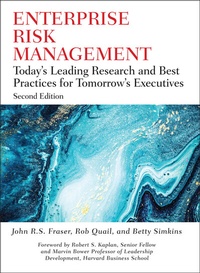
Enterprise Risk Management
Beschreibung

There has been much evolution in terms of ERM best practices, experience, and standards and regulation over the past decade. Enterprise Risk Management: Today's Leading Research and Best Practices for Tomorrow's Executives, Second Edition is the revised and updated essential guide to the now immensely popular topic of enterprise risk management (ERM). With contributions from leading academics and practitioners, this book offers insights into what practitioners are doing and what the future holds. You'll discover how you can implement best practices, improve ERM tools and techniques, and even learn to teach ERM. Retaining the holistic approach to ERM that made the first edition such a success, this new edition adds coverage of new topics including cybersecurity risk, ERM in government, foreign exchange risk, risk appetite, innovation risk, outsourcing risk, scenario planning, climate change risk, and much more. In addition, the new edition includes important updates and enhancements to topics covered in the first edition; so much of it has been revised and enhanced that it is essentially an entirely new book.
Enterprise Risk Management introduces you to the concepts and techniques that allow you to identify risks and prioritize the appropriate responses. This invaluable guide offers a broad overview, covering key issues while focusing on the principles that drive effective decision making and determine business success. This comprehensive resource also provides a thorough introduction to ERM as it relates to credit, market, and operational risk, as well as the evolving requirements of the board of directors' role in overseeing ERM.
Through the comprehensive chapters and leading research and best practices covered, this book:
* Provides a holistic overview of key topics in ERM, including the role of the chief risk officer, development and use of key risk indicators and the risk-based allocation of resources
* Contains second-edition updates covering additional material related to teaching ERM, risk frameworks, risk culture, credit and market risk, risk workshops and risk profiles and much more. Over 90% of the content from the first edition has been revised or enhanced
* Reveals how you can prudently apply ERM best practices within the context of your underlying business activities
Filled with helpful examples, tables, and illustrations, Enterprise Risk Management, Second Edition offers a wealth of knowledge on the drivers, the techniques, the benefits, as well as the pitfalls to avoid, in successfully implementing ERM.
Weitere Details
Weitere Ausgaben
Andere Ausgaben
Personen
John R.S. Fraser is the former Senior Vice President, Internal Audit, and Chief Risk Officer of Hydro One Networks Inc., one of North America's largest electricity transmission and distribution companies.
Rob Quail is the Principal of Robert Quail Consulting. His professional focus is on the subject of enterprise risk management, and he has nearly 20 years of experience in developing and applying ERM tools and practices.
Betty Simkins, PhD, is Regents Professor of Finance, Williams Companies Chair, and Department Head in the Department of Finance at Oklahoma State University's Spears School of Business. She serves on the Commodity Futures Trading Commission Market Risk Advisory Committee.
Inhalt
Foreword to the Second Edition by Robert S. Kaplan Foreword to the First Edition by Robert S. Kaplan
Part I: Overview and Drivers of Enterprise Risk Management
Chapter 1: Enterprise Risk Management: An Introduction and Overview
Chapter 2: A Brief History of Risk Management
Chapter 3: Strategic Risk Management: The Third Paradigm
Chapter 4: The Role of the Board of Directors and Senior Management in Enterprise Risk Management
Chapter 5: How to Teach Enterprise Risk Management: A Learner-Centered Activities Approach
Chapter 6: The Role of the Board in Risk Management Oversight
Part II: Enterprise Risk Management, Culture, and Control
Chapter 7: ERM Frameworks
Chapter 8: Becoming the Lamp Bearer: The Emerging Roles of the Chief Risk Officer
Chapter 9: Creating a Risk-Aware Culture
Chapter 10: Key Risk Indicators
Chapter 11: Decision Risk Management
Chapter 12: Increasing Adoption of Enterprise Risk Management in the U.S. Federal Government
Chapter 13: Toolmaking in Risk Management: The Case of Core Values and the Formalization of "Risk Appetite"
Chapter 14: Incorporating Risk Acumen and Enterprise Risk Management into Innovation Approaches
Chapter 15: Scenario Planning as an Enrichment of ERM
Chapter 16: Unconscious Bias and Risk Management
Chapter 17: Cognitive Bias: A Practical Approach
Part III: Enterprise Risk Tools and Techniques
Chapter 18: Risk Appetite and Tolerance in Competitive Strategy
Chapter 19: How to Plan and Run a Risk Management Workshop
Chapter 20: How to Prepare a Risk Profile
Chapter 21: How to Allocate Resources Based on Risk
Chapter 22: Quantitative Risk Assessment in ERM
Chapter 23: Risk Appetite
Chapter 24: Organizational Decision Making
Chapter 25: The Challenges of and Solutions for Implementing Enterprise Risk Management
Part IV: Types of Risk
Chapter 26: Market Risk Management and Common Elements with Credit Risk Management
Chapter 27: Credit Risk Management
Chapter 28: Operational Risk Management
Chapter 29: Managing Financial Risk and Its Interaction with Enterprise Risk Management
Chapter 30: Climate Change Risk
Chapter 31: Cybersecurity: Risks and Governance
Chapter 32: Foreign Exchange Risk Management
Chapter 33: Risk Management and Outsourcing
Chapter 34: Leveraging ERM for Growth
Chapter 35: Commercial and D&O Insurance for Large Corporations
Chapter 36: Managing Risk Associated with Project Delivery: A How-To Guide
Part V: Special Topics and Case Studies
Chapter 37: The Rise and Evolution of the Chief Risk Officer: Enterprise Risk Management at Hydro One
Chapter 38: Enterprise Risk Management in the Public Sector: A First Look at the U.S. Department of Commerce
Chapter 39: A Review of Academic Research on Enterprise Risk Management
Chapter 40: Lessons from the Academy: ERM Implementation in the University Setting
Chapter 41: Enterprise Risk Management: Lessons from the Field
Chapter 42: Financial Reporting and Disclosure Risk Management
Chapter 43: Directors and Risk: Whither the Best Practices: Evidence from Canada
Praise for Enterprise Risk Management
"The 2010 version of this book was a masterpiece on the topic of risk management; the first of its kind to brilliantly cover the risk management landscape and summarize it in a highly readable, understandable and enlightening format style. This latest version represents how the authors have taken their masterpiece and turned it into an even better one. The management of enterprise risk is one of the most vexatious problems confronting boards and executives worldwide. Accordingly, this 'update' by Fraser, Quail, and Simkins represents the ultimate 'how to' book written with the 'risk management problem solver' in mind. As with the first edition, it continues to provide the essential link that has been missing for effectively teaching ERM at the university and executive education levels and it is an exceptional achievement by true risk management gurus."
-Dr. Chris Bart, FCPA, founder and Lead Faculty, The Directors College of Canada; Executive Chairman, Caribbean Governance Training Institute
"The comprehensive application of risk management principles and practice is a necessary aspect of the business management of any organization, whether public, private, or not-for-profit. This book, edited by Fraser, Quail, and Simkins, provides a thorough review of the aspects of risk management from cultural to quantitative, as well as from the practical to the theoretical. Just as risk management cannot sit still, this edition reflects developments in risk theory and understanding that must be reflected in an organization's overall management of risk."
-Doug Brooks, retired CEO and Vice-Chair, ivari (formerly Transamerica Life Insurance Company of Canada)
"Consider an amalgam of risk disciplines that, aggregated correctly, shines spotlights on pitfalls and points out attainable opportunities. Financial regulators call this tonic of survival enterprise risk management (ERM). The effectiveness of ERM programs meaningfully predicted how well financial institutions weathered the Great Recession. Of course, ERM applies to nonfinancial organizations as well. ERM is measurement, monitoring, and escalation. It is culture, governance, and strategy. ERM is for poets and for gearheads and needs both to be effective. Perhaps above all, ERM is dynamic. An effective ERM framework for a given company at a given time might not be effective for another company or even that same company at another time. How does one confine ERM to a single volume? Identify and flesh out the components; recognize what has changed in the past 10 years; compile a meaningful, relevant set of chapters from which users can glean what they seek; and open up the collection with a succinct introduction that pulls the components together and guides the reader on how to use the book. Messrs Fraser, Quail, and Dr. Simkins have done just that in Enterprise Risk Management: Today's Leading Research and Best Practices for Tomorrow's Executives, Second Edition. With almost a complete overhaul of the work they did in their first edition, Messrs. Fraser, Quail, and Dr. Simkins hit the latest hot ERM topics. They added a timely discussion of cybersecurity risks and guidance for managing it. Further, this edition adds chapters on the burgeoning ESG topic though environmental issues like climate change and societal concepts like bias to supplement no less than three repeated and amended chapters on governance matters. This volume will be a valuable resource for me and my ERM team at BOK Financial, and I'm glad they compiled it."
-Tally Ferguson, CFA, CERP|SVP Director of Enterprise-Wide Risk Management, Bank of Oklahoma, a division of BOKF NA
"The effective management of enterprise risk is essential for boards and executives worldwide. Enterprise Risk Management: Today's Leading Research and Best Practices for Tomorrow's Executives includes insightful, highly readable, and practical contributions from leading practitioners and academics. I believe that this unique and definitive collection will serve as a valuable reference for executives, risk managers, and students."
-Laura Formusa, LLB, ICD.D, Corporate Director; former President and CEO, Hydro One Inc.
"Throughout many years of serving risk professionals and executives within our corporate clients, I have seen numerous attempts to design and execute integrated risk management strategies within their businesses and disciplines. A recurring problem has been a lack of common points-of-reference and language to focus stakeholders toward that result. This book is by far the most comprehensive study I have seen, logically layered to enable a summary read or deep treatment of all risk categories, written by both experienced practitioners and top academics.. Enthusiastically recommended!"
-Alan Garner, president and CEO (retired), Marsh Canada
"Enterprise Risk Management provides a comprehensive overview of how and why companies ought to approach risk management. For more than 25 years, companies have struggled to understand the value of ERM and, in particular, how sound risk management practices enhance resilience. This book offers insights from leading consultants and academics on the basics of risk management, covering key stakeholders' roles as well as 'how to' frameworks that support effective risk management. Most importantly, practitioners who have developed and refined ERM programs at their companies offer a frank view of what works and what doesn't. Enterprise Risk Management translates ERM foundations and frameworks into effective risk practices and will help every organization that is embarking on or re-booting ERM."
-Ellen Hexter, principal, Hexter & Co.; Senior Advisor, Enterprise Risk Management, The Conference Board
"Not only has ERM continued to generate more attention in academic literature, I can confirm from my service as the chair of a corporate audit committee that managing risk on an enterprise-wide basis is drawing more and more attention from boards too. Recent surveys suggest that the COVID-19 pandemic has increased the scrutiny and visibility of risk management. However, questions about optimizing and gaining the most benefit from ERM activities remain. In many organizations, how they assess progress, measure maturity, and evaluate success of their risk management programs are key issues. In this environment, the second edition of Enterprise Risk Management: Today's Leading Research and Best Practices for Tomorrow's Executives, offers insights into what practitioners are doing and what the future holds. With insights from top ERM thought leaders in industry and academe and with added chapters on hot topics such as climate change, cyber security, outsourcing, and risk appetite, this book is a much-needed resource for scholars, practitioners, board members, and educators alike."
-Rob Hoyt, PhD, Moore Chair and Professor of Risk Management and Insurance, Terry College of Business, University of Georgia; ERM scholar; insurance company Audit Committee Chair
"In the aftermath of the Covid-19 pandemic, all organizations should examine the effectiveness of their ERM program and make necessary improvements. In this second edition, the co-editors-Fraser, Quail, and Simkins-have put together a comprehensive and updated compilation of ERM research and best practices. The blend of academic and industry insights, along with new content on disruptive risks such as cyber security and climate change, provide a useful guide to ERM implementation."
-James Lam, President, James Lam & Associates; independent director and audit committee chairman, RiskLens, Inc.; author, Implementing Enterprise Risk Management-From Methods to Applications
"Simkins and Fraser have already published two successful risk publications, which I hold in high regard, and that have received great feedback from anyone I have spoken to about the books. Their eagerness to update their content is therefore greatly welcomed. It is refreshing and encouraging to see a book that seeks to capture what I believe to be the true essence of risk management the way Enterprise Risk Management: Today's Leading Research and Best Practices for Tomorrow's Executives does. Specifically, that risk management is not just about surviving, but about thriving in a constant changing world. The book covers a wide variety of topics that range from risk culture to quantitative risk analysis, both of which are hot topics in the field of risk management at the moment, and special attention has been given to emerging risk subjects such as climate change, cyber risk, and outsourcing, ensuring that this is one of the most up-to-date books on the market.
What makes this book so compelling, is that rather than relying on only a couple of authors, Simkins, Fraser, and Quail have invited leading global experts in the field of risk management to contribute. The book is also complemented with real case studies and examples. This, along with their understanding that risk management is not a one size fits all, ensures that this is a book that will add huge value to anyone seeking to learn about ERM or implement it within their organization."
-Alexander Larsen, BHRM, CFIRM, President, Baldwin Global Risk Services Ltd.
"This set of readings will be an invaluable resource for academic and practitioner alike, and...
