

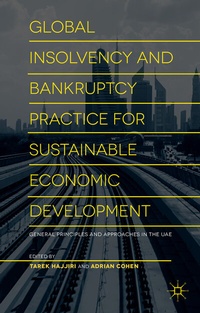
Global Insolvency and Bankruptcy Practice for Sustainable Economic Development
Beschreibung

This book explores the general principles and practice of legal reform within bankruptcy. From a variety of specialists including practitioners, lawyers, bankers, accountants and judges from the United Arab Emirates, the UK and Singapore, it provides a variety of perspectives on the topic. Chapters include topics such as the 'Four Pillars of Regulatory Framework', the history and application of the UNCITRAL Model Law on Cross-Border Insolvency, the challenges for financial institutions and the treatment of the insolvency of natural persons. The book also offers a comparative study of Islamic Shari'ah principles with modern bankruptcy regimes, an analysis of bankruptcy in the UAE and an evaluation of the legal infrastructure of the DIFC Courts.
The authors explore core questions surrounding bankruptcy law, including its ability to facilitate the turnaround of business, to enable efficient reallocation of capital, to provide coherent rules for entrepreneurs, investors, employees, and creditors, and to provide for both appropriate sanctions and for rehabilitation. ?
Weitere Details
Weitere Ausgaben
Personen
Tarek Hajjiri is Director of Legal Policy within the Legal Policy and Research Centre of the Dubai Economic Council.
Inhalt
1. Regulatory Framework principles: The Four Pillars: Gordon Stewart
2. Regional and Global Initiatives and Lessons: UNCITRAL global insolvency standards: Jenny Clift
3. The changing landscape and challenges for financial institutions Derek Sach: Angelina Bopp
4. Law and Development in the Treatment of the Insolvency of Natural Persons: The World Bank Report on the Treatment of the Insolvency of Natural Persons : José M. Garrido
5. Insolvency in Shari'ah and Law: A Comparative Study: Muddassir Siddiqui
6. Bankruptcy and bankruptcy procedure in the United Arab Emirates : James Farn
7. Legal Infrastructure of the DIFC Courts: The RT. HON. Sir Anthony Evans
8. Legal Infrastructure in the UAE - Initiatives and Development, Banking & Financial Environment: Ismail Al Bloushi
