

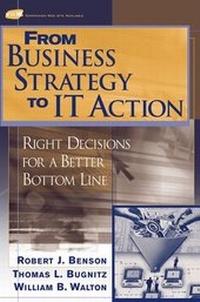
From Business Strategy to IT Action
Beschreibung

Rezensionen / Stimmen
"The book provides a road map for C-level executives, including CIOs, on how to manage and invest in IT to deliver business value." (COMPUTERWORLD; 11/29/04)Weitere Details
Weitere Ausgaben
Andere Ausgaben
Personen
Inhalt
Preface xxi
Acknowledgments xxiii
Chapter 1 Define the Goals 1
Today's Reality 2
The Entire IT Spend: Reducing Cost and Improving Bottom-Line Impact 4
The Strategy-to-Bottom-Line Value Chain 5
Disconnects 6
Critical Success Factors 7
Completing the Picture: The New Information Economics Practices 8
Summary of the Book 13
Define the Goals: Management Agenda 14
Chapter 2 Ask the Right Questions 17
The Right Questions Focus on Affordability and Impact 18
Affordability Questions: The Starting Point for the Right Actions 20
Impact Questions: The Roadmap for the Right Actions 22
Examples: Answering the Questions 24
The Contexts for Management Questions Are Planning and Budgeting Processes 26
Why Ask Affordability and Impact Questions? 26
Taking Action 28
Chapter Summary 29
Ask the Right Questions: Management Agenda 30
Chapter 3 Connect to the Bottom Line 33
Bottom-Line Impact Based on Cause and Effect 35
Cause and Effect Is Based on Management's Intentions 36
Management's Strategic Intentions 37
Principles of IT's Bottom-Line Impact 39
Summary and Additional Implications 43
Connect to the Bottom Line: Management Agenda 45
Chapter 4 Understand Costs and Resources 47
Introduction 47
Origins of Portfolio Management 49
IT Portfolio Management in Prioritization 51
Portfolios in NIE Practices 52
Four IT Portfolio Concepts 56
Practical Problems in Applying Portfolio Management 62
Summing Up Portfolios and Portfolio Management in Information Technology 67
Chapter Summary 68
Understand Costs and Resources: Management Agenda 70
Chapter 5 Focus on the Right Things 73
The Goals and Principles for Right Decisions/Right Results 74
Goal 1: Actionable, Commonly Understood Strategic Intentions 74
Goal 2: The Right Bottom-Line Results from IT 79
Goal 3: The Right Management Culture and Management Roles 81
Goal 4: Portfolios and Portfolio Management 83
Goal 5: Actions and Results 84
Summary of Right Decisions/Right Results-Goals and Principles 85
Goals and Principles Applied to the Strategy-to-Bottom-Line Value Chain and NIE Practices 86
Focus on the Right Things: Management Agenda 88
Chapter 6 Adopt Effective Process to Produce Action 91
The Strategy-to-Bottom-Line Value Chain 92
Establishing the Process Connections 98
Management Roles 98
New Information Economics Practices 99
Summing Up New Information Economics Practices 106
Summing Up: Adopt Effective Process to Produce Action 107
Adopt Effective Process to Produce Action: Management Agenda 109
Chapter 7 Tackle the Practical Problems 111
A Practical Perspective 111
The Practical Problems Revolve around People 112
Addressing Practical Problems: IT Impact Management 113
Practical Problems Getting from Strategy to Bottom-Line Impact 113
The Role of IT Impact Management 126
Tackle the Practical Problems: Management Agenda 127
Chapter 8 Make the Right Decisions 129
The Management Context for "Make the Right Decisions" 130
Elements of Right Decisions 132
Make the Right Decisions: Two NIE Practices 141
The Prioritization Practice 141
The Alignment Practice 150
Make the Right Decisions with Prioritization and Alignment 160
Chapter Summary 162
Make the Right Decisions: Management Agenda 164
Chapter 9 Plan for the Right Results 167
Two Planning Processes 168
The Strategic Demand/Supply Planning Practice 172
The Innovation Planning Practice 187
Chapter Summary: Plan for the Right Results 194
Plan for the Right Results: Management Agenda 196
Chapter 10 Keep Score 199
Management Issues 201
Frameworks and Process Overview 202
Result 207
Critical Success Factors: Right Decisions/Right Results Principles in Performance Measurement 208
Summary: Performance Measurement Practice 210
Keep Score: Management Agenda 211
Chapter 11 Deal with Culture 213
Part 1: The Impact of Management Culture 214
Part 2: The Need for Culture Change 217
Part 3: Classification of Business/IT Culture 218
Part 4: Applying Culture Management Concepts 225
Deal with Culture: Management Agenda 230
Chapter 12 Chart the Path to Implementation 233
Introduction to the Business Value Maturity Model 235
Maturity Model Goals 237
Requirement for Management Action 238
Embedding NIE Practices into Management Processes 240
Using the Business Value Maturity Model 242
Summary: The Business Value Maturity Model 245
Chapter 12 Appendix A: Details of the Business Value Maturity Model 246
Chapter 12 Appendix B: The Development of Maturity Models 250
Chapter 13 Define What's Next 253
Three Methods to Establish Right Decisions/ Right Results Goals 254
Setting Goals from a Corporate Governance and Process Perspective 261
The IT Impact Management Program to Implement Right Decisions/Right Results and NIE Practices 263
Conclusion to Chapter 13 267
Chapter 14 Answer the "So What?" Question 271
Why This Trip Is Necessary 271
First, Hit the IT Improvement Zone 272
The "So What?" for the Company 273
The "So What?" for the CEO 273
The "So What?" for the CFO 274
The "So What?" for Line of Business Management 274
The "So What?" for IT Management 275
The "So What?" for the Business 276
Continuing Development 276
Appendices 277
Appendix A The Role of Enterprise Architecture in Right Decisions/Right Results 277
Appendix B Management Team Roles in Right Decisions/ Right Results 283
Appendix C The Development of Strategic Intentions, with Examples 289
Appendix D Applying Strategic Intentions in Prioritization 297
Appendix E The CFO Role in Right Decisions/Right Results 299
Appendix F The Details of the Business Value Maturity Model TM 301
Bibliography 313
Index 323
