

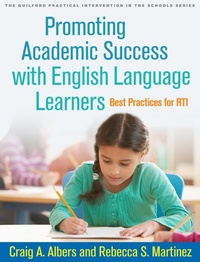
Promoting Academic Success with English Language Learners
Best Practices for RTI
Erschienen am 31. August 2015
256 Seiten
978-1-4625-2502-7 (ISBN)
Beschreibung

School psychologists, classroom teachers, special educators, and ELL teachers in grades K-5; school administrators; speech-language pathologists; graduate students in these areas. May serve as a supplemental text in graduate-level courses.
Weitere Details
Weitere Ausgaben
Andere Ausgaben
Craig A. Albers | Rebecca S. Martinez
Promoting Academic Success with English Language Learners
Best Practices for RTI
Buch
09/2015
1. Auflage
Guilford Press
47,50 €
Versand in 15-20 Tagen
Personen
Craig A. Albers, PhD, is Associate Professor of Educational Psychology in the School Psychology Program at the University of Wisconsin-Madison, where he also serves as Chair of the interdisciplinary Prevention and Intervention Sciences Program. Prior to joining the University of Wisconsin in 2004, Dr. Albers worked as a school psychologist in the Kyrene School District in Phoenix, Arizona. His research focuses on universal screening, prevention, and early intervention services; the provision of school psychological services to English language learners (ELLs); and the measurement and resulting intervention implications of English language proficiency assessment. He is the author of Alternate ACCESS for ELLs, an English language proficiency measure designed for use with ELLs with significant disabilities, which is currently administered in 34 states. He is also Associate Editor of the Journal of School Psychology. Rebecca S. Martinez, PhD, is Associate Professor in the School Psychology Program at Indiana University Bloomington. A native Spanish speaker, Dr. Martinez was raised in Mexico City, Mexico, where she attended elementary school through the third grade. After obtaining her bachelor's degree, she joined Teach for America and became a bilingual education teacher on the Texas-Mexico border. Her research and practice focus on the prevention of and intervention for children's academic failure, particularly for ELLs. She has published multiple book chapters and peer-reviewed empirical articles.
Inhalt
1. Introduction
2. Who Are These ELLs? Foundations, Demographics, and Outcomes
3. Understanding RTI and How It Will Help Your ELLs Succeed
4. The Critical Variable: Academic Language Proficiency and Its Impact on Students Learning English as a Second Language
5. Best Practices in Assessment and Interaction for ELLs at Tier 1
6. Monitoring Progress, Determining Growth Rates, and Intensifying Instruction for ELLs at Tiers 2 and 3
7. Special Education Referral and Evaluation Consideration for ELLs Who Have Not Responded to Instruction and Intervention
8. Next Steps: Conclusions and Directions for the Future
2. Who Are These ELLs? Foundations, Demographics, and Outcomes
3. Understanding RTI and How It Will Help Your ELLs Succeed
4. The Critical Variable: Academic Language Proficiency and Its Impact on Students Learning English as a Second Language
5. Best Practices in Assessment and Interaction for ELLs at Tier 1
6. Monitoring Progress, Determining Growth Rates, and Intensifying Instruction for ELLs at Tiers 2 and 3
7. Special Education Referral and Evaluation Consideration for ELLs Who Have Not Responded to Instruction and Intervention
8. Next Steps: Conclusions and Directions for the Future
