

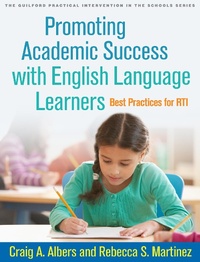
Promoting Academic Success with English Language Learners
Best Practices for RTI
1. Auflage
Erschienen am 25. September 2015
Buch
Softcover
256 Seiten
978-1-4625-2126-5 (ISBN)
Beschreibung
Educators and school psychologists throughout the country are working with growing numbers of English language learners (ELLs), but often feel unprepared to help these students excel. This highly informative book presents evidence-based strategies for promoting proficiency in academic English and improving outcomes in a response-to-intervention (RTI) framework. Illustrated with a detailed case example, the book describes best practices for working with K-5 ELLs in all stages of RTI: universal screening, progress monitoring, data collection, decision making, and intensifying instruction. In a large-size format for easy photocopying, the book includes more than two dozen reproducible worksheets. Purchasers get access to a Web page where they can download and print the reproducible materials.
This book is in The Guilford Practical Intervention in the Schools Series, edited by Sandra M. Chafouleas.
This book is in The Guilford Practical Intervention in the Schools Series, edited by Sandra M. Chafouleas.
Rezensionen / Stimmen
"This book has unique value for any educator or school striving to provide the most effective instruction for ELLs. Within an RTI framework, the authors provide excellent contextual and demographic information, practical recommendations, user-friendly worksheets, and many case examples--all cohesively integrated in a way that will surely assist current and future educators' efforts to best serve ELLs."--John C. Begeny, PhD, Department of Psychology, North Carolina State University"Albers and Martinez help fill a large gap in the literature with this timely and important book. Writing in an approachable manner, the authors provide insightful information that will be highly useful to practitioners and students. The book includes step-by-step guidance for professionals aiming to provide equitable and research-based services to ELLs. It will be a welcome addition as a text in graduate programs in school psychology and special education."--Bryn Harris, PhD, NCSP, School of Education and Human Development, University of Colorado Denver
"This comprehensive book will be a go-to manual for school practitioners looking for guidance around implementing linguistically responsive tiered instruction and supports for ELLs. The readable, easy-to-understand format is enhanced by case examples and resources. Albers and Martinez underscore the value of leveraging alterable variables--such as the curriculum, instruction, and environment--to close the gap between ELLs and native English speakers."--Caroline Racine Gilles, PhD, Director of Multi-Tiered System of Supports, Madison (Wisconsin) Metropolitan School District -
Weitere Details
Reihe
Sprache
Englisch
Verlagsort
New York
USA
Verlagsgruppe
Guilford Publications
Zielgruppe
Für Beruf und Forschung
Professional and Professional Practice & Development
Produkt-Hinweis
Broschur/Paperback
Klebebindung
Maße
Höhe: 267 mm
Breite: 203 mm
Dicke: 13 mm
Gewicht
590 gr
ISBN-13
978-1-4625-2126-5 (9781462521265)
Copyright in bibliographic data and cover images is held by Nielsen Book Services Limited or by the publishers or by their respective licensors: all rights reserved.
Schweitzer Klassifikation
Weitere Ausgaben
Andere Ausgaben
Craig A. Albers | Rebecca S. Martinez
Promoting Academic Success with English Language Learners
Best Practices for RTI
E-Book
08/2015
The Guilford Press
47,49 €
Als Download verfügbar
Personen
Craig A. Albers, PhD, is Associate Professor of Educational Psychology in the School Psychology Program at the University of Wisconsin-Madison, where he also serves as Chair of the interdisciplinary Prevention and Intervention Sciences Program. Prior to joining the University of Wisconsin in 2004, Dr. Albers worked as a school psychologist in the Kyrene School District in Phoenix, Arizona. His research focuses on universal screening, prevention, and early intervention services; the provision of school psychological services to English language learners (ELLs); and the measurement and resulting intervention implications of English language proficiency assessment. He is the author of Alternate ACCESS for ELLs, an English language proficiency measure designed for use with ELLs with significant disabilities, which is currently administered in 34 states. He is also Associate Editor of the Journal of School Psychology. Rebecca S. Martinez, PhD, is Associate Professor in the School Psychology Program at Indiana University Bloomington. A native Spanish speaker, Dr. Martinez was raised in Mexico City, Mexico, where she attended elementary school through the third grade. After obtaining her bachelor's degree, she joined Teach for America and became a bilingual education teacher on the Texas-Mexico border. Her research and practice focus on the prevention of and intervention for children's academic failure, particularly for ELLs. She has published multiple book chapters and peer-reviewed empirical articles.
Inhalt
1. Introduction
2. Who Are These ELLs? Foundations, Demographics, and Outcomes
3. Understanding RTI and How It Will Help Your ELLs Succeed
4. The Critical Variable: Academic Language Proficiency and Its Impact on Students Learning English as a Second Language
5. Best Practices in Assessment and Interaction for ELLs at Tier 1
6. Monitoring Progress, Determining Growth Rates, and Intensifying Instruction for ELLs at Tiers 2 and 3
7. Special Education Referral and Evaluation Consideration for ELLs Who Have Not Responded to Instruction and Intervention
8. Next Steps: Conclusions and Directions for the Future
2. Who Are These ELLs? Foundations, Demographics, and Outcomes
3. Understanding RTI and How It Will Help Your ELLs Succeed
4. The Critical Variable: Academic Language Proficiency and Its Impact on Students Learning English as a Second Language
5. Best Practices in Assessment and Interaction for ELLs at Tier 1
6. Monitoring Progress, Determining Growth Rates, and Intensifying Instruction for ELLs at Tiers 2 and 3
7. Special Education Referral and Evaluation Consideration for ELLs Who Have Not Responded to Instruction and Intervention
8. Next Steps: Conclusions and Directions for the Future