

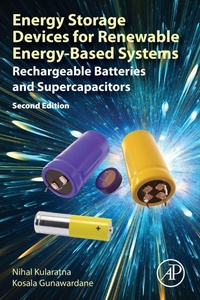
Energy Storage Devices for Renewable Energy-Based Systems
Rechargeable Batteries and Supercapacitors
2. Auflage
Erschienen am 17. Mai 2021
Buch
Softcover
438 Seiten
978-0-12-820778-9 (ISBN)
Beschreibung
Energy Storage Devices for Renewable Energy-Based Systems: Rechargeable Batteries and Supercapacitors, Second Edition is a fully revised edition of this comprehensive overview of the concepts, principles and practical knowledge on energy storage devices. The book gives readers the opportunity to expand their knowledge of innovative supercapacitor applications, comparing them to other commonly used energy storage devices. With new application case studies and definitions, this resource will strengthen your understanding of energy storage from a practical, applications-based point-of-view without requiring detailed examination of underlying electrochemical equations. Users will learn about various design approaches and real-time applications of ESDs.
Electronic engineering experts and system designers will find this book useful to deepen their understanding on the application of electronic storage devices, circuit topologies, and industrial device data sheets to develop new applications. The book is also intended to be used as a textbook for masters and doctoral students who want to enhance their knowledge and understanding the concepts of renewable energy sources and state-of-the-art ESDs.
Electronic engineering experts and system designers will find this book useful to deepen their understanding on the application of electronic storage devices, circuit topologies, and industrial device data sheets to develop new applications. The book is also intended to be used as a textbook for masters and doctoral students who want to enhance their knowledge and understanding the concepts of renewable energy sources and state-of-the-art ESDs.
Rezensionen / Stimmen
"The new energy landscape has the potental for m any new innovations for powering the future. With the proliferation of renewable energy sources such as wind, solar, fuel cells, and geothermal, there is increasing research and development of technologies expected to support the power grid of the future. Currently, many proposed power networks require some form of energy storage to moderate the intermittent nature of these renewable energy sources. Two such energy storage devices, that the authors are convinced will play a critical role in future power distribution systems, are batteries and supercapacitors." --IEEE: Electrical Insulation MagazineWeitere Details
Auflage
2nd edition
Sprache
Englisch
Verlagsort
San Diego
USA
Verlagsgruppe
Elsevier Science Publishing Co Inc
Zielgruppe
Für Beruf und Forschung
Energy, electrical and power engineers
Electronics product designers; graduate students; research engineers and professionals in energy, electronics and automotive industries
Produkt-Hinweis
Broschur/Paperback
Illustrationen
Approx. 100 illustrations
Maße
Höhe: 229 mm
Breite: 152 mm
Dicke: 23 mm
Gewicht
584 gr
ISBN-13
978-0-12-820778-9 (9780128207789)
Copyright in bibliographic data and cover images is held by Nielsen Book Services Limited or by the publishers or by their respective licensors: all rights reserved.
Schweitzer Klassifikation
Weitere Ausgaben
Andere Ausgaben
Nihal Kularatna | Kosala Gunawardane
Energy Storage Devices for Renewable Energy-Based Systems
Rechargeable Batteries and Supercapacitors
E-Book
05/2021
2. Auflage
Academic Press
145,00 €
Als Download verfügbar
Vorauflage
Nihal Kularatna
Energy Storage Devices for Electronic Systems
Rechargeable Batteries and Supercapacitors
Buch
11/2014
Academic Press
141,50 €
Versand in 15-20 Tagen
Personen
Nihal Kularatna is an Associate Professor in the School of Engineering at the University of Waikato, New Zealand. He won the New Zealand Innovator of the Year Award (2013). His electronic engineering career spans 45 years and he is currently active in research in supercapacitor applications, power converter topologies, and power conditioning. He has contributed to over 160 papers and authored nine books. Multiple patents were granted for his supercapacitor assisted (SCA) circuit topologies. Before migrating to New Zealand in 2002, he was the CEO of the Arthur C Clarke Institute in Sri Lanka. Kosala Gunawardane is currently a senior lecturer in Electrical and Electronic Engineering at the Auckland University of Technology, New Zealand. Her research interests are analog circuit design, power electronic converters, supercapacitor-based, non-traditional applications and renewable energy and DC-microgrids. Gunawardane received the B.Sc. (Hons.) degree in Electronics and Telecommunication engineering from the University of Moratuwa, Sri Lanka, in 2005. She completed her PhD degree at the University of Waikato, New Zealand in 2014 in Electronics Engineering.
Inhalt
1. Energy storage devices - a general overview
2. Rechargeable battery technologies: an electronic engineer's view point
3. Dynamics, models, and management of rechargeable batteries
4. Capacitors as energy storage devices - simple basics to current commercial families
5. Electrical double-layer capacitors: Fundamentals, characteristics, and equivalent circuits
6. Supercapacitor as a lossless dropper in DC-DC converters
7. Supercapacitors for surge absorption
8. Supercapacitors in a rapid heat transfer application
Appendix
A. Capacitors and AC line filtering
2. Rechargeable battery technologies: an electronic engineer's view point
3. Dynamics, models, and management of rechargeable batteries
4. Capacitors as energy storage devices - simple basics to current commercial families
5. Electrical double-layer capacitors: Fundamentals, characteristics, and equivalent circuits
6. Supercapacitor as a lossless dropper in DC-DC converters
7. Supercapacitors for surge absorption
8. Supercapacitors in a rapid heat transfer application
Appendix
A. Capacitors and AC line filtering