

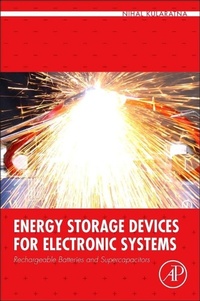
Energy Storage Devices for Electronic Systems
Rechargeable Batteries and Supercapacitors
Erschienen am 27. November 2014
Buch
Softcover
320 Seiten
978-0-12-407947-2 (ISBN)
Beschreibung
Energy storage devices are a crucial area of research and development across many engineering disciplines and industries. While batteries provide the significant advantage of high energy density, their limited life cycles, disposal challenges and charge and discharge management constraints undercut their effectiveness in certain applications. Compared to electrochemical cells, supercapacitors are charge-storage devices with much longer life cycles, yet they have traditionally been hobbled by limited DC voltage capabilities and energy density. However, recent advances are improving these issues.
This book provides the opportunity to expand your knowledge of innovative supercapacitor applications, comparing them to other commonly used energy storage devices. It will strengthen your understanding of energy storage from a practical, applications-based point-of-view, without requiring detailed examination of underlying electrochemical equations. No matter what your field, you will find inspiration and guidance in the cutting-edge advances in energy storage devices in this book.
This book provides the opportunity to expand your knowledge of innovative supercapacitor applications, comparing them to other commonly used energy storage devices. It will strengthen your understanding of energy storage from a practical, applications-based point-of-view, without requiring detailed examination of underlying electrochemical equations. No matter what your field, you will find inspiration and guidance in the cutting-edge advances in energy storage devices in this book.
Weitere Details
Sprache
Englisch
Verlagsort
San Diego
USA
Verlagsgruppe
Elsevier Science Publishing Co Inc
Zielgruppe
Für Beruf und Forschung
Energy, chemical, electrical and power engineers; electronics product designers; graduate students; research engineers and professionals in energy, electronics and automotive industries.
Produkt-Hinweis
Broschur/Paperback
Klebebindung
Maße
Höhe: 229 mm
Breite: 154 mm
Dicke: 17 mm
Gewicht
465 gr
ISBN-13
978-0-12-407947-2 (9780124079472)
Copyright in bibliographic data and cover images is held by Nielsen Book Services Limited or by the publishers or by their respective licensors: all rights reserved.
Schweitzer Klassifikation
Weitere Ausgaben
Nachauflagen
Nihal Kularatna | Kosala Gunawardane
Energy Storage Devices for Renewable Energy-Based Systems
Rechargeable Batteries and Supercapacitors
Buch
05/2021
2. Auflage
Academic Press
157,50 €
Versand in 15-20 Tagen
Andere Ausgaben
Nihal Kularatna
Energy Storage Devices for Electronic Systems
Rechargeable Batteries and Supercapacitors
E-Book
01/2014
Elsevier
118,00 €
Als Download verfügbar
Person
Nihal Kularatna is an Associate Professor in the School of Engineering at the University of Waikato, New Zealand. He won the New Zealand Innovator of the Year Award (2013). His electronic engineering career spans 45 years and he is currently active in research in supercapacitor applications, power converter topologies, and power conditioning. He has contributed to over 160 papers and authored nine books. Multiple patents were granted for his supercapacitor assisted (SCA) circuit topologies. Before migrating to New Zealand in 2002, he was the CEO of the Arthur C Clarke Institute in Sri Lanka.
Inhalt
1. Energy storage devices: A general overview2. Rechargeable battery technologies: An electronic engineer's viewpoint3. Dynamics, models, and management of rechargeable batteries4. Capacitors as energy storage devices: Simple basics to current commercial families5. Electrical double-layer capacitors: Fundamentals, characteristics, and equivalent circuits6. Supercapacitor as a lossless dropper in DC-DC converters7. Supercapacitors for surge absorption8. Supercapacitors in a rapid heat transfer application
AppendixA. Capacitors and AC line filtering
AppendixA. Capacitors and AC line filtering