

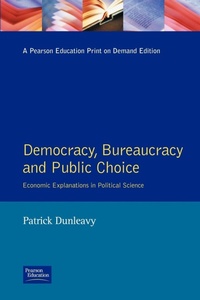
Democracy, Bureaucracy and Public Choice
Economic Approaches in Political Science
1. Auflage
Erschienen am 1. April 1991
Buch
Softcover
300 Seiten
978-0-7450-0233-0 (ISBN)
Beschreibung
First published in 1991. This book initially offers a critique of some key rational public choice models, to show that they were internally inconsistent and ideologically slanted. Then due to the authors' research the ideas are restructured around a particular kind of institutional public choice method, recognizing the value of instrumental models as a mode of thinking clearly about the manifold complexities of political life.
Weitere Details
Sprache
Englisch
Verlagsort
London
Großbritannien
Verlagsgruppe
Taylor & Francis Ltd
Zielgruppe
Für Beruf und Forschung
Maße
Höhe: 229 mm
Breite: 152 mm
Dicke: 16 mm
Gewicht
441 gr
ISBN-13
978-0-7450-0233-0 (9780745002330)
Copyright in bibliographic data and cover images is held by Nielsen Book Services Limited or by the publishers or by their respective licensors: all rights reserved.
Schweitzer Klassifikation
Weitere Ausgaben
Andere Ausgaben
Buch
05/2016
1. Auflage
Routledge
252,40 €
Versand in 10-20 Tagen
E-Book
06/2014
1. Auflage
Routledge
86,99 €
Als Download verfügbar
E-Book
06/2014
1. Auflage
Routledge
86,99 €
Als Download verfügbar
Vorauflage

Buch
04/1991
Prentice Hall / Harvester Wheatsheaf
75,56 €
Artikel ist vergriffen; siehe Neuauflage
Person
Professor Patrick Dunleavy (Department of Government, London School of Economics and Political Science.)
Inhalt
Introduction: Institutional Public Choice Theory and Political Analysis
DEMOCRACY
Interest Groups and Collective Action
Reconstructing the Theory of Groups
Economic Explanations of Voting Behaviour
Party Competition - The Preference-Shaping Model
BUREAUCRACY
Existing Public Choice Models of Bureaucracy
The Bureau-Shaping Model
Comparing Budget - Maximizing and Bureau-Shaping Models
Conclusion - Economic Explanations in Political Science
DEMOCRACY
Interest Groups and Collective Action
Reconstructing the Theory of Groups
Economic Explanations of Voting Behaviour
Party Competition - The Preference-Shaping Model
BUREAUCRACY
Existing Public Choice Models of Bureaucracy
The Bureau-Shaping Model
Comparing Budget - Maximizing and Bureau-Shaping Models
Conclusion - Economic Explanations in Political Science