

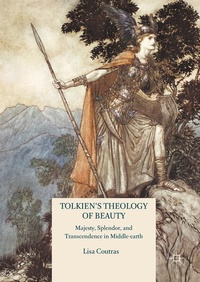
Tolkien's Theology of Beauty
Majesty, Splendor, and Transcendence in Middle-earth
Erschienen am 6. Juli 2016
Buch
Hardcover
XVII, 279 Seiten
978-1-137-55344-7 (ISBN)
Beschreibung
In this book, Lisa Coutras explores the structure and complexity of J.R.R. Tolkien's narrative theology, synthesizing his Christian worldview with his creative imagination. She illustrates how, within the framework of a theological aesthetics, transcendental beauty is the unifying principle that integrates all aspects of Tolkien's writing, from pagan despair to Christian joy.
J.R.R. Tolkien's Christianity is often held in an unsteady tension with the pagan despair of his mythic world. Some critics portray these as incompatible, while Christian analysis tends to oversimplify the presence of religious symbolism. This polarity of opinion testifies to the need for a unifying interpretive lens. The fact that Tolkien saw his own writing as "religious" and "Catholic," yet was preoccupied with pagan mythology, nature, language, and evil, suggests that these areas were wholly integrated with his Christian worldview. Tolkien's Theology of Beauty examines six structural elements, demonstrating that the author's Christianity is deeply embedded in the narrative framework of his creative imagination.
J.R.R. Tolkien's Christianity is often held in an unsteady tension with the pagan despair of his mythic world. Some critics portray these as incompatible, while Christian analysis tends to oversimplify the presence of religious symbolism. This polarity of opinion testifies to the need for a unifying interpretive lens. The fact that Tolkien saw his own writing as "religious" and "Catholic," yet was preoccupied with pagan mythology, nature, language, and evil, suggests that these areas were wholly integrated with his Christian worldview. Tolkien's Theology of Beauty examines six structural elements, demonstrating that the author's Christianity is deeply embedded in the narrative framework of his creative imagination.
Rezensionen / Stimmen
"This book was an interesting read. To find out more about where Tolkien's theology stands, Catholic though it may be, was certainly enlightening. I give this book 4 stars out of 5." (Justin Dilliplane, Resolved for Christ, resolvedfc.blogspot.de, January, 2018)
"This excellent study . is, to the best of my knowledge, the only monograph on its subject . . Throughout the text, Coutras gives ample and insightful references to earlier scholarship, making the book valuable as an introduction above and beyond the virtues of its own argument." (John Wm. Houghton, Journal of Tolkien Research, Vol. 4 (2), 2017)"Lisa Coutras's Tolkien's Theology of Beauty is an important addition to Tolkien Studies, and worthy of being read by more than just those interested in religious readings of the Silmarillion legendarium or The Lord of the Rings." (Philip Irving Mitchell, Mythlore, Vol. 36 (1), 2017)
Weitere Details
Weitere Ausgaben
Andere Ausgaben
E-Book
08/2016
1. Auflage
Palgrave MacMillan
128,39 €
Als Download verfügbar
Person
Lisa Coutras holds a PhD in Theology from King's College London, UK, and an MTh in Applied Theology from the University of Oxford, UK.
Inhalt
Foreword; Alister McGrath.- Introduction.- Part I: On Myth.- Chapter 1. A Theology of Beauty.- Chapter 2. Primary Truth.- Part II: On Creation.- Chapter 3. The Light of Being.- Chapter 4. Incarnate Beings.- Chapter 5. The Wonder of Being.- Part III: On Language.- Chapter 6. The Law of the Logos.- Chapter 7. The Song of Lúthien.- Part IV: On Good and Evil.- Chapter 8. Being and Unbeing.- Chapter 9. The Splendor of Being.- Part V: On Tragic Heroism.- Chapter 10. The Tragedy of Túrin.- Chapter 11. Hope Without Guarantees.- Part VI: On Women.- Chapter 12. Tolkien and Feminist Criticism.- Chapter 13. The Transcendental Feminine.- Chapter 14. The Renunciation of Power.- Conclusion.