

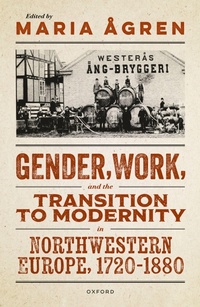
Gender, Work, and the Transition to Modernity in Northwestern Europe, 1720-1880
Erschienen am 5. Februar 2025
288 Seiten
978-0-19-893430-1 (ISBN)
Beschreibung

It is well-known that gender distinctions structure the modern labour market, but why is this so and how far back in time does the pattern extend? Gender, Work, and the Transition to Modernity in Northwestern Europe, 1720-1880 uses a unique method to map and explain how gender rather than marital status came to be important.
Gender, Work, and the Transition to Modernity in Northwestern Europe, 1720-1880 investigates how and why the division of work between men and women changed in the transition from early modern to modern society. Based on the verb-oriented method and around 19,000 observations of work activities in historical sources, its focus is on a mid-Swedish local society in the period 1720 to 1880. There were several continuities across this time: both women and men were observed in practically all forms of work, many households (both affluent and destitute) still relied on multiple sources of income, and the marital partnership continued to be important for what women and men did to support themselves. Yet, there was also change: tasks that conferred authority were gradually masculinised, the differences between married and unmarried women with respect to work declined, and while women remained mobile, men's work-related mobility increased. In an even longer time perspective, from 1550 to 1880, gender slowly became more important for what types of work people did. The main reason behind this development was increasing social differentiation and shifts in labour relations. The growing impact of gender was not the result of a trickling down of new middle-class ideals, nor the effect of new preferences, nor a consequence of a separation of home and work. Instead, differences grew because more people were in a position where someone else - an employer - controlled how they used their time.
Weitere Details
Weitere Ausgaben
Andere Ausgaben
Buch
02/2025
Oxford University Press
130,50 €
Versand in 15-20 Tagen
Person
Maria Ågren is a Swedish historian who specializes in early modern and nineteenth-century history. She has published extensively about credit, property, inheritance, marriage, and work, in both Swedish and English. She is the leader of the Gender and Work project at Uppsala University, within which the GaW database was developed as an example of the Digital Humanities. She has supervised 20 Ph.D. students to completion of their doctorates.
Inhalt
- Cover
- Gender, Work, and the Transition to Modernity in Northwestern Europe, 1720-1880
- Copyright
- Acknowledgements
- Contents
- About Authorship and Authors
- List of Figures
- List of Tables
- 1: Women's and Men's Work in the Transition from Early Modern to Modern Society
- Identifying the Research Problem
- Approaching Late Nineteenth-Century Marriage from Two Different Perspectives
- Defining the Marital Partnership
- Choices
- Key Results
- Conclusion
- 2: The Study Area
- Tuhundra and Snevringe in the Eighteenth Century
- Västerås in the Eighteenth Century
- Transformations
- Agrarian growth and commercialization
- Society is liberalized and reformed
- Tuhundra, Snevringe, and Västerås in the 1870s
- Population
- 3: Method, Sources, and the GaW2 Data Set
- Why Verbs?
- Where Do We Find the Verbs?
- What Do We Do with the Verbs?
- Whose Work Do We Capture?
- What Work Do We Capture?
- What Additional Methods and Data Do We Need?
- What General Patterns Do We Find?
- Conclusion
- 4: The Diversity of Work: Practice and Perception
- Basis for the Study
- Practices of Multiple Employment
- Perceptions of People Having Multiple Employment
- Where Practice and Perception Meet
- Conclusion
- 5: Marriage and Work: Continuity and Subtle Change
- The Work of Married People Compared with That of the Unmarried
- Combining Childcare with Other Forms of Work
- Extended Repertoires through Trade
- A Source of Authority?
- Conclusion
- 6: The Masculinization of Authority
- Introduction
- Managerial Work
- Micro-administration
- Legal Examinations and Inspections
- Conclusion
- 7: The Home as a Place for Work
- House, Home, and Dwelling
- Work in Homes and Other Buildings
- Housework as a Specific Set of Tasks
- Increasing Focus on and Commercialization of the Domestic Sphere
- Conclusion
- 8: The Everyday Geography of Work
- Verbs and Places of Work
- The Infrastructure of Everyday Mobility
- The Spatial Organization of Agricultural Work
- The Need for Extra Labour
- The Distribution of Goods
- Close to Home or Far Away
- Conclusion
- 9: Wage Work and the Household: Four Stories of Interconnectedness
- Sala Silver Mine (c. 1730-70)
- The Linen Factory at Kättsta (c .1730-60)
- The Västerås Steam Brewery (1880)
- The Stud Farm at Strömsholm (1720-1880)
- Conclusion
- 10: Conclusion: On the Threshold of Modern Society
- The Verb-Oriented Method Applied to the Nineteenth Century: An Evaluation
- Empirical Results
- Across time, gender became more important for women's work
- Across time, home and work were not separated but connected in new ways
- Explanations
- Continuities, Shifts and Changes on the Threshold of Modern Society
- Appendix A: The GaW2 data set
- Court Records
- Accounts
- Ego-documents
- Registers
- Petitions
- Appendix B: Categories
- Appendix C: Probate Inventories as Indicators of Repertoires of Practices
- Bibliography
- Primary sources
- Unpublished sources
- Published sources
- Secondary sources
- Index
