

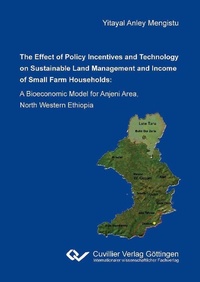
The effect of policy incentives and technology on sustainable land management and income of small farm households
A bioeconomic model for Anjeni area, North Western Ethiopia
Cuvillier Verlag eBooks
Erschienen am 17. Januar 2011
160 Seiten
978-3-7369-3623-2 (ISBN)
Beschreibung

Land degradation due to soil erosion and soil nutrient depletion has contributed to declining agricultural productivity, poverty and food insecurity in Ethiopia. Due to the continuous dependency on agriculture, land degradation and unfavorable climatic conditions, rural development policies in Ethiopia are challenged by two important issues: the need to improve household income to meet the demand for food in the face of growing population and the need to improve or sustain the productivity of land. This highlights the important task of undertaking development research to understand and design appropriate policy incentives and technology interventions.
Using primary and secondary data, this study employed a bioeconomic model in a mathematical programming framework to analyze the impact of selected policy incentives and technology interventions on land quality and income of small farm households and an econometric model to assess the factors that influence the use of improved soil and water conservation measures in Anjeni area, North Western Ethiopia.
Analyses of the results of the bioeconomic model indicate that there are potentials for policy incentives and technology interventions to improve household income and reduce land degradation. The combined effect of improved soil and water conservation measures, access to fertilizer credit and high yielding crop variety appear to have the highest impact on income and land degradation as compared to the effect of individual policy incentives and technology interventions as they address, simultaneously, several constraints of small farm households.
However, the results indicate that the process of land degradation can’t be reversed and these interventions are not able to fully control land degradation, they can only slow down the process of land degradation. A conclusion that can be drawn from this analysis is that the use of physical soil conservation measures alone is not a sufficient solution to curb the problem of land degradation. Other alternatives such as biological soil conservation measures should be thought of as an integral part of the solution to the problem of land degradation.
Finally, analysis of the results of the econometric model indicated that the probability and extent of use of improved soil and water conservation technologies largely depends on the resource constraints such as size of farm land and labour and the capacity and level of understanding of farm households such as education level, age and perception about the problem of land degradation. This suggests that Interventions and agricultural development programs that seek to address farmers’ resource constraints and that provide incentives to farm households have a positive and significant effect on promoting soil and water conservation measures and sustaining agricultural productivity and food security.
Weitere Details
Weitere Ausgaben
Andere Ausgaben
Yitayal Anley Mengistu
THE EFFECT OF POLICY INCENTIVES AND TECHNOLOGY ON SUSTAINABLE LAND MANAGEMENT AND INCOME OF SMALL FARM HOUSEHOLDS: A BIOECONOMIC MODEL FOR ANJENI AREA, NORTH WESTERN ETHIOPIA
Buch
01/2011
1. Auflage
Cuvillier Verlag
24,15 €
Versand in 10-15 Tagen
