

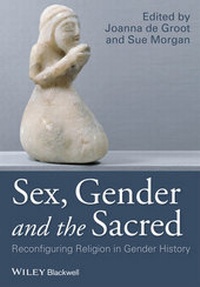
Sex, Gender and the Sacred
Beschreibung

Weitere Details
Weitere Ausgaben
Andere Ausgaben
Personen
Inhalt
Introduction: Beyond the ‘Religious Turn’? Past, Present and Future Perspectives in Gender History
Joanna de Groot and Sue Morgan
In the twenty-fifth anniversary year of Gender & History, this special issue on religion provides an opportune moment for the review and reassessment of an aspect of gender history that has developed a substantial scholarship and witnessed important historiographical shifts both before and since the 1980s. As a capacious heuristic category, ‘religion’ stands in for a range of meanings historically, from the highly individuated interior experience of prayer and mysticism to the public corporate structures of institutional or national religious politics. As the various contributors to this volume illustrate, religious discourses can be expressed through private contemplation, worship rituals, sacred works of art, spiritual communities, associational networks and nationalist agendas. They have been appropriated performatively by women and men in the past as part of both individual identity formations and socio-political practices. In what ways, then, might an analysis of religion help us rethink the current frameworks and narratives of histories of gender and, conversely, how might a focus on gender and sexuality illuminate the past interactions of religion and culture? These questions framed a stimulating two-day international symposium held in September 2012 at the University of York from which this volume developed, where speakers debated the tenacious and creative power of religion in fashioning gendered selves across a wide geographical, spiritual and chronological spectrum. Spanning almost 4,000 years from the second millennium BCE to the twenty-first century, the interlocking narratives of religion and gender were scrutinised from ancient Mesopotamia to renaissance Milan, from Song China to post-revolutionary Mexico, from medieval Ireland to modern Spain and Cuba, and from early modern England to nineteenth-century India.
Several major themes emerged from the symposium and are enlarged upon here: that we live in a world which is both increasingly secular and increasingly religious, and that within this paradox issues concerning gender and sexuality constitute repeated points of crisis and rupture; that in a field committed to exploring relations of difference through gender, age, ethnicity, class or sexual orientation, gender history has not always accorded religious differences a similar analytical force, subsuming them within national, ethnic or other cultural identities; following on from this point – ‘theology really matters’. As the exposition of a given faith's encounter with, and revelation of, the divine (an essentially metaphysical experience), theology has often been collapsed by historians into its wider social and more visible counterpart, religion. Yet as Dominic Erdozain warns, the omission of theology reduces religion to little more than a reflection or determinant of culture. In neglecting theological heterogeneity, the material impact of differing doctrines and beliefs upon the lives of men and women is obscured.1 For gender historians, this loss is particularly significant in understanding how hegemonies are made and maintained. As feminist theologians have demonstrated, symbolic and anthropomorphic images of the divine are saturated with gender constructs, often with important, if inconsistent implications for the temporal gender order. Patriarchy may have been well served, although sometimes subverted, by the Christian symbols of God the Father and Son, Eve and the Virgin Mary, but what were the lived gender effects of Hindu goddess cults such as that of Kali with its maternal and warrior-like representations of femininity, or Nahua deities of Central Mexico who transgressed gender binaries?2
Since its establishment, Gender & History has contributed regularly to the historiography of gender and religion through a wide range of articles. Among other subjects these have examined medieval convent spirituality, early modern Islamic conversion narratives, masculinity and priestly power in medieval Normandy and Florence, Jewish women in the Holocaust, Australian missionary masculinities and Aboriginal peoples, clerical marriage in the English and German reformations, diasporic West African spiritualities, Irish Catholic masculinity, Scottish missionaries and sexual misconduct, female Quaker ministries, and modern Italian and Argentinian Catholic women's organisations.3 A significant increase in articles centred on religion in the nineties and ‘noughties’ reflects a more general ‘religious turn’ in cultural history. Our introduction focuses upon past, present and future perspectives on the history of gender and religion, identifying some of the major tropes, narratives and turning-points to date, situating the volume's contents within some currently important themes in gender history and suggesting future potentialities for this burgeoning field.
Past perspectives
The earliest and most extensive historiographies of gender and religion over the last forty years have dealt with Christianity in its multiple forms. This literature, particularly in the anglophone world, has manifested interesting, albeit uneven developments shaped by diverse national contexts. In the USA, landmark articles such as Barbara Welter's ‘The Cult of True Womanhood’ (1966) and ‘The Feminisation of American Religion, 1800–1860’ (1974), led the way in identifying religion's formative contribution to one of the major organising tropes of women's history, ‘separate spheres’ ideology.4 Since then, an enormous literature on American women and religion has been forthcoming which, as Catherine Brekus observes, ‘virtually defies categorization’. Numerous studies of the beliefs and practices of enslaved women, African American holiness preachers, Catholic, Protestant, Mormon and Jewish men and women in addition to Native American forms of spirituality have been produced, despite a relative decline in interest during the 1980s due to the rise of the Religious Right and its ultra-conservative gender and sexual politics.5 In Britain, the socialist-feminist focus of much early gender history often marginalised religion as of limited relevance for understanding women's economic and political disadvantages. Nonetheless, Barbara Taylor's work has acknowledged the interaction of religious with other intellectual and political influences in the writings and activism of Owenite feminists and Mary Wollstonecraft.6 As the early modern historian Patricia Crawford would later comment, the religious subject appeared unexciting – all too often ‘the godly woman was the successfully socialised woman’.7 However, in its iconic reading of the role of gender in the formation of the middle classes, Leonore Davidoff and Catherine Hall's Family Fortunes: Men and Women of the English Middle Class, 1780–1850 (1987) provided what remains one of the most nuanced readings of Victorian evangelicalism and its contradictory implications for hegemonic constructions of both femininity and masculinity.8 It modelled an approach with rich possibilities for those working on gender and religion in other contexts.
One of the dominant narratives to emerge in modern scholarship recounts the ‘feminisation of religion’, a multivalent thesis originating in work on American Protestantism focused on women's greater preponderance in religious and church life and the increasing cultural designation of women as the more pious sex. Despite numerous studies of this phenomenon in Europe, North America and Australia, the theory has received increasing criticism as an overly simplistic formula that disregards both free-thinking, secularist and atheist women – many of whom, like the atheist and broadcaster Margaret Knight, attracted considerable vilification – and devout men (discussed later in this introduction).9 The ‘feminisation of religion’ theory, it is argued, reinscribes gender binaries and essentialises the very categories that require historical interrogation. It is also quite religiously specific. In Judaism, for example, it was certainly the case that pioneering women such as Lily Montagu and Ray Frank engaged in quasi-theological forms of social and educational activities among their co-religionists, as shown by Jean Spence, Shari Rabin and Susan L. Tananbaum.10 Nonetheless, Anne Summers has argued that the feminisation theory remains ‘largely inapplicable’ to modern western Jewish communities where, with women excluded from the rabbinate until the 1970s, religious practice remained overwhelmingly male and women's responsibility for Sabbath observance was a largely domestic affair. Benjamin Baader's work on nineteenth-century Judaism and bourgeois culture in Germany, however, suggests a more complex picture.11
A flourishing body of work on religion and women's historical agency, often using interpretative models such as ‘women's culture’ and ‘female associational networks’ in studies of family life, philanthropy, missionary activity, sisterhoods, preaching and social reform, suggests that the feminisation theory persists.12 The extent to which female religious activism might be designated ‘feminist’ has also prompted long-standing and unresolved debate. Feminism could be nurtured by heterodox forms of...
