

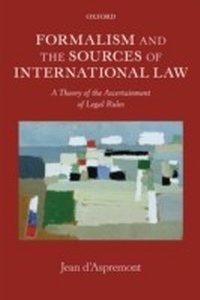
Formalism and the Sources of International Law: A Theory of the Ascertainment of Legal Rules
A Theory of the Ascertainment of Legal Rules
1. Auflage
Erschienen am 15. September 2011
285 Seiten
978-0-19-150482-2 (ISBN)
Beschreibung

This book revisits the theory of the sources of international law from the perspective of formalism. It critically analyzes the virtues of formalism, construed as a theory of law ascertainment, as a means of distinguishing between law and non-law. The theory of formalism is re-evaluated against the backdrop of the growing acceptance by international legal theorists of the blurring of the lines between law and non-law. At the same time, the book acknowledges that much internationalnormative activity nowadays takes place outside the ambit of traditional international law and that only a limited part of the exercise of public authority at the international level results in the creation of international legal rules. The theory of ascertainment that the book puts forward attempts to dispel some of the illusions of formalism that accompany the delimitation of customary international law. It also sheds light on the tendency of scholars, theorists, and advocates to deformalize the identification of international legal rules with a view to expanding international law. The book seeks to revitalize and refresh the formal identification of rules by engaging with some tenets of the postmodern critique of formalism. As a result, the book not only grapples with the practice of law-making at the international level, but it also offers broad theoretical insights on international law, dealing with the main schools of thought in legal theory (positivism, naturalism, legal realism, policy-oriented jurisprudence, andpostmodernism).The main theory of law ascertainment presented in this work rests on a rejuvenated and modernized version the social thesis found in English analytical jurisprudence.
Weitere Details
Weitere Ausgaben
Andere Ausgaben
Jean d'Aspremont
Formalism and the Sources of International Law
A Theory of the Ascertainment of Legal Rules
Buch
09/2011
1. Auflage
Oxford University Press
180,40 €
Versand in 15-20 Tagen
Inhalt
- Cover
- Contents
- List of Abbreviations
- 1. Introduction
- 1.1 Setting the Stage: The Retreat from Formal Law-Ascertainment
- 1.2 The Argument: Rejuvenating Formalism in the Theory of the Sources of International Law
- 1.3 Preliminary Caveats About the Argument Made in this Book
- 2. The Concept and the Rationale of Formalism in International Law
- 2.1 Formalism and its Multiple Meanings
- 2.1.1 The concept of formalism espoused in this book: formalism as a theory of law-ascertainment based on social practice
- 2.1.2 Other conceptions of formalism
- 2.2 Rationale of Formalism in the Theory of the Sources of International Law
- 3. The Emergence of Formal Law-Ascertainment in the Theory of the Sources of International Law
- 3.1 The Emergence of Formal Law-Ascertainment in General Legal Theory: A Sketch
- 3.1.1 Introduction
- 3.1.2 Formal law-ascertainment and the restrictive source thesis: Hobbes, Bentham, and Austin
- 3.1.3 The emergence of the social thesis: from Kelsen to Hart
- 3.1.4 Formal law-ascertainment after Hart
- 3.2 Formal Law-Ascertainment in the Theory of the Sources of International Law
- 3.2.1 Modern and classical theories of sources of international law
- 3.2.2 International law in the 20th and 21st centuries
- 3.2.3 Formal law-ascertainment in constitutionalist theory of international law
- 4. The Critiques of Formal Law-Ascertainment in the Theory of the Sources of International Law
- 4.1 The Critiques of Formal Law-Ascertainment in General Legal Theory: A Sketch
- 4.1.1 Modern natural law objections
- 4.1.2 Legal realism
- 4.1.3 Dworkin's famous attacks on the source and social theses
- 4.1.4 Postmodern objections to the source and social theses
- 4.2 The Contestations of Formal Law-Ascertainment in the Theory of the Sources of International Law
- 4.2.1 Remnants of substantive validity theory
- 4.2.2 International realism: the turn to pragmatism
- 4.2.3 The New Haven School: the turn to instrumentalism
- 4.2.4 Critical legal studies and deconstructivism in international law: international law as a language
- 5. Deformalization of Law-Ascertainment in Contemporary Theory of the Sources of International Law
- 5.1 The Various Manifestations of Deformalization of Law-Ascertainment in Contemporary International Legal Scholarship
- 5.2 The Softness of International Law
- 5.3 The Diverging Agendas Behind the Deformalization of Law-Ascertainment
- 6. Lessons from the Discontent with Formalism
- 6.1 Assuming Indeterminacy of Law-Ascertainment Criteria
- 6.2 The Politics of Formal Law-Ascertainment
- 6.3 Normativity and Empirical Methodology
- 7. The Configuration of Formal Ascertainment of International Law: The Source Thesis
- 7.1 Dispelling the Illusion of Formalism Accompanying Formal Evidentiary, Law-Making, and Content-Determining Processes
- 7.2 Ascertainment of International Legal Rules in Traditional Source Doctrines and Case-Law
- 7.2.1 Rules ascertained short of any written instrument: custom, general principles of law, oral treaties, and oral promises
- 7.2.2 Rules ascertained by virtue of a written instrument: written treaties and other international legal acts
- 7.2.3 Deficiencies of formal law-identification in traditional source doctrines: the lingering law-ascertaining role of intent
- 7.2.4 A limited abatement: the translation of intent in the use of material or procedural indicators
- 7.3 Devising Formal Law-Ascertainment of International Legal Rules Beyond Intent
- 7.3.1 The use of written linguistic indicators to ensure formal law-ascertainment of international legal rules
- 7.3.2 The use of written linguistic indicators in contemporary practice
- 7.3.3 Written linguistic indicators as law-ascertainment criteria and the move away from intent
- 7.4 Concluding Remarks: From the Source Thesis to the Social Thesis
- 8. The Foundations of Formal Ascertainment of International Law: The Social Thesis
- 8.1 The Foundations and Meaning of Law-Ascertainment Criteria: Communitarian Semantics
- 8.2 The Concept of Law-Applying Authority in International Law: Judges, Non-State Actors, and Legal Scholars
- 8.3 The Deficient Social Consciousness of Law-Applying Authorities in the International Legal Order
- 8.4 The Vainness of the Question of the Validity of International Law
- 8.5 The Conciliatory Virtues of the Social Thesis for the International Legal Scholarship
- 9. Concluding Remarks: Ascertaining International Legal Rules in the Future
- Bibliography
- Index
- A
- B
- C
- D
- E
- F
- G
- H
- I
- J
- K
- L
- M
- N
- O
- P
- Q
- R
- S
- T
- U
- V
- W
