

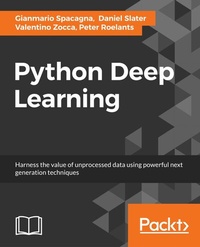
Python Deep Learning
Next generation techniques to revolutionize computer vision, AI, speech and data analysis
1. Auflage
Erschienen am 3. Juni 2024
406 Seiten
978-1-78646-066-0 (ISBN)
Beschreibung

Take your machine learning skills to the next level by mastering Deep Learning concepts and algorithms using Python.Key Features - [*] Explore and create intelligent systems using cutting-edge deep learning techniques
- [*] Implement deep learning algorithms and work with revolutionary libraries in Python
- [*] Get real-world examples and easy-to-follow tutorials on Theano, TensorFlow, H2O and more
Book DescriptionWith an increasing interest in AI around the world, deep learning has attracted a great deal of public attention. Every day, deep learning algorithms are used broadly across different industries. The book will give you all the practical information available on the subject, including the best practices, using real-world use cases. You will learn to recognize and extract information to increase predictive accuracy and optimize results. Starting with a quick recap of important machine learning concepts, the book will delve straight into deep learning principles using Sci-kit learn. Moving ahead, you will learn to use the latest open source libraries such as Theano, Keras, Google's TensorFlow, and H20. Use this guide to uncover the difficulties of pattern recognition, scaling data with greater accuracy and discussing deep learning algorithms and techniques. Whether you want to dive deeper into Deep Learning, or want to investigate how to get more out of this powerful technology, you'll find everything inside. What you will learn - [*] Get a practical deep dive into deep learning algorithms
- [*] Explore deep learning further with Theano, Caffe, Keras, and TensorFlow
- [*] Learn about two of the most powerful techniques at the core of many practical deep learning implementations: Auto-Encoders and Restricted Boltzmann Machines
- [*] Dive into Deep Belief Nets and Deep Neural Networks
- [*] Discover more deep learning algorithms with Dropout and Convolutional Neural Networks
- [*] Get to know device strategies so you can use deep learning algorithms and libraries in the real world
Who this book is forThis book is for Data Science practitioners as well as aspirants who have a basic foundational understanding of Machine Learning concepts and some programming experience with Python. A mathematical background with a conceptual understanding of calculus and statistics is also desired.
- [*] Implement deep learning algorithms and work with revolutionary libraries in Python
- [*] Get real-world examples and easy-to-follow tutorials on Theano, TensorFlow, H2O and more
Book DescriptionWith an increasing interest in AI around the world, deep learning has attracted a great deal of public attention. Every day, deep learning algorithms are used broadly across different industries. The book will give you all the practical information available on the subject, including the best practices, using real-world use cases. You will learn to recognize and extract information to increase predictive accuracy and optimize results. Starting with a quick recap of important machine learning concepts, the book will delve straight into deep learning principles using Sci-kit learn. Moving ahead, you will learn to use the latest open source libraries such as Theano, Keras, Google's TensorFlow, and H20. Use this guide to uncover the difficulties of pattern recognition, scaling data with greater accuracy and discussing deep learning algorithms and techniques. Whether you want to dive deeper into Deep Learning, or want to investigate how to get more out of this powerful technology, you'll find everything inside. What you will learn - [*] Get a practical deep dive into deep learning algorithms
- [*] Explore deep learning further with Theano, Caffe, Keras, and TensorFlow
- [*] Learn about two of the most powerful techniques at the core of many practical deep learning implementations: Auto-Encoders and Restricted Boltzmann Machines
- [*] Dive into Deep Belief Nets and Deep Neural Networks
- [*] Discover more deep learning algorithms with Dropout and Convolutional Neural Networks
- [*] Get to know device strategies so you can use deep learning algorithms and libraries in the real world
Who this book is forThis book is for Data Science practitioners as well as aspirants who have a basic foundational understanding of Machine Learning concepts and some programming experience with Python. A mathematical background with a conceptual understanding of calculus and statistics is also desired.
Alle Preise
Weitere Details
Weitere Ausgaben
Nachauflagen
Ivan Vasilev | Daniel Slater | Gianmario Spacagna
Python Deep Learning
Exploring deep learning techniques and neural network architectures with PyTorch, Keras, and TensorFlow
E-Book
06/2024
2. Auflage
Packt Publishing Limited
30,99 €
Als Download verfügbar
Personen
Zocca Valentino :
Valentino Zocca has a PhD degree and graduated with a Laurea in mathematics from the University of Maryland, USA, and University of Rome, respectively, and spent a semester at the University of Warwick. He started working on high-tech projects of an advanced stereo 3D Earth visualization software with head tracking at Autometric, a company later bought by Boeing. There he developed many mathematical algorithms and predictive models, and using Hadoop he automated several satellite-imagery visualization programs. He has worked as an independent consultant at the U.S. Census Bureau, in the USA and in Italy. Currently, Valentino lives in New York and works as an independent consultant to a large financial company.Spacagna Gianmario :
Gianmario Spacagna is a senior data scientist at Pirelli, processing sensors and telemetry data for internet of things (IoT) and connected-vehicle applications. He works closely with tire mechanics, engineers, and business units to analyze and formulate hybrid, physics-driven, and data-driven automotive models. His main expertise is in building ML systems and end-to-end solutions for data products. He holds a master's degree in telematics from the Polytechnic of Turin, as well as one in software engineering of distributed systems from KTH, Stockholm. Prior to Pirelli, he worked in retail and business banking (Barclays), cyber security (Cisco), predictive marketing (AgilOne), and did some occasional freelancing.Slater Daniel :
Daniel Slater started programming at age 11, developing mods for the id Software game Quake. His obsession led him to become a developer working in the gaming industry on the hit computer game series Championship Manager. He then moved into finance, working on risk- and high-performance messaging systems. He now is a staff engineer working on big data at Skimlinks to understand online user behavior. He spends his spare time training AI to beat computer games. He talks at tech conferences about deep learning and reinforcement learning; and the name of his blog is Daniel Slater's blog. His work in this field has been cited by Google.Roelants Peter :
Peter Roelants holds a master's in computer science with a specialization in AI from KU Leuven. He works on applying deep learning to a variety of problems, such as spectral imaging, speech recognition, text understanding, and document information extraction. He currently works at Onfido as a team leader for the data extraction research team, focusing on data extraction from official documents.
Valentino Zocca has a PhD degree and graduated with a Laurea in mathematics from the University of Maryland, USA, and University of Rome, respectively, and spent a semester at the University of Warwick. He started working on high-tech projects of an advanced stereo 3D Earth visualization software with head tracking at Autometric, a company later bought by Boeing. There he developed many mathematical algorithms and predictive models, and using Hadoop he automated several satellite-imagery visualization programs. He has worked as an independent consultant at the U.S. Census Bureau, in the USA and in Italy. Currently, Valentino lives in New York and works as an independent consultant to a large financial company.Spacagna Gianmario :
Gianmario Spacagna is a senior data scientist at Pirelli, processing sensors and telemetry data for internet of things (IoT) and connected-vehicle applications. He works closely with tire mechanics, engineers, and business units to analyze and formulate hybrid, physics-driven, and data-driven automotive models. His main expertise is in building ML systems and end-to-end solutions for data products. He holds a master's degree in telematics from the Polytechnic of Turin, as well as one in software engineering of distributed systems from KTH, Stockholm. Prior to Pirelli, he worked in retail and business banking (Barclays), cyber security (Cisco), predictive marketing (AgilOne), and did some occasional freelancing.Slater Daniel :
Daniel Slater started programming at age 11, developing mods for the id Software game Quake. His obsession led him to become a developer working in the gaming industry on the hit computer game series Championship Manager. He then moved into finance, working on risk- and high-performance messaging systems. He now is a staff engineer working on big data at Skimlinks to understand online user behavior. He spends his spare time training AI to beat computer games. He talks at tech conferences about deep learning and reinforcement learning; and the name of his blog is Daniel Slater's blog. His work in this field has been cited by Google.Roelants Peter :
Peter Roelants holds a master's in computer science with a specialization in AI from KU Leuven. He works on applying deep learning to a variety of problems, such as spectral imaging, speech recognition, text understanding, and document information extraction. He currently works at Onfido as a team leader for the data extraction research team, focusing on data extraction from official documents.
Inhalt
Table of Contents - Machine Learning: An Introduction
- Neural Networks
- Deep Learning fundamentals
- Feature learning
- Image recognition
- Recurrent neural networks and languages models
- Deep Learning for board games
- Deep learning for computer Games
- Anomaly detection
- Building a Production-ready Intrusion Detection System
- Neural Networks
- Deep Learning fundamentals
- Feature learning
- Image recognition
- Recurrent neural networks and languages models
- Deep Learning for board games
- Deep learning for computer Games
- Anomaly detection
- Building a Production-ready Intrusion Detection System

