

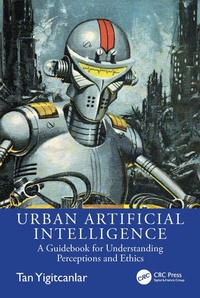
Urban Artificial Intelligence
A Guidebook for Understanding Perceptions and Ethics
1. Auflage
Erschienen am 12. Dezember 2024
414 Seiten
978-1-040-26459-1 (ISBN)
Beschreibung

This volume thoroughly explores the perceptions and ethical considerations surrounding urban artificial intelligence (AI). Tan Yigitcanlar delves into the complex public and professional views on AI, offering invaluable insights for policymakers, urban planners, and developers.
As the world rapidly advances technologically, the role of AI has become increasingly significant. AI's transformative power spans various sectors, revolutionising how we operate and innovate in fields such as healthcare, finance, agriculture, and space exploration. Despite its wide-reaching impact, the integration of AI into urban planning and development remains relatively underexplored. This is surprising given AI's immense potential to revolutionise urban design, management, and experience. Comprising eight comprehensive and insightful chapters, this book examines AI's role in urban contexts, including its applications, public perceptions, and ethical implications. The first part of the guidebook delves into varied perceptions of AI within different urban sectors, presenting detailed perception analyses on AI's role in urban planning, local government services, disaster management, and the construction industry. The second part shifts focus to the ethical implications and responsible implementation of AI in urban settings. It provides frameworks and strategies to ensure AI technologies contribute positively to urban development while mitigating potential risks and ethical concerns.
This volume, alongside its companion Urban Artificial Intelligence: A Guidebook for Understanding Concepts and Technologies, offers a holistic view of Urban Artificial Intelligence. Together, these books provide essential insights for urban planners, policymakers, researchers, and anyone interested in AI and urban development, guiding responsible AI integration to foster smarter, more sustainable, and equitable urban environments.
As the world rapidly advances technologically, the role of AI has become increasingly significant. AI's transformative power spans various sectors, revolutionising how we operate and innovate in fields such as healthcare, finance, agriculture, and space exploration. Despite its wide-reaching impact, the integration of AI into urban planning and development remains relatively underexplored. This is surprising given AI's immense potential to revolutionise urban design, management, and experience. Comprising eight comprehensive and insightful chapters, this book examines AI's role in urban contexts, including its applications, public perceptions, and ethical implications. The first part of the guidebook delves into varied perceptions of AI within different urban sectors, presenting detailed perception analyses on AI's role in urban planning, local government services, disaster management, and the construction industry. The second part shifts focus to the ethical implications and responsible implementation of AI in urban settings. It provides frameworks and strategies to ensure AI technologies contribute positively to urban development while mitigating potential risks and ethical concerns.
This volume, alongside its companion Urban Artificial Intelligence: A Guidebook for Understanding Concepts and Technologies, offers a holistic view of Urban Artificial Intelligence. Together, these books provide essential insights for urban planners, policymakers, researchers, and anyone interested in AI and urban development, guiding responsible AI integration to foster smarter, more sustainable, and equitable urban environments.
Rezensionen / Stimmen
Urban Artificial Intelligence: A Guidebook for Understanding Perceptions and Ethics is a must-read for academics and professionals in urban-themed research. This book examines how AI is perceived by the public and the ethical challenges it presents in urban contexts. By filling crucial knowledge gaps, it supports policymakers and experts in responsibly implementing AI to build smart and connected communities. It's an invaluable resource for shaping the agenda of urban AI and for a brighter future.Xinyue Ye, Texas A&M University, USA
In an increasingly digital world, it is critical urban planners and governments consider the role of AI in supporting the better planning of our cities. In this second volume, Urban Artificial Intelligence: A Guidebook for Understanding Perceptions and Ethics, Prof Tan Yigitcanlar has produced a comprehensive and timely guidebook which can assist both urban researchers and practitioners to understand the opportunities and pitfalls of AI. Specifically, this volume focuses on understanding the important dimensions of user perceptions and ethical use of AI in urban planning and development.
Chris Pettit, Director, University of New South Wales, Australia
Yigitcanlar's new book, Urban Artificial Intelligence: A Guidebook for Understanding Perceptions and Ethics, fills a crucial gap in knowledge, by fleshing out the complex issue of responsible urban AI in theory and practice. The book covers a wide range of important issues and domains, ranging from the construction sector to local governments and disaster management, convincingly showing how AI is becoming a core element of cities' governance and, thus, of their very future.
Federico Cugurullo, Trinity College Dublin, Ireland
Weitere Details
Auflage
1. Auflage
Sprache
Englisch
Verlagsort
London
Großbritannien
Verlagsgruppe
Taylor & Francis Ltd
Zielgruppe
Für höhere Schule und Studium
Für Beruf und Forschung
Illustrationen
92 Tables, black and white; 46 Halftones, black and white; 46 Illustrations, black and white
Dateigröße
18,05 MB
ISBN-13
978-1-040-26459-1 (9781040264591)
Copyright in bibliographic data and cover images is held by Nielsen Book Services Limited or by the publishers or by their respective licensors: all rights reserved.
Schweitzer Klassifikation
Weitere Ausgaben
Andere Ausgaben

Buch
12/2024
1. Auflage
CRC Press
70,90 €
Versand in 10-20 Tagen
Buch
12/2024
1. Auflage
CRC Press
188,40 €
Versand in 10-20 Tagen
Person
Tan Yigitcanlar is a globally renowned Australian researcher and author in urban studies, technology, and planning, and was acknowledged as one of the top 1% of scientists worldwide by Clarivate in 2023. He serves as a Professor of Urban Studies and Planning at Queensland University of Technology's School of Architecture and Built Environment in Brisbane, Australia.
Inhalt
Part 1 Perceptions on Urban Artificial Intelligence
Chapter 1 ? Perceptions on Urban Artificial Intelligence in Urban Planning and Development
Chapter 2 ? Perceptions on Artificial Intelligence in Local Government Services
Chapter 3 ? Perceptions on Artificial Intelligence in Urban Disaster Management
Chapter 4 ? Perceptions on Artificial Intelligence in the Construction Industry
Part 2 Responsible Urban Artificial Intelligence
Chapter 5 ? Responsible Local Government Artificial Intelligence
Chapter 6 ? Conceptual Framework of Responsible Urban Artificial Intelligence
Chapter 7 ? Assessment Framework of RespoDevelopment Goalsnsible Urban Artificial Intelligence
Chapter 8 ? Artificial Intelligence and Sustainable
Chapter 1 ? Perceptions on Urban Artificial Intelligence in Urban Planning and Development
Chapter 2 ? Perceptions on Artificial Intelligence in Local Government Services
Chapter 3 ? Perceptions on Artificial Intelligence in Urban Disaster Management
Chapter 4 ? Perceptions on Artificial Intelligence in the Construction Industry
Part 2 Responsible Urban Artificial Intelligence
Chapter 5 ? Responsible Local Government Artificial Intelligence
Chapter 6 ? Conceptual Framework of Responsible Urban Artificial Intelligence
Chapter 7 ? Assessment Framework of RespoDevelopment Goalsnsible Urban Artificial Intelligence
Chapter 8 ? Artificial Intelligence and Sustainable
