

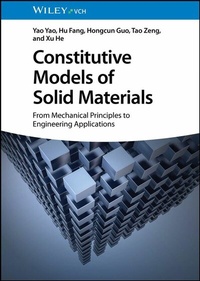
Constitutive Models of Solid Materials
From Mechanical Principles to Engineering Applications
1. Auflage
Erschienen am 27. März 2026
304 Seiten
978-3-527-85350-2 (ISBN)
Beschreibung

Covers a wide range of essential concepts and skills, from continuum mechanics to advanced constitutive modeling, addressing the needs of both academics and professionals.
Weitere Details
Weitere Ausgaben
Andere Ausgaben
Yao Yao | Hu Fang | Hongcun Guo
Constitutive Models of Solid Materials
From Mechanical Principles to Engineering Applications
Buch
05/2026
1. Auflage
Wiley-VCH
149,00 €
Versand in 5-7 Tagen
Personen
Prof. Yao Yao has long been engaged in the research of mechanical properties of materials and disaster prevention of engineering structures under extreme loads. His research interests include engineering material constitution, fatigue and damage under multi-physical field, new chip and electronic packaging materials and structural performance, research and development of new green building materials and disaster prevention and mitigation of high temperature structures, flexible electronic devices, etc.
Dr. Hu Fang is mainly engaged in the development of high-temperature damage constitutive models for solid materials, the research on material fracture and damage theory, and the research on the mechanical properties of composite material interfaces.
Dr. Hongcun Guo's research focuses on the mechanical behavior of green building materials, the high-temperature mechanical properties of ultra-high performance concrete (UHPC), and the development of constitutive models.
Dr. Tao Zeng focuses on research related to underground engineering, including rock mechanics and the development of micromechanical models of rock materials. Dr. Zeng currently serves as a council member of the Shaanxi Society for Rock Mechanics and Engineering.
Dr. Xu He is mainly engaged in multi-scale modeling of mechanical properties, constitutive behavior and failure processes of advanced materials under extreme loads, as well as related computational mechanics and numerical modeling.
Dr. Hu Fang is mainly engaged in the development of high-temperature damage constitutive models for solid materials, the research on material fracture and damage theory, and the research on the mechanical properties of composite material interfaces.
Dr. Hongcun Guo's research focuses on the mechanical behavior of green building materials, the high-temperature mechanical properties of ultra-high performance concrete (UHPC), and the development of constitutive models.
Dr. Tao Zeng focuses on research related to underground engineering, including rock mechanics and the development of micromechanical models of rock materials. Dr. Zeng currently serves as a council member of the Shaanxi Society for Rock Mechanics and Engineering.
Dr. Xu He is mainly engaged in multi-scale modeling of mechanical properties, constitutive behavior and failure processes of advanced materials under extreme loads, as well as related computational mechanics and numerical modeling.
Inhalt
Chapter 01 Overview of Continuum Mechanics
Chapter 02 Fundamentals of Elasticity Theory
Chapter 03 Plastic Constitutive Theory
Chapter 04 Damage constitutive principles and methods
Chapter 05 Basics of Micromechanics
Chapter 06 Numerical Implementation of Constitutive Relations
Chapter 07 Artificial Intelligence in Constitutive Research
Chapter 08 Tensile Creep Failure Mechanism and Theoretical
Chapter 09 Unified creep-plasticity model for high strength steel and solder alloys
Chapter 10 A multiscale framework for the constitutive modeling of rock
Chapter 11Development of a high temperature constitutive model for concrete based on elastoplastic theory
Chapter 02 Fundamentals of Elasticity Theory
Chapter 03 Plastic Constitutive Theory
Chapter 04 Damage constitutive principles and methods
Chapter 05 Basics of Micromechanics
Chapter 06 Numerical Implementation of Constitutive Relations
Chapter 07 Artificial Intelligence in Constitutive Research
Chapter 08 Tensile Creep Failure Mechanism and Theoretical
Chapter 09 Unified creep-plasticity model for high strength steel and solder alloys
Chapter 10 A multiscale framework for the constitutive modeling of rock
Chapter 11Development of a high temperature constitutive model for concrete based on elastoplastic theory
