

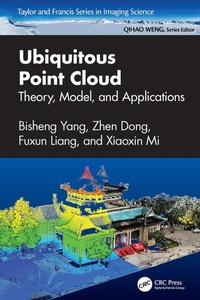
Ubiquitous Point Cloud
Theory, Model, and Applications
1. Auflage
Erschienen am 4. Dezember 2024
250 Seiten
978-1-040-26127-9 (ISBN)
Beschreibung

Point clouds from LiDAR and photogrammetry are vital and vast sources of geospatial information besides remote sensing imagery. This book provides the latest theory and methodology for point cloud processing with AI to better serve earth observation, 3D vision, autonomous driving, smart city, and geospatial information applications. It covers various aspects of 3D geospatial information, including data capturing, fusing, geocomputing, modeling, and vast downstream applications. With the inclusion of numerous illustrations, diagrams, and practical applications, readers will better understand the point cloud, and its technical challenges, and learn how to utilize point cloud in different fields.
Features
Provides in-depth point cloud processing pipeline, cutting-edge theory, and technology with AI.
Includes many specific applications of point cloud in the geospatial field.
Offers a comprehensive step-by-step guide from theory to application in point cloud processing.
Includes ample supplementary materials including datasets, tools, and other online resources.
Helps readers across many disciplines, from geospatial to engineering, to understand the vast application of point clouds and how to further generate new ideas and innovative thoughts.
This book is an excellent resource for researchers, academics, students, and professionals in a variety of fields including Geomatics, Remote Sensing, Cartography and Geographic Information Systems, Data Science, Geography, Earth Science, and more.
Features
Provides in-depth point cloud processing pipeline, cutting-edge theory, and technology with AI.
Includes many specific applications of point cloud in the geospatial field.
Offers a comprehensive step-by-step guide from theory to application in point cloud processing.
Includes ample supplementary materials including datasets, tools, and other online resources.
Helps readers across many disciplines, from geospatial to engineering, to understand the vast application of point clouds and how to further generate new ideas and innovative thoughts.
This book is an excellent resource for researchers, academics, students, and professionals in a variety of fields including Geomatics, Remote Sensing, Cartography and Geographic Information Systems, Data Science, Geography, Earth Science, and more.
Weitere Details
Reihe
Auflage
1. Auflage
Sprache
Englisch
Verlagsort
London
Großbritannien
Verlagsgruppe
Taylor & Francis Ltd
Zielgruppe
Für Beruf und Forschung
Für höhere Schule und Studium
Illustrationen
55 Tables, black and white; 41 Line drawings, color; 5 Line drawings, black and white; 51 Halftones, color; 1 Halftones, black and white; 92 Illustrations, color; 6 Illustrations, black and white
ISBN-13
978-1-040-26127-9 (9781040261279)
Copyright in bibliographic data and cover images is held by Nielsen Book Services Limited or by the publishers or by their respective licensors: all rights reserved.
Schweitzer Klassifikation
Weitere Ausgaben
Andere Ausgaben
Buch
ca. 06/2026
1. Auflage
Taylor & Francis
68,50 €
Noch nicht erschienen
Buch
12/2024
1. Auflage
CRC Press
194,50 €
Versand in 10-20 Tagen
Personen
Dr. Bisheng Yang is a full professor in LidAR and photogrammetry at Wuhan University, China, and the director of State Key Laboratory of Information Engineering in Surveying, Mapping and Remote Sensing (LIESMARS). His research expertise includes LiDAR and UAV photogrammetry, point cloud processing, GeoAI, and GIS and remote sensing applications. He has been Co-Chair of Point Cloud Processing Workgroup in the Photogrammetry Commission of the International Society for Photogrammetry and Remote Sensing (ISPRS) since 2016. He also serves as Associate Editor of the ISPRS Journal of Photogrammetry and Remote Sensing. He is the recipient of many academic awards including the Carl Pulfrich Award (2019), and the Smart City Technology Innovation Award Gold Medal (2023).
Prof. Dr. Zhen Dong honorably received his B.E. and Ph.D. degrees in remote sensing and photogrammetry from Wuhan University in 2011 and 2018, respectively. After his graduation, he worked as a post-doctoral researcher at LIESMARS, Wuhan University for two years. In 2022, he was promoted to full professor at LIESMARS, Wuhan University for his outstanding works in intelligent spatial understanding. His research interest lies in the field of 3D computer vision, particularly 3D reconstruction, scene understanding, and point cloud processing, as well as their applications in intelligent transportation systems, digital twin cities, urban sustainable development, and robotics.
Dr. Fuxun Liang received his Ph.D. degree in remote sensing and photogrammetry from Wuhan University. He is currently a postdoctoral fellow in the LIESMARS at Wuhan University. His research interest lies in the field of point cloud processing and its applications in building and energy.
Dr Xiaoxin Mi received her B.E. and Ph.D. degrees in remote sensing and photogrammetry from Wuhan University in 2016 and 2023, respectively. She is currently a post-doctoral fellow at Wuhan University of Technology. Her research interests include point cloud classification and segmentation, and road infrastructure modeling.
Prof. Dr. Zhen Dong honorably received his B.E. and Ph.D. degrees in remote sensing and photogrammetry from Wuhan University in 2011 and 2018, respectively. After his graduation, he worked as a post-doctoral researcher at LIESMARS, Wuhan University for two years. In 2022, he was promoted to full professor at LIESMARS, Wuhan University for his outstanding works in intelligent spatial understanding. His research interest lies in the field of 3D computer vision, particularly 3D reconstruction, scene understanding, and point cloud processing, as well as their applications in intelligent transportation systems, digital twin cities, urban sustainable development, and robotics.
Dr. Fuxun Liang received his Ph.D. degree in remote sensing and photogrammetry from Wuhan University. He is currently a postdoctoral fellow in the LIESMARS at Wuhan University. His research interest lies in the field of point cloud processing and its applications in building and energy.
Dr Xiaoxin Mi received her B.E. and Ph.D. degrees in remote sensing and photogrammetry from Wuhan University in 2016 and 2023, respectively. She is currently a post-doctoral fellow at Wuhan University of Technology. Her research interests include point cloud classification and segmentation, and road infrastructure modeling.
Inhalt
Part I: Introduction. 1. Introduction to Point Cloud. 2. Ubiquitous Point Cloud. Part II: Introduction of Fusion and Enhancement. 3. Multiview Point Clouds Registration. 4. Cross-Platform Points Clouds Registration. 5. Point Clouds and Panoramic Images Registration. Part III: Introduction of Detection and Segmentation. 6. 3D Object Detection. 7. Point Cloud Semantic Segmentation. 8. Point Cloud Instance Segmentation. Part IV: Introduction of Modeling and Analysis. 9. 3D Terrain Modeling. 10. 3D Building Reconstruction. 11. 3D Road Reconstruction. Part V: Software and Applications. 12. Point Cloud Processing Software - Point2Model. 13. Applications of Uniquitous Point Cloud. 14. Conclusion and Outlooks.
