

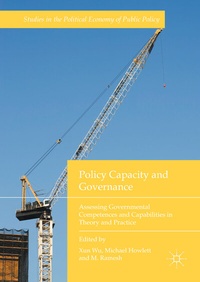
Policy Capacity and Governance
Beschreibung

Weitere Details
Weitere Ausgaben
Andere Ausgaben
Personen
Michael Howlett is Burnaby Mountain Chair in the Department of Political Science at Simon Fraser University, Canada, and Yong Pung How Chair Professor at the Lee Kuan Yew School of Public Policy at the National University of Singapore.
M Ramesh is Professor at the Lee Kuan Yew School of Public Policy at the National University of Singapore.
WU Xun is Professor in the Division of Social Science and the Division of Environment at the Hong Kong University of Science and Technology. He is also an Adjunct Professor at the Lee Kuan Yew School of Public Policy at the National University of Singapore.
Inhalt
1: Policy Capacity: Conceptual Framework and Essential Components; Wu Xun, M Ramesh and Michael Howlett.- Part I - Conceptual and Measurement Issues.- 2: Policy Capacity in Public Administration; B. Guy Peters.- 3: Policy Analytical Capacity: The Supply and Demand for Policy Analysis in Government; Michael Howlett.- 4: Measuring Policy Capacity through Governance Indices; Kris Hartley and Jingru Zhang.- 5: Measuring Policy Analytical Capacity for the Environment: A Case for Engaging New Actors; Angel Hsu.- Part II - Theoretical and Empirical Issues.- 6: Innovation and the State: Towards an Evolutionary Theory of State Capacity; Erkki Karo and Reiner Kattel.- 7: The Role of Analysts in Public Agencies: Toward an Empirically Grounded Typology; Karol Olejniczak, Pawel Sliwowski and Rafal Trzcinski.- 8: Policy Analytical Practice Investigated: Exploring Sectoral Patterns in Use of Policy Analytical Techniques; Ellen Fobé, Valerie Pattyn and Marleen Brans.- 9: Government's Credible Accountability and Strategic Policy Capacity: Evidence from the Asian NICs of Taiwan, South Korea, Malaysia, and Singapore; Fiona Yap.- 10: Does Political Legitimacy Matter for Policy Capacity? A Cross-National Study of Perceived Legitimacy; Honorata Mazepus.- 11: Interest Groups and Policy Capacity: Modes of Engagement, Policy Goods and Networks; Carsten Daugbjerg, Bert Fraussen and Darren Halpin.- Part III - Case Studies.- 12: Building Organizational Political Capacity through Policy Learning: Communicating with Citizens on Health and Safety in the UK; Claire A. Dunlop.- 13: Exploring Capacity for Strategic Policy Work: Water Policy in Australia; Yvette Bettini and Brian Head.- 14: Philanthropic Foundations in the City Policy Process: a Perspective on Policy Capacity from the United States; Madeleine Pill.- 15: Policy Capacity within a Federation: The Case of Australia; Scott Brenton.- 16: Dynamic Mechanisms for Resolving Collective Incidents in China: A Policy Capacity Analysis; Jieren Hu, Guoqin Wang and Jingyan Fei.- 17: Policy-Related Expertise and Policy Work in Czech Political Parties: Theory and Methods; Martin Polasek, Vilém Novotny, and Michel Perottino.- 18: The Dynamic Nature of Policy Capacity: Internet Policy in Italy, Belarus and Russia; Nina Belyaeva.-
