

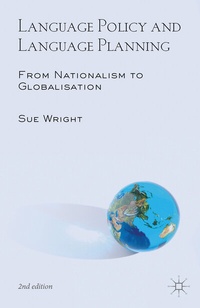
Language Policy and Language Planning
Beschreibung

Rezensionen / Stimmen
"The intended readership of the book is broad, and may include sociolinguists, diachronic linguistics researchers, general language researchers, and anyone who shows an interest in investigations into language problems, language policy, and language planning. . the book remains a great contribution to the area of language policy and language planning and deserves my wholehearted recommendation." (Haoda Feng, Language in Society, Vol. 48 (2), April, 2019)
Weitere Details
Weitere Ausgaben
Andere Ausgaben
Person
Sue Wright is Research Professor at the University of Portsmouth, UK. She is co-editor of Sociolinguistica and the Language and Globalization book series. She is the author of numerous publications on the linguistic dimension of nation building, globalisation, democracy and migration and on the linguistic effects of technological developments in communication.
Inhalt
PART I: COMMUNITY AND THE ROLE OF NATIONAL LANGUAGE
2. From Language Continuum to Linguistic Mosaic: European Language Communities from the Feudal Period to the Age of Nationalism
3. Language Planning in State Nations and Nation States
4. Nation Building in the Wake of Colonialism: Old Concepts in New Settings
PART II: TRANSCENDENCE AND LANGUAGE LEARNING
5. Transcending the Group: Languages of Contact and Lingua Francas
6. French: The Rise and Fall of a Prestige Lingua Franca
7. English: From Language of Empire to Language of Globalisation
8. Lingua Francas for the New Millennium
9. Globalisation and Rethinking the Concept of Language
PART III: RENAISSANCE AND REVITALISATION IN SMALL LANGUAGE COMMUNITIES
10. New Discourse, New Legal Instruments and a New Political Context for Minorities and their Languages
11 . New Polities and New Nation Building
12 . Endangered Languages
13. Conclusion: Community and Transcendence
