

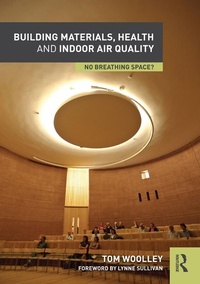
Building Materials, Health and Indoor Air Quality
No Breathing Space?
Erschienen am 4. Oktober 2016
230 Seiten
978-1-317-38976-7 (ISBN)
Beschreibung

The impact of building materials and construction methods on the health and wellbeing of occupants is often underestimated. This book is an essential guide to understanding and avoiding hazardous materials and poor air quality in buildings. The author covers a range of issues beginning with an explanation of how buildings work and how this influences the health of occupants and users. The text covers:
Ventilation, air conditioning and indoor air quality
Damp and mould
Asthma and respiratory problems
Cancer and endocrine disorders
Radiation and radon
Hazardous building materials used in construction
Indoor air quality and emissions
Ecological alternatives and approaches and remedies for 'sick' buildings
The book also guides the reader through the confusing world of regulations, EU and international guidelines and certifications, and provides a critical analysis of different theories of healthy buildings and philosophies.
Written in a clear and accessible style, this book provides indispensable advice and information to anyone wishing to better understand healthy buildings and materials. It is essential reading for architects, surveyors, public health professionals, facilities managers and environmentalists.
Ventilation, air conditioning and indoor air quality
Damp and mould
Asthma and respiratory problems
Cancer and endocrine disorders
Radiation and radon
Hazardous building materials used in construction
Indoor air quality and emissions
Ecological alternatives and approaches and remedies for 'sick' buildings
The book also guides the reader through the confusing world of regulations, EU and international guidelines and certifications, and provides a critical analysis of different theories of healthy buildings and philosophies.
Written in a clear and accessible style, this book provides indispensable advice and information to anyone wishing to better understand healthy buildings and materials. It is essential reading for architects, surveyors, public health professionals, facilities managers and environmentalists.
Rezensionen / Stimmen
"The book offers a phenomenally well-researched and worrying insight into the indoor air quality issues that hazardous substances create."-Health and Safety at Work, March 2017 As industry and regulation increasingly focus on energy and carbon saving to fulfil our environmental responsibility, this book is a timely reminder that the quality of the buildings we occupy has to be given the same importance as energy performance. In this book Professor Woolley revisits his previous excellent research in toxicity and materials by delivering a book that will be vital in addressing the issues of health and our built environment for practitioners and students alike.
Alison Pooley, Anglia Ruskin University
For quite some time issues of the outdoor environment and climate change have overshadowed the issue of indoor air quality. Woolley presents a range of evidence showing that the indoor air quality problem remains highly pertinent, and largely ignored not only by public authorities and the construction industry, but also unfortunately by several health - and environmental organizations.
Modern solutions for energy efficient buildings, such as the passive house, potentially amplify this problem through increased focus on impermeability, new insulation materials and balanced ventilation system with heat recovery.
But Woolley shows us the way forward. He documents with great experience and thoroughness that there is no contradiction between high energy efficiency and good indoor air quality. Proposed solutions include the use of low-emitting materials, hygroscopic surfaces and natural ventilation.
This knowledge is deeply valuable to anyone interested in indoor air quality.
Bjorn Berge, Gaia Architects
A powerful plea to to make better choices about the products we use and the way we build. This book is a wake-up call for anyone who believes it possible to deliver healthy buildings without challenging the dependence on complex industrial chemicals.
Gary Newman, Alliance for Sustainable Building Products
"The book offers a phenomenally well-researched and worrying insight into the indoor air quality issues that hazardous substances create."
Health and Safety at Work, March 2017
Weitere Details
Sprache
Englisch
Verlagsort
London
Großbritannien
Verlagsgruppe
Taylor & Francis Ltd
Zielgruppe
Für höhere Schule und Studium
Für Beruf und Forschung
Illustrationen
23 s/w Tabellen, 7 s/w Zeichnungen
23 Tables, black and white; 7 Line drawings, black and white
Dateigröße
1,82 MB
ISBN-13
978-1-317-38976-7 (9781317389767)
Copyright in bibliographic data and cover images is held by Nielsen Book Services Limited or by the publishers or by their respective licensors: all rights reserved.
Schweitzer Klassifikation
Weitere Ausgaben
Andere Ausgaben
Buch
09/2016
1. Auflage
Routledge
87,20 €
Versand in 10-20 Tagen
Buch
09/2016
1. Auflage
Routledge
267,29 €
Versand in 10-20 Tagen
Person
Tom Woolley is an architect and environmental consultant in County Down, Northern Ireland. He has been a practising architect and academic, teaching at UK institutions including Strathclyde University, Hull School of Architecture, Queens University Belfast, University of Central Lancashireand the Centre for Alternative Technology. Heco-authored the Green Building Handbook andis author ofNatural Building, Hemp Lime Construction and Low Impact Building.
Inhalt
1. Introduction
2. Volatile Organic Compound Emissions
3. Emissions from materials - Why do we need to use hazardous chemicals?
4. Cancer, Carcinogens and Building Materials
5. Other Hazards and Radiation
6. Hazardous Materials to be avoided and why
7. Mould, Damp, Fuel Poverty and Breathability
8. Ventilation and a critique of Passiv Haus
9. Dealing with problems in existing buildings
10. Healthy building theories
11. How to build healthier buildings
12. Policy Issues for Healthy Buildings - A critical analysis
2. Volatile Organic Compound Emissions
3. Emissions from materials - Why do we need to use hazardous chemicals?
4. Cancer, Carcinogens and Building Materials
5. Other Hazards and Radiation
6. Hazardous Materials to be avoided and why
7. Mould, Damp, Fuel Poverty and Breathability
8. Ventilation and a critique of Passiv Haus
9. Dealing with problems in existing buildings
10. Healthy building theories
11. How to build healthier buildings
12. Policy Issues for Healthy Buildings - A critical analysis
