

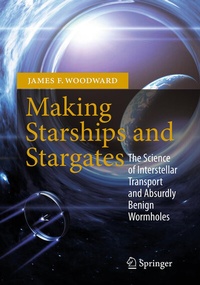
Making Starships and Stargates
Beschreibung

There may now be a way to achieve these lofty objectives. "Making Starships and Stargates" will have three parts. The first will deal with information about the theories of relativity needed to understand the predictions of the effects that make possible the "propulsion" techniques, and an explanation of those techniques. The second will deal with experimental investigations into the feasibility of the predicted effects; that is, do the effects exist and can they be applied to propulsion? The third part of the book - the most speculative - will examine the question: what physics is needed if weare to make wormholes and warp drives? Is such physics plausible? And how might we go about actually building such devices? This book pulls all of that material together from various sources, updates and revises it, and presents it in a coherent form so that those interested will be able to find everything of relevance all in one place.
Rezensionen / Stimmen
"The author looks into published scientific papers in those topics on the possibility of travel at light-speed using different methods, looking into the physics and mathematics there etc. . the book also has excellent bibliography which can guide you either in the more popular books direction or to some more technical books. I found that it was interesting, well written and followed a logical structure so you see how the different principles and concepts are all necessary for it." (AstroMadness.com, October, 2016)
Weitere Details
Weitere Ausgaben
Andere Ausgaben
Person
Dr. James F. Woodward is a professor of history emeritus and adjunct professor of physics at California State University Fullerton.
Jim earned bachelor's and master's degrees in physics at Middlebury College and New York University (respectively) in the 1960s. From his undergraduate days, his chief interest was in gravitation. For his Ph.D., he changed to the history of science, writing a dissertation on the history of attempts to deal with the problem of "action-at-a-distance" in gravity theory from the 17th to the early 20th centuries (Ph.D., University of Denver, 1972).
On completion of his graduate studies, Jim took a teaching job in the history of science at California State University Fullerton (CSUF), where he has been ever since. Shortly after his arrival at CSUF, he established friendships with colleagues in the Physics Department who helped him set up a small-scale, table-top experimental research program doing offbeat experiments related to gravitation - experiments which continue to this day. In 1980, the faculty of the Physics Department elected Jim to an adjunct professorship in the department in recognition of his ongoing research.
Inhalt
Foreword by John Cramer.- Part I: Inertia, Mach's Principle, and Mach Effects.- Chapter 1: The Principle of Relativity and the Origin of Inertia.- Chapter 2: Mach's Principle.- Chapter 3: Mach Effects.- Part II: Do Mach Effect Exist?.- Chapter 4: Getting in Touch with Reality.- Chapter 5: In Reality's Grip.- Part III: Exotic Physics, Spacetime Transport, and Mach Effects.- Chapter 6: Advanced Propulsion in the Era of Wormhole Physics.- Chapter 7: Where Do We Find Exotic Matter?.- Chapter 8: Making the ADM Electron Plausible.- Chapter 9: Making Stargates.- Chapter 10: The Road Ahead.- Select Bibliography.- Index.
