

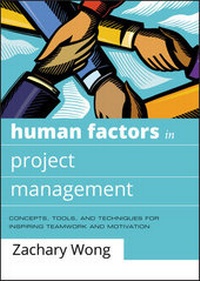
Human Factors in Project Management
Concepts, Tools, and Techniques for Inspiring Teamwork and Motivation
Erschienen am 29. Dezember 2010
368 Seiten
978-1-118-04757-6 (ISBN)
Beschreibung

In Human Factors in Project Management, author ZacharyWong--a noted trainer and acclaimed leader of more than 250project teams--provides a summary of "people-based"management skills and techniques that can be applied whenworking in a team environment. This comprehensive resource bringstogether in one book new and current models in team motivation andintegrates the most significant concepts in team motivation andbehaviors into a single set of principles called "Human Factors."Wong shows how these factors can be applied to the most challengingissues facing project managers today including
* Motivating a diverse workforce
* Facilitating team decisions
* Resolving interpersonal conflicts
* Managing difficult people
* Strengthening team accountability
* Communications
* Leadership
Rezensionen / Stimmen
"This book will be a benchmark for those of us seriously strivingto make the most of self-managed teams. Read this one with yournotepad at hand." --Norm Szydlowski, president and CEO, Colonial PipelineCompany "An essential business guide for those committed to improvingteamwork. Dr. Wong evaluates management styles, leadership skills,and conflict resolution, emphasizing the critical importance ofpositive, mutually beneficial interactions among team members asthey pursue a common goal." --Elizabeth M. Whelan, president, American Council on Scienceand Health "Practical, insightful, and enlightening--a great resourcefor how teams should work and what to do if they don't." --Carol J. Henry, vice president, Industry PerformancePrograms, American Chemistry Council "This book is a great synthesis of many useful concepts and amust-read for anyone from the first-line supervisor to aCEO." --Jeet S. Bindra, president, Global Refining, Chevron "The days of the true autocrat are behind us. Here's today'show-to guide about leading and inspiring a team that cares abouteffort--and results!" --Stephen A. Lundin, president and CEO, Alta Bates SummitFoundation "Instead of a complex psychological methodology, HumanFactors in Project Management is easy to follow with techniquesthat are instantly useful in furthering personal influence andimproving project outcomes." --Jim O'Donnell, vice president, MSI Learning; projectmanagement instructor, UC Berkeley Extension and San FranciscoState University "Human factors are too often overlooked as the 'soft skills'that are actually essential to develop and grow high-performanceproject teams--not anymore according to the words of wisdomespoused by Dr. Zachary Wong." --Ray Ju, vice president programs, PMI Diversity SIG;leadership architect, Get IT LLCWeitere Details
Weitere Ausgaben
Andere Ausgaben
Zachary Wong
Human Factors in Project Management
Concepts, Tools, and Techniques for Inspiring Teamwork and Motivation
Buch
07/2007
Jossey-Bass
63,50 €
Versand in 10-20 Tagen
Person
The Author
Zachary Wong, Ph.D., is a manager at the Chevron Energy Technology Company in Richmond, California. He is a highly acclaimed instructor of human factors and team dynamics at the University of California at Berkeley Extension.
Inhalt
Acknowledgments.
The Author.
Introduction.
ONE: Emergence of Human Factors.
TWO: Human Factors and Team Dynamics in Project Management.
THREE: Key Elements of Team Performance: Content.
FOUR: Key Elements of Team Performance: Process.
FIVE: Key Elements of Team Performance: Behavior.
SIX: Secrets of Managing the Three Key Elements.
SEVEN: Key Stages of Team Development.
EIGHT: Moving the Team Forward: Facilitation Techniques.
NINE: Personal Space.
TEN: Team Conflicts.
ELEVEN: How Conflicts Affect Personal Space.
TWELVE: Expanding Your Space.
THIRTEEN: Managing Good and Bad Behaviors.
FOURTEEN: Raising Your Game.
FIFTEEN: Those Who Break Through Will Never Go Back.
SIXTEEN: Hearts and Minds of Human Factors.
SEVENTEEN: Personal Leadership: Putting It All Together.
Epilogue.
References.
Index.
chapter ONE Emergence of Human Factors For over two decades, the successful teachings and practices of Edward Deming, Joseph Juran, Quality Management, Total Quality Management, and Six Sigma have been key drivers in shaping business culture. They have helped improve business productivity and enabled change through greater strategic alignment, customer focus, and continuous process improvement. These concepts have greatly contributed to the global competitiveness and success of international companies. They have provided philosophies for effective strategic leadership, systematic methods for improving business processes, and tools for driving performance improvements. Most important, they have advanced the concepts of teamwork in organizational performance.
In the past three decades, business management has dramatically changed. Prior to 1970, management was predominantly top down, rules based, and autocratic. A militaristic philosophy was common. This changed as companies realized that when power was restricted to the top few, creativity and discretionary performance suffered. In the 1980s, team-based, values-driven organizations appeared. More employee participative philosophies were introduced. Companies were no longer driven by rules and autocrats but by systems and teams. They were still managed by rules, policies, and standard operating procedures. The effect was to standardize behaviors and shape people to fit processes. The visionary 1990s inspired a shared mission, vision, values, and objectives approach and opened the process for greater employee participation. With a shared vision and plan, people were considered in sync with the direction and priorities of management-a new shared ownership of objectives. But this shared ownership turned out to be insufficient, and new tools and processes to execute these objectives were needed. Enlightened companies soon recognized that old command-and-control processes did not work well with their shared strategies. Also, companies faced pressures of rising costs, product cycles, globalization, and a rapidly changing workforce and were forced to adopt a more distributed, leveraged system of operation. In other words, they had to make every employee count. A key enabler of this change was technology, which provided the connectivity and critical tools to make dramatic improvements in information sharing, work productivity, communications, and rate of change. Another key was building organizational capabilities around core businesses and technologies. These business developments resulted in a profound change in organizational structures and how work was being managed. The traditional hierarchical structure was replaced with natural teams, self-managed teams, cross-functional teams, employee networks, and project teams. A team operated as a group of people with shared objectives and processes and possessed complementary skills, knowledge, and experiences. Some of these team structures, such as project teams and cross-functional teams, were not necessarily new, but how the teams operated and the impact of these teams on organizations were far different and much more empowered than in the past to make changes. The team-based structure quickly became a norm in organizations. Businesses and projects benefited when people worked together well as a team. Successful team-based companies saw higher employee morale, innovation, and financial success. But creating a productive, sustainable team environment took more work. In addition to strategies and processes, a third need was identified: an improved system for managing people's behaviors. Modifying and adopting new behaviors to facilitate strategies and processes were not keeping pace with the structural changes that were occurring. Behavioral management was an intangible, the soft side of business. Yet it is critical to success. Companies knew this but did not know how to do it. In the past decade, the focus on strategies and processes has significantly shifted to team behaviors and project execution. It has been recognized that successful execution requires a stronger emphasis on people skills such as leadership and collaboration, and team behaviors around decision making, problem solving, and conflict resolution. To help, companies began personalizing their value statements by defining specific behaviors that supported those values. These values define how people will work together on a day-to-day basis. Companies have sought to build a community of workers dedicated to common behavioral norms (the GE Values, The Nokia Way and Values, the Chevron Way), cast as the things they believe in. They seek not just to get results but to get results the right way, meaning that people walk away feeling good about the project and themselves, including their relationships with others and their contributions to the team. Feelings and relationships are the motivating human factors that carry over into future projects. These motivating factors generate human energy and discretionary performance and produce sustained success. The new definition of success in project management is "getting results and feeling good about it." As Figure 1.1 shows, project success has two dimensions of performance. First is meeting project expectations. This means that the results meet project objectives, which includes being on time, on spec, and within budget. Second is meeting people's expectations: this means that values are respected, people feel fulfilled, and they succeed together as a team. High performance in one or the other is only partial success; true project success requires meeting both people and project expectations. Project managers lead both projects and people. We are in the midst of learning how best to manage employees in a changing global business environment. A team-based work environment still fits well in a rapidly changing global marketplace. However, there is a strong drive to maximize knowledge, skills, and behaviors across the enterprise. The focus on shaping workforce behaviors has resulted in greater profit sharing, individual and team incentives, greater team recognitions and awards, and employee development programs. With a new emphasis on team behaviors, human factors have emerged as a critical element. The study of human factors has extended beyond ergonomics and engineering and into team behaviors as it relates to organizational performance. Human factors are clearly a business issue today. The issue has grown in large part due to globalization and workforce reductions: employee downsizings, right sizing, rationalizing, optimizing, restructuring, delayering, and offshoring. These "ings" have reshaped how we work and reshaped our view of the work environment forever. These developments have changed not only the competitive landscape but also the human landscape: the relationship between employees and employer and how people behave on the job. Companies that recognize this change and respond to it successfully will be the winners. Figure 1.1 Project Success Organizational success will continue to depend on how people work and interact with each other. Human factors help by bringing effective behavioral elements into structure and process. The power of human factors is understanding motivation. How we motivate and develop people is determined by their talents and dynamics, as well as the competitive challenges of company objectives and strategies. When people understand each other and processes are in place to support them, enormous human energy and productivity are created. When they are in conflict or are forced to fit into processes, tremendous opportunity is lost. For example, a major movement in business today is to standardize and institutionalize processes to get the best and most efficient results. So companies continue to streamline, reengineer, right-size, and rationalize their enterprises to achieve superior business results for the shareholders. What this approach fails to recognize is that people are not standardized, and trying to force-fit people into standardized processes can limit success by limiting human creativity, motivation, and freedom to operate. Work becomes a compliant, punishable activity. When setting organizational standards, it is important to ask which human elements are being affected and which behaviors are critical for the execution of these standards. Respecting diversity and individuality are essential. For example, does a strict nine-to-five work schedule respect individual needs? Does placing employees in standardized work cubicles maximize employee performance and creativity? How will an open work environment affect people's values, personal stress, and emotions? Standardization is good as long as human factors are considered and integrated into these processes. Processes become best practices when they are aligned with business objectives, human elements, and the culture of the organization. That is why best practices in one organization are so difficult to adopt in other companies. In order for an organization to be successful, the human element must be factored into operational and management systems. When human factors are well integrated into the objectives, strategies, and processes of the organization, then people are engaged and performing at their best. The motivational power of human factors comes from meeting the intellectual and emotional needs of people, valuing people for who they are, and respecting the diversity of their backgrounds, cultures, and experiences. Project objectives need to align to processes, but they also need to align to people if projects are to be planned and executed successfully....
In the past three decades, business management has dramatically changed. Prior to 1970, management was predominantly top down, rules based, and autocratic. A militaristic philosophy was common. This changed as companies realized that when power was restricted to the top few, creativity and discretionary performance suffered. In the 1980s, team-based, values-driven organizations appeared. More employee participative philosophies were introduced. Companies were no longer driven by rules and autocrats but by systems and teams. They were still managed by rules, policies, and standard operating procedures. The effect was to standardize behaviors and shape people to fit processes. The visionary 1990s inspired a shared mission, vision, values, and objectives approach and opened the process for greater employee participation. With a shared vision and plan, people were considered in sync with the direction and priorities of management-a new shared ownership of objectives. But this shared ownership turned out to be insufficient, and new tools and processes to execute these objectives were needed. Enlightened companies soon recognized that old command-and-control processes did not work well with their shared strategies. Also, companies faced pressures of rising costs, product cycles, globalization, and a rapidly changing workforce and were forced to adopt a more distributed, leveraged system of operation. In other words, they had to make every employee count. A key enabler of this change was technology, which provided the connectivity and critical tools to make dramatic improvements in information sharing, work productivity, communications, and rate of change. Another key was building organizational capabilities around core businesses and technologies. These business developments resulted in a profound change in organizational structures and how work was being managed. The traditional hierarchical structure was replaced with natural teams, self-managed teams, cross-functional teams, employee networks, and project teams. A team operated as a group of people with shared objectives and processes and possessed complementary skills, knowledge, and experiences. Some of these team structures, such as project teams and cross-functional teams, were not necessarily new, but how the teams operated and the impact of these teams on organizations were far different and much more empowered than in the past to make changes. The team-based structure quickly became a norm in organizations. Businesses and projects benefited when people worked together well as a team. Successful team-based companies saw higher employee morale, innovation, and financial success. But creating a productive, sustainable team environment took more work. In addition to strategies and processes, a third need was identified: an improved system for managing people's behaviors. Modifying and adopting new behaviors to facilitate strategies and processes were not keeping pace with the structural changes that were occurring. Behavioral management was an intangible, the soft side of business. Yet it is critical to success. Companies knew this but did not know how to do it. In the past decade, the focus on strategies and processes has significantly shifted to team behaviors and project execution. It has been recognized that successful execution requires a stronger emphasis on people skills such as leadership and collaboration, and team behaviors around decision making, problem solving, and conflict resolution. To help, companies began personalizing their value statements by defining specific behaviors that supported those values. These values define how people will work together on a day-to-day basis. Companies have sought to build a community of workers dedicated to common behavioral norms (the GE Values, The Nokia Way and Values, the Chevron Way), cast as the things they believe in. They seek not just to get results but to get results the right way, meaning that people walk away feeling good about the project and themselves, including their relationships with others and their contributions to the team. Feelings and relationships are the motivating human factors that carry over into future projects. These motivating factors generate human energy and discretionary performance and produce sustained success. The new definition of success in project management is "getting results and feeling good about it." As Figure 1.1 shows, project success has two dimensions of performance. First is meeting project expectations. This means that the results meet project objectives, which includes being on time, on spec, and within budget. Second is meeting people's expectations: this means that values are respected, people feel fulfilled, and they succeed together as a team. High performance in one or the other is only partial success; true project success requires meeting both people and project expectations. Project managers lead both projects and people. We are in the midst of learning how best to manage employees in a changing global business environment. A team-based work environment still fits well in a rapidly changing global marketplace. However, there is a strong drive to maximize knowledge, skills, and behaviors across the enterprise. The focus on shaping workforce behaviors has resulted in greater profit sharing, individual and team incentives, greater team recognitions and awards, and employee development programs. With a new emphasis on team behaviors, human factors have emerged as a critical element. The study of human factors has extended beyond ergonomics and engineering and into team behaviors as it relates to organizational performance. Human factors are clearly a business issue today. The issue has grown in large part due to globalization and workforce reductions: employee downsizings, right sizing, rationalizing, optimizing, restructuring, delayering, and offshoring. These "ings" have reshaped how we work and reshaped our view of the work environment forever. These developments have changed not only the competitive landscape but also the human landscape: the relationship between employees and employer and how people behave on the job. Companies that recognize this change and respond to it successfully will be the winners. Figure 1.1 Project Success Organizational success will continue to depend on how people work and interact with each other. Human factors help by bringing effective behavioral elements into structure and process. The power of human factors is understanding motivation. How we motivate and develop people is determined by their talents and dynamics, as well as the competitive challenges of company objectives and strategies. When people understand each other and processes are in place to support them, enormous human energy and productivity are created. When they are in conflict or are forced to fit into processes, tremendous opportunity is lost. For example, a major movement in business today is to standardize and institutionalize processes to get the best and most efficient results. So companies continue to streamline, reengineer, right-size, and rationalize their enterprises to achieve superior business results for the shareholders. What this approach fails to recognize is that people are not standardized, and trying to force-fit people into standardized processes can limit success by limiting human creativity, motivation, and freedom to operate. Work becomes a compliant, punishable activity. When setting organizational standards, it is important to ask which human elements are being affected and which behaviors are critical for the execution of these standards. Respecting diversity and individuality are essential. For example, does a strict nine-to-five work schedule respect individual needs? Does placing employees in standardized work cubicles maximize employee performance and creativity? How will an open work environment affect people's values, personal stress, and emotions? Standardization is good as long as human factors are considered and integrated into these processes. Processes become best practices when they are aligned with business objectives, human elements, and the culture of the organization. That is why best practices in one organization are so difficult to adopt in other companies. In order for an organization to be successful, the human element must be factored into operational and management systems. When human factors are well integrated into the objectives, strategies, and processes of the organization, then people are engaged and performing at their best. The motivational power of human factors comes from meeting the intellectual and emotional needs of people, valuing people for who they are, and respecting the diversity of their backgrounds, cultures, and experiences. Project objectives need to align to processes, but they also need to align to people if projects are to be planned and executed successfully....
