

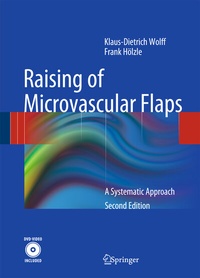
Raising of Microvascular Flaps
Beschreibung

This book provides all those who deal with microsurgical tissue transfer, i.e. plastic surgeons, ENT surgeons, trauma surgeons, and oral and maxillofacial surgeons, with all they need to know in their daily practice. In this second edition, the authors have followed the principle of systematic teaching based on photographs of cadaver preparations alongside explanatory color drawings to enhance understanding of the anatomy. Since microvascular tissue transfer is continuously developing, three flaps from the new generation that expand the spectrum of reconstructive possibilities have been added. A special strength of the book is its clear didactic structure. The highly instructive text is comprehensive and precise and also covers all representative literature on flap raising.
Rezensionen / Stimmen
From the reviews:
"'Raising Microvascular Flaps, A Systematic Approach' will be an invaluable tool for both the experienced and budding microsurgeon performing free tissue transfer regardless of the surgical subspecialty. . Further, the authors provide an excellent, thorough and systematic detailed approach to raising various indispensable, yet technique-dependant flaps. . 'Raising Microvascular Flaps, A Systematic Approach' is an excellent operative manual and should be an asset to the armamentarium of all reconstructive plastic surgeons . ." (Mariam Awada, European Journal of Plastic Surgery, Vol. 28 (6), 2006)
From the reviews of the second edition:
"This is a concisely orchestrated, vibrantly illustrated step-by-step approach to microvascular flaps that simplifies extremely complex surgical procedures. . The authors have extensive expertise in this field and have developed a teaching tool that will benefit microvascular surgeons who work in oncologic andreconstructive surgery. . Good things arrive in small packages, as evidenced by this book. Never has microvascular surgery been so clearly presented." (Jeffrey S. Rosenthal, Doody's Review Service, December, 2011)
Weitere Details
Weitere Ausgaben
Andere Ausgaben
Vorauflage
Personen
Frank Hölzle is Chairman, Full Professor, and Head of the Department of Oral and Maxillofacial Surgery at the University Hospital of RWTH University Aachen, Germany. He was previously Vice Chairman and Assistant Professor at the Department of Oral and Maxillofacial Surgery, Klinikum rechts der Isar, Technische Universität München (TUM), and prior to that Vice Chairman at the Department of Oral and Maxillofacial Plastic Surgery at Ruhr University Bochum, both periods under the leadership of his mentor Professor Klaus-Dietrich Wolff. Professor Hölzle studied medicine and dentistry at the Free University of Berlin, the Humboldt University of Berlin, the University of Glasgow, and University College London Medical School from 1989 to 1998. He was recognized as a medical specialist for oral and maxillofacial surgery in 2002, and in 2005 he achieved additional qualification as a plastic and reconstructive face surgeon. In 2006, he received his venia legendi for oral and maxillofacial surgery and also became a Fellow of the European Board of Oral & Maxillofacial Surgeons. Professor Hölzle is especially known for his work in the field of plastic facial reconstruction, and in 2007 he received the Martin Wassmund Award from the German Society of Maxillofacial Surgery for his research work on monitoring and improvement of the perfusion of microsurgical flaps and development of retrograde perfusion for perforator flaps in the head and neck.
Inhalt
Introduction.- Radial forearm flap.- Lateral arm flap.- Anterolateral thigh / Vastus lateralis flap.- Latissimus dorsi flap.- Scapular flap.- Fibula flap.- Iliac Crest Bone Flap.- Anterolateral Thigh Perforator Flap.- Soleus Perforator Flap.- Deep inferior epigastric artery perforator flap (DIEAP-flap).
