

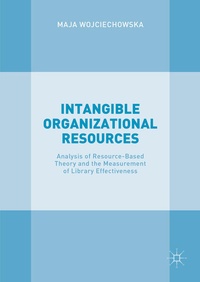
Intangible Organizational Resources
Beschreibung

This book addresses the challenges of organizing modern-day institutions, focusing on the management of intangible organizational resources of libraries through both library science and management theory. Highlighting new information requirements, knowledge transfer technologies and changing patterns of social behaviour, Intangible Organizational Resources explores how these changes are affecting the organization of information services such as libraries, and discusses what they mean for the effectiveness and quality of their services. Making a unique contribution in an otherwise under-explored field, this is an essential text for those involved in the organization of information services.
Weitere Details
Weitere Ausgaben
Andere Ausgaben
Person
Maja Wojciechowska is a Professor at University of Gdansk, Poland. Her research interests revolve around the organization and management of libraries, library marketing, and the promotion of reading and knowledge management in various institutions. Maja is a member of the IFLA Management and Marketing group, on the Advisory Board for the Polish Librarians' Association and is Editor-in-Chief of the polish journal Library Management. Since 2007 she has been the Chairman and of the 'Management and Organization of Libraries' conference.
Inhalt
Introduction.- Chapter 1. Concept of intangible resources in knowledge-based society.- 1.1 Tangible and intangible resources. Definitions and classifications.- 1.2 Types of intangible resources.- 1.3 Influence of socio-economic transformation on intangible resources management.- 1.4 Intangible resources as a source of the organization competitive advantage.- Chapter 2. Characteristics and analysis of intangible organizational resources related to intellectual capital.- 2.1 Intellectual capital in concept of intangible resources management.- 2.2 Human capital.- 2.3 Leadership.- 2.4 Communication and relations.- Chapter 3. Characteristics and analysis of the other intangible organizational resources.- 3.1 Strategy.- 3.2 Organizational culture.- 3.3 Reputation.- 3.4 Brand.- 3.5 Flexibility and innovativeness.- 3.6 Networks and consortia.- 3.7 Support for new technologies and processes.- 3.8 Intellectual property.- Chapter 4. Intangible organizational resources management.- 4.1 Models of intangible organizational resource management.- 4.2 Measurement of intangible resources.- 4.3 Protection of intangible resources.- 4.4 Intangible organizational resources management in Polish libraries - research results.- Conclusion.
