

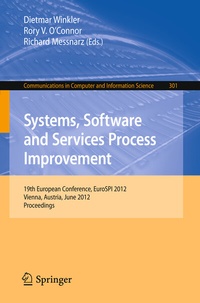
Systems, Software and Services Process Improvement
19th European Conference, EuroSPI 2012, Vienna, Austria, June 25-27, 2012. Proceedings
Erschienen am 12. Juni 2012
364 Seiten
978-3-642-31199-4 (ISBN)
Beschreibung

This volume constitutes the refereed proceedings of the 19th EuroSPI conference, held in Vienna, Austria, in June 2012.
The 29 revised papers presented in this volume were carefully reviewed and selected. They are organized in topical sections on SPI and business factors; SPI lifecycle and models; SPI assessment and quality; SPI processes and standards; SPI in SMEs; SPI and implementation; creating environments supporting innovation and improvement; standards and experiences with the implementation of functional safety; business process management; SPI in SMEs - a project management perspective.
Weitere Details
Weitere Ausgaben
Andere Ausgaben
Dietmar Winkler | Rory V. O'Connor | Richard Messnarz
Systems, Software and Services Process Improvement
19th European Conference, EuroSPI 2012, Vienna, Austria, June 25-27, 2012. Proceedings
Buch
06/2012
1. Auflage
Springer
53,49 €
Versand in 7-9 Tagen
Inhalt
- Title
- Preface
- Recommended Further Reading
- References
- Organization
- Table of Contents
- SPI and Business Factors
- Business Success in Software SMEs: Recommendations for Future SPI Studies
- Introduction
- Study Background
- Business Success in Software Development Companies
- Examining Business Success in Software SMEs Using the HSC
- Phase 1 - Business Objectives Elicitation in Software SMEs
- Phase 2 - Extent of Achievement of Business Objectives in Software SMEs
- Objectives with Greatest Degree of Achievement
- Objectives with Lowest Degree of Achievement
- Summary and Conclusions
- References
- MEDEPRO: A Method to Deploy Processes Focused on People
- Introduction
- Research Work Context
- Change Management
- Training
- Communication
- Staff Involvement
- MEDEPRO Method
- Stage 1: Establish the Infrastructure
- Stage 2: Motivate the Use and Adoption of the Processes
- Stage 3: Manage Deployment
- Stage 4: Monitor Deployment
- Stage 5: Feedback
- Case Study
- Process Deployment Evaluation at the Centers
- Processes Use
- Critical Success Factors
- Conclusions
- References
- A Market Based Approach for Resolving Resource Constrained Task Allocation Problems in a Software Development Process
- Introduction
- Game Theory in Software Engineering Literature
- Mechanism Design
- An Auction-Based Market Mechanism
- Our Approach
- Auction Basics
- Rules to the Auction
- A Demonstration of Our Approach
- Conclusion and Future Work
- References
- SPI Lifecycle and Models
- Rule-Based Detection of Process Conformance Violations in Application Lifecycle Management
- Introduction
- Background and Study Context
- Framework for Detecting Conformance Violations
- Process Rule Definition and Rule Base
- Rule Execution Engine and Nightly Builds
- Process Quality Report
- Development and Evolution of Process Rules
- Results
- Analysis and Discussion
- Hot Spots in Process Conformance
- Frequently Violated Process Rules
- Impact on Process Quality
- Summary and Lessons Learned
- References
- A Model for Business Value in Large-Scale Agile and Lean Software Development
- Introduction
- Background and Related Work
- Definitions of Business Value
- Business Value in Agile Planning Practices
- A Proposal for a Model for Business Value
- Detailed Model Description
- Intended Use and Visualization
- Discussion and Future Work
- Conclusions
- References
- Establishing a Continual Service Improvement Model: A Case Study
- Introduction
- Related Work
- Our Contribution
- Research Methods
- Data Analysis
- Establishing a CSI Model
- Defining the Research Problem and Investigation
- Building the Continual Service Improvement Model
- Validating the CSI Model
- Analysis
- Conclusions
- References
- SPI Assessment and Quality
- Application of the ISO/IEC 15504 Standard Based Model - innoSPICE
- Introduction
- The innoSPICE Innovation, Knowledge and Technology Transfer Model
- Assessment Methodology for Guided Self-assessment KTT Capability
- Assessment Results
- Examples of Assessment Results
- Profiles
- Conclusion and Outlook
- References
- Software Process Improvement Health Checklist
- Introduction
- Research Method
- Checklist
- Software Process
- SPI Process
- Process Tools
- Organization
- Stakeholders
- Process Literacy
- Social Factors
- Results
- Software Process
- SPI Process
- Process Tools
- Organization
- Stakeholders
- Process Literacy
- Social Factors
- Conclusions
- References
- Software Sustainability from a Process-Centric Perspective
- Introduction
- Green and Sustainable Software Process Principles and Definitions
- The Sustainability Factors of the Software Processes
- Addressing Sustainability in Software Processes
- Sustainability Management Process
- Sustainability Engineering Process
- Sustainability Qualification Process
- Evaluating and Improving Software Processes Sustainability
- Conclusions and Future Works
- References
- SPI Processes and Standards
- Integrating Governance, Service Management and Project Management of IT
- Introduction
- IT Governance Standards and Project Management with PRINCE2
- PRINCE2 as Project Management Framework
- ISO/IEC 20000. IT Service Management
- ISO/IEC 38500. IT Governance Standard
- Integrating Standards of Governance and IT Management in PRINCE2
- Conclusions
- References
- A Harmonized Multimodel Framework for Safety Environments
- Introduction
- Research Background
- CMM to CMMI® Constellations and a Safety Adaptation Model
- ISO26262
- Multimodels Approaches
- A Harmonized Multimodel Framework
- From a Practical Point of View
- Multimodel Analysis
- Multimodel Comparison
- Multimodel Results
- Multimodel Recommendations
- Conclusions and Further Work
- References
- Towards the Harmonization of Process and Product Oriented Software Quality Approaches
- Introduction
- Related Work
- Comparison Method
- Mapping ISO/IEC 25010 onto Both CMMI and ISO/IEC 12207
- Analyze Models
- Design the Mapping
- Execute the Mapping
- Assess Mapping Results
- Conclusions
- References
- SPI in SMEs
- Improvement of Task Management with Process Models in Small and Medium Software Companies
- Introduction
- Related Work
- The Method
- Case Studies
- Company A Case Study
- Company B Case Study
- Assessment of Results
- Conclusions
- References
- Towards a Maturity Model for IT Service Management Applied to Small and Medium Enterprises
- Introduction
- The Brazilian Program for Software Process Improvement -MPS.BR
- Research Methodology
- The Proposed Model Conception
- Results of the Field Research
- Research Results from Other Authors
- Result Consolidation and Discussion
- Evaluation Using Experts Opinion
- Conclusion
- References
- Towards Configurable ISO/IEC 29110-Compliant Software Development Processes for Very Small Entities
- Introduction
- Background and RelatedWorks
- ISO/IEC 29110
- Method Engineering
- ConfigurableWorkflows
- ResearchMethodology
- Automating ISO/IEC 29110 RE via Process Configuration
- A DomainWorkflow for ISO/IEC 29110 RE Profiles
- Deriving an ApplicationWorkflow through Individualisation
- Discussion
- Lessons LearntWhile Interpreting ISO/IEC 29110
- Threats to Validity
- Conclusion
- References
- SPI and Implementation
- Using Functional Defect Analysis as an Input for Software Process Improvement: Initial Results
- Introduction
- Research Setting
- Functional Defect Classification
- General Defect Distribution Scheme
- Beizer's Taxonomy for the Functional Defects
- Improved Functional Defect Classification Scheme
- Applying Functional Defect Analysis in Process Improvement
- General Defect Distribution
- Functional Defects Classified According to Beizer's Taxonomy
- Functional Defects Classified According to Our Own Defect Scheme
- Further Development of the Functional Defect Scheme
- Process Improvement Suggestions Based on Functional Defect Data Analysis
- Discussion
- Conclusion
- References
- Documenting Evolutionary Process Improvements with Method Increment Case Descriptions
- Introduction
- Research Context
- Related Literature
- Research Approach
- Method Increment Case
- Method Increment Case Description
- Linking Method Increment Case Descriptions to PDD's
- Evaluation
- Conclusions and Further Research
- References
- Towards an Integration of Multiple Process Improvement Reference Models Based on Automated Concept Extraction
- Introduction
- Challenges and Goals
- The MoSaIC Integration Approach
- Meta-models
- Normalization of Writing Style
- Automated Extraction of IRM Concepts
- Transformation Rules
- Natural Language Processing Support
- Tool Support
- Evaluation
- Future Work and Conclusions
- References
- Selected Key Notes and Workshop Papers
- Creating Environments Supporting Innovation and Improvement
- Innovating Innovation: A Conceptual Framework
- Introduction
- Existing Research: Methodology and Cases
- Innovation Capability dEtermination (ICE)
- Disruptive Innovation and Uncertainty
- Case Based Approach to Improvement and Process Assessment
- Innovation Update to the SPI Manifesto
- Summary and Outlook
- References
- Towards an Ideation Process Applied to the Automotive Supplier Industry
- Introduction
- Drivers for the Development of an Idea Generation Process
- Motivation and Methodology
- Objectives
- Development of an Ideation Process at KSPG AG
- Analysis of the Initial Situation at KSPG AG
- Analysis and Evaluation of Best Practice Examples
- Approach towards an Ideation Process at KSPG AG
- Essential Elements of the Ideation Process
- Conclusion and Outlook
- References
- Launching Innovation in the Market Requires Competences in Dissemination and Exploitation
- Introduction
- Innovating in Europe
- Innovation Success Factors in General
- Diffusion of Innovation
- Building on the Valorisation Competences
- Pedagogic Framework and Quality Assurance
- Conclusions
- References
- Standards and Experiences with the Implementation of Functional Safety
- EU Project SafEUr - Competence Requirements for Functional Safety Managers
- Introduction
- Modern Challenges in Functional Safety
- Methodology
- Functional Safety Manager Skill Card
- Functional Safety Manager Competency Requirements
- Introduction to Functional Safety Management
- Management of Functional Safety
- Engineering Aspects of Functional Safety
- Legal Aspects of Functional Safety
- Safety on Product Level
- Conclusion and Outlook
- References
- Experiences with Trial Assessments Combining Automotive SPICE and Functional Safety Standards
- The Integrated Assessment Model Used
- Reference Case for the Extension of Automotive SPICE with ISO 26262
- Trial Assessments
- Lessons Learned
- Conclusions
- References
- Business Process Management (CertiBPM)
- A Way to Support SPI Strategy through CertiBPM Training and Certification Program in Romania
- Introduction
- The CertiBPM Project - SPI Motivation and Source
- Marketing Survey - CertiBPM Impact on SPI Politics and Strategies in Romanian Companies
- The Research Context and Design
- The Survey Results
- Conclusions and Lessons Learned
- References
- EU Project BPM-GOSPEL - Applying Compliance Management Scenarios in Business Process Modelling for Trusted Business Coaching Programs
- Background and Applied Methodology
- Business Contexts of the Business Case Implementation
- Implementing the Compliance Management Scenarios
- Conclusions
- References
- There Is No Knowledge without Terminology: Key Factors for Organisational Learning
- Current Situation
- One Central Knowledge Base or Several Systems?
- Terminology in the Innovation Process
- Examples from the Car Industry
- Demands on Organisational / Corporate Knowledge
- Need for Metadata
- Conclusions
- References
- SPI in SMEs - A Project Management Perspective
- Process Improvement for the Small and Agile
- Potential Problems of Process Improvement Today
- How Organizations Are Viewed
- Goal Alignment and Goal Orientation
- Discussion on Potential Solutions
- Systemic View of Organizations
- Summary and Potential Research Problems for Future
- References
- A Practical Approach to Project Management in a Very Small Company
- Introduction
- The Context
- The Organization
- Scrum
- Agile Management Tool
- Tailoring Scrum in the Organization
- The Tailored Process
- Addition 1: The Requirements Elicitation in the Preparation Phase
- Addition 2: Sprint Design
- Addition 3: Sprint Test
- The Support Tool for Agile Project Management
- Change Management
- Bugs Management
- User Histories Management
- Impediments Management
- Sprint Planning and Load Balancing
- Project Monitoring
- Daily Activities Support
- Conclusions
- The Unfinished
- References
- Software Project Management in Very Small Entities with ISO/IEC 29110
- Introduction
- Software Project Management
- ISO/IEC 29110 Standard
- Engineering and Management Guide
- ISO/IEC 2910 Project Management Objectives Practices
- Deployment Assistance
- Pilot Projects
- Trials to Date
- Discussion
- References
- Author Index
