

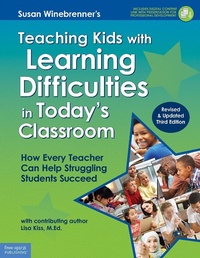
Teaching Kids with Learning Difficulties in Today's Classroom
How Every Teacher Can Help Struggling Students Succeed
Erschienen am 28. Februar 2017
256 Seiten
978-1-57542-581-8 (ISBN)
Beschreibung

A gold mine of practical, easy-to-use teaching methods, strategies, and tips to improve learning outcomes for students who score below proficiency levels. This fully revised and updated third edition of Teaching Kids with Learning Difficulties in Today's Classroom provides information on integrated learning, problem solving, and critical thinking in line with Common Core State Standards and 21st-century skills. It reflects the use of technology and schoolwide cluster grouping in support of all students and includes proven, practical, classroom-tested strategies and step-by-step instructions for how to use them. Sidebars throughout highlight special information for working with students on the autism spectrum; ';tech tips' describe technologies that are especially useful for kids with LD. Digital content includes all of the book's customizable forms, additional content organization charts, and a PDF presentation for book study groups and professional development.
Weitere Details
Reihe
Sprache
Englisch
Verlagsort
Huntington Beach, CA
USA
Verlagsgruppe
Teacher Created Materials, Inc
Zielgruppe
Für Beruf und Forschung
US School Grade: From Kindergarten to Twelfth Grade, Interest Age: From 4 to 18 years
Dateigröße
7,82 MB
ISBN-13
978-1-57542-581-8 (9781575425818)
Copyright in bibliographic data and cover images is held by Nielsen Book Services Limited or by the publishers or by their respective licensors: all rights reserved.
Schweitzer Klassifikation
Weitere Ausgaben
Andere Ausgaben
Susan Winebrenner | Lisa Kiss
Teaching Kids with Learning Difficulties in Today's Classroom
How Every Teacher Can Help Struggling Students Succeed
Buch
08/2014
3. Auflage
Free Spirit Publishing Inc.,U.S.
53,50 €
Versand in 3-4 Wochen
Inhalt
- A
- Title page
- Copyright page
- Acknowledgments
- Contents
- Contents Cont.
- Contents Cont.
- List of Reproducible Pages and Digital Content xii
- Foreword by Richard D. Lavoie xiii
- Introduction 1
- A Positive Learning Experience Leads to a Love of Learning 2
- What's New in This Edition 3
- Teacher Effectiveness Leads to Student Success 5
- Chapter 1: Creating Active Learning for All Students 7
- Welcoming Activities 7
- More Ways to Create a Welcoming Environment 9
- Welcoming English Language Learners into the Classroom 10
- Getting Everyone Involved in Learning 11
- The Name Card Method 12
- Cooperative Learning/Problem-Based Learning 15
- More Ways to Get Everyone Involved in Learning 16
- Questions and Answers 17
- Chapter 2: Understanding Learning Difficulties and Intervening Effectively 22
- Learning Difficulties (LD) 23
- Ways to Intervene with LD 25
- Students Who Are Twice Exceptional (2e) 29
- Conditions That Make Learning Difficult 31
- Attribution Theory and Learned Helplessness 37
- Least Restrictive Environment (LRE) 39
- Working as a Team with Special Education Teachers 40
- Questions and Answers 41
- Chapter 3: Using Students' Learning Styles (Modalities) to Facilitate Learning Success 44
- Understanding Learning Modalities 45
- Learning Modalities and School Success 47
- Teaching Students About Learning Modalities 50
- Teaching Your Students About Their Learning Modalities 50
- Matching Teaching to Students' Learning Modalities 51
- Questions and Answers 52
- Chapter 4: Ensuring That All Students Make At Least One Year's Academic Growth During Each School Y
- The Impact of Poverty on Learning 59
- The Revised IDEA 60
- Creating a Mindset for Success in Learning and in Life 61
- Goal Setting 61
- Common Core as It Impacts Students with Learning Difficulties 63
- Metacognition: Becoming Aware of One's Own Thinking 65
- Providing a Meaningful and Challenging Curriculum 66
- Seal the Deal: More Strategies to Make This Chapter Title Become a Reality 73
- Using Technology as an Integral Component of Effective Teaching 74
- Summary of Teaching Strategies for Students with Learning Difficulties and Those Emerging into Engl
- The School-Wide Cluster Grouping Model (SCGM) 83
- Questions and Answers 85
- Chapter 5: Teaching Integrated Language Arts, Including Literature, Sounds, and Writing 91
- Reading 91
- Guidelines for Helping Students with Reading Difficulties Become Successful Readers 92
- Three Components of Effective Reading Instruction 93
- The Language Experience Method 95
- Fluency 97
- Improving Comprehension 101
- Literature-Based Reading 108
- Effective Guided and Independent Practice 110
- Teaching Reading: Sounds, Spelling, and Vocabulary 111
- The Evolution of Phonics 111
- Phonics Instruction 112
- Building Reading Vocabulary 113
- Spelling and Vocabulary Instruction 115
- Teaching Writing 118
- What to Do When Students Hate to Write 118
- What to Do When Students Don't Know What to Write About 119
- Writing Programs 120
- The Writing Process 120
- Penmanship and Handwriting 121
- Making Writing Visual and Kinesthetic 122
- Assessing Students' Writing 124
- Questions and Answers 124
- Chapter 6: Reading and Learning with Informational Text 139
- Getting Ready to Learn 140
- The Magic of Using Graphic Organizers 140
- Understanding Content from Written Sources and Lectures 142
- Questions and Answers 148
- Chapter 7: All Students Can Be Successful in Math 154
- Ways to Get Struggling Students Hooked on Math 155
- Teaching Techniques to Try 157
- Teaching Computation and Operations 158
- Word Problems 166
- Questions and Answers 166
- Chapter 8: Using Assessments to Support Student Learning 169
- Effective Assessment Practices 169
- Assessment and Grading 172
- Types of Assessment Processes 173
- Ways to Make Assessment Less Stressful and More Accurate for All Students 176
- Struggling Students and Standardized Tests 177
- Interaction Between Assessments and the IEP 179
- Assessment Checklist 179
- Questions and Answers 180
- Chapter 9: Improving Students' Executive Functioning Skills 184
- Bringing Order into the Disorganized Lives of Students with LD 184
- Mnemonics 187
- Visual Learning Aids 188
- Teaching Students How to Study 189
- Homework 189
- Ways to Improve Testing Outcomes for Students with LD 192
- Questions and Answers 193
- Chapter 10: Helping Students Choose Appropriate Behaviors 199
- Looking Dumb or Being Bad: What Would Your Students Choose? 199
- The Relentless Cycle of Threat 200
- Intervening with Inappropriate Behavior 201
- Helping Students Learn to Choose Appropriate Behavior 206
- Improving Behavior for the Whole Class 213
- Conflict Resolution and Peer Mediation 214
- School-Wide Behavior Models 214
- Dealing with Bullying in Your Class and School 215
- Questions and Answers 215
- Chapter 11: Helping Parents Become Partners in Their Children's Learning 227
- Ways to Promote Parent Involvement at School 228
- Homework Issues 229
- Productive Parent-Teacher Meetings 231
- Open Houses 233
- Questions and Answers 233
- References and Resources 245
- Index 262
- About the Authors 272
- B
