

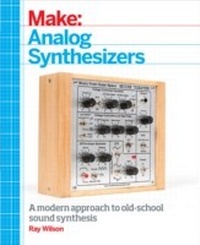
Make: Analog Synthesizers
Make Electronic Sounds the Synth-DIY Way
1. Auflage
Erschienen am 6. Mai 2013
184 Seiten
978-1-4493-4519-8 (ISBN)
Beschreibung

Dive hands-on into the tools, techniques, and information for making your own analog synthesizer. If youre a musician or a hobbyist with experience in building electronic projects from kits or schematics, this do-it-yourself guide will walk you through the parts and schematics you need, and how to tailor them for your needs. Author Ray Wilson shares his decades of experience in synth-DIY, including the popular Music From Outer Space (MFOS) website and analog synth community.At the end of the book, youll apply everything youve learned by building an analog synthesizer, using the MFOS Noise Toaster kit. Youll also learn what it takes to create synth-DIY electronic music studio. Get started in the fun and engaging hobby of synth-DIY without delay.With this book, youll learn:The differences between analog and digital synthesizersAnalog synthesizer building blocks, including VCOs, VCFs, VCAs, and LFOsHow to tool up for synth-DIY, including electronic instruments and suggestions for home-made equipmentFoundational circuits for amplification, biasing, and signal mixingHow to work with the MFOS Noise Toaster kitSetting up a synth-DIY electronic music studio on a budget
Weitere Details
Weitere Ausgaben
Andere Ausgaben
Ray Wilson
Make: Analog Synthesizers
Buch
06/2013
1. Auflage
Make Community, LLC
23,50 €
Versand in 10-20 Tagen
Inhalt
- Intro
- Copyright
- Table of Contents
- How I Got Started
- Preface
- My Electronic Roots
- Music From Outer Space
- What You Should Know
- What's Next?
- Conventions Used in This Book
- Using Examples
- Safari® Books Online
- How to Contact Us
- Chapter 1. What Is Synth-DIY?
- A Bit of Analog Synthesizer Etymology
- What Can I Build?
- How Far Can I Go?
- Chapter 2. Tooling Up for Building Analog Synths
- Instrumenting Your Workbench
- The Oscilloscope
- Frequency Response (or Bandwidth)
- Input Channels
- Sensitivity
- What Else Should I Look for in a Scope?
- The Digital Multimeter (DM)
- Multimeter Advanced Features
- Logic Probe
- The Bench Power Supply
- Some Nice-to-Haves
- Second Multimeter
- Capacitance Meter
- Frequency Counter
- Function Generator
- Tips for Reliable Soldering
- Temperature-Controlled Solder Station
- Soldering Tips
- Desoldering Is Important, Too
- Obtaining Electronic Components
- Surplus Parts
- Capacitors
- Capacitors to Keep On Hand
- Resistors to Keep On Hand
- Mechanical Components
- Active Components
- Solderless Breadboarding
- Hand Tools
- Troubleshooting Tips
- How to Minimize Troubleshooting
- Divide and Conquer
- Chapter 3. Analog Synthesizer Building Blocks
- Three Configurations: Normalized, Modular, and Hybrid
- Voltage Control
- The Voltage-Controlled Oscillator (VCO)
- The Voltage-Controlled Filter (VCF)
- The Voltage-Controlled Amplifier (VCA)
- The Low-Frequency Oscillator (LFO)
- The Keyboard Controller
- The Envelope Generator (EG)
- AR Envelope Generator
- ADSR Envelope Generator
- The White Noise Generator
- The Sample and Hold (S&H)
- Audio and DC Signal Mixers
- The Ring Modulator
- The Voltage Sequencer
- Putting It All Together
- Chapter 4. Make the Noise Toaster Analog Sound Synthesizer
- Noise Toaster Block Diagram
- Building the Noise Toaster
- Gathering the Parts
- The Bill of Materials (BOM)
- The Noise Toaster Printed Circuit Board (PCB)
- Populating the Noise Toaster PCB
- Making the Noise Toaster Front Panel
- Making the Noise Toaster Front Panel Legend Overlay
- Installing the Noise Toaster Front Panel Components
- Wiring the Noise Toaster Front Panel Components
- Preparing the Noise Toaster Case
- Wiring the PCB to the Front Panel
- Testing the Noise Toaster
- Testing the White Noise Generator
- Testing the VCO
- Testing the VCF
- Testing the VCA
- Testing the AREG
- Testing the LFO
- Testing the Output Jack
- My Noise Toaster Is Being Sullen and Listless
- Chapter 5. The Incredible Op Amp
- Op Amps as Amplifiers
- Negative Feedback Demystified
- Op Amps as Comparators
- Positive Feedback (Hysteresis)
- Chapter 6. How the Noise Toaster Works
- The Noise Toaster Schematics
- The Power Supply
- The Attack Release Envelope Generator (AREG)
- The Low-Frequency Oscillator (LFO)
- The Voltage-Controlled Oscillator (VCO)
- The White Noise Generator
- The Voltage-Controlled Low-Pass Filter (VCF)
- The Voltage-Controlled Amplifier (VCA)
- The Audio Amplifier
- Chapter 7. Your Electronic Music Studio
- Connecting a Project to Your Computer's Sound Card
- Introducing Audacity
- The Audacity Interface
- Sound Card Interface Discovery
- Saving Projects
- Exporting Audio Formats
- Transport Controls
- Audacity Tools
- Audacity Edit Toolbar
- Sound-on-Sound Recording
- Audacity Effects
- Effect Tails
- Recording Exercises
- Musique Concrete
- Multitrack Layering
- Multitrack Volume Envelope Layering
- Floobydust
- Appendix A. A Field Guide to Op Amp Circuit Applications
- Buffers
- Inverting Buffer
- Noninverting Buffer
- High-Impedance Buffer Follower
- Comparators
- A Basic Comparator
- The Window Comparator
- Signal Mixing
- Simple AC-Coupled Audio Mixer
- Simple Multichannel DC Modulation Mixer
- Simple but Useful Op Amp Oscillators
- Single Op Amp Square-Wave Oscillator
- Two Op Amp Square- and Triangle-Wave Oscillator
- Digital-to-Analog Conversion Using Binarily Weighted Resistors or the R/2R Resistor Ladder
- The Binarily Weighted Resistor DAC
- The R/2R Resistor Ladder DAC
- Light Up Your Synth with LEDs
- The Simplest Way to Light an LED
- Isolating the LED Control Source with a Transistor (I)
- Isolating the LED Control Source with a Transistor (II)
- Isolating the LED Control Source with a CD40106 Inverter (I)
- Isolating the LED Control Source with a CD40106 Inverter (II)
- Light an LED Using a Comparator (I)
- Light an LED Using a Comparator (II)
- Appendix B. The LM13700
- LM13700 Manufacturers
- LM13700 Chip Details
- Three Examples of LM13700 Circuits
- A Simple VCA Using the LM13700
- A Simple State-Variable VCF
- A Triangle-to-Sine Converter
- Appendix C. Working with CMOS Logic Chips
- Logic Chips in Synth-DIY
- CD4013 Dual D Flip-Flop
- CD4011 Quad Two-Input NAND Gate
- CD4001 Quad Two-Input NOR Gate
- CD4066 Quad Analog Switch
- CD4024 Seven-Stage Ripple Carry Binary Counter
- CD4042 Quad D Latch
- CD4094 Eight-Stage Shift Register
- CD40193 Binary Up/Down Counter
- CD4514 4-Bit Latch/4-to-16 Line Decoder
- CD4017 Decade Counter with 10 Decoded Outputs
- CD4067 Single 16-Channel Multiplexer/Demuliplexer
- CD40106 Hex Inverting Schmitt Trigger
- CD40106 Square Wave Oscillator
- CD40106 Pulse Wave Oscillator
- CD40106 Multiple-Input NAND Gate
- CD40106 Multiple-Input NOR Gate
- CD40106 Positive Edge to Negative-Going Pulse
- CD40106 Negative Edge to Positive-Going Pulse
- CD40106 Narrow Pulse Stretcher
- Index
- About the Author
