

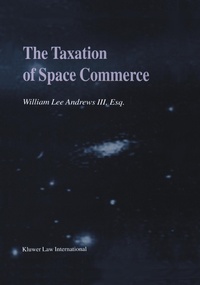
The Taxation of Space Commerce
Erschienen am 1. Juni 2002
158 Seiten
978-90-411-7864-0 (ISBN)
Beschreibung

Outer space is in constant use. Most obviously, billions of "packets" of information travel through it every day, for the infinitely various purposes of countless people and organisations. Space platforms increasingly provide important research data for businesses, institutions, and governments. Taxation issues are inevitable. In fact, tax planners have for several years been engaged in designing tax incentives to enhance the development of space commerce.
A significant focus of this extraordinary book is an in-depth evaluation of the current U.S. discussion of tax rules designed to stimulate space commerce. For the first time such a debate is placed squarely in its complete context of historic developments and constraints, prevailing tax law (in this case the U.S. internal revenue code), and the body of international and national space law that began with the 1967 Space Treaty. Valuable comparative analysis is provided by examination of corresponding schemes evolving in Canada, Japan, Australia, and France.
Specific events, developments, issues, and probabilities dealt with in The Taxation of Space Commerce include the following:
- the economic significance of the Challenger launch in 1986;
- the value of F.J. Turner's classic "frontier" thesis for understanding the "new frontier" of space;
- the Commercial Space Launch Act of 1984 (U.S.);
- the role of the U.S. internal revenue code's foreign tax credit:
- the 1979 Moon Treaty;
- remote-sensing and nuclear power;
- the 1998 Inter-Governmental Space Station Agreement;
- case law, especially Smith v. United States;
- multinational vs. unilateral taxation schemes;
- benefits of space commerce for society as a whole; and
- competitiveness and economic efficiency.
As a major contribution to the literature of space law and tax law, The Taxation of Space Commerce fills an important need. Beyond that, it is a work of enormous value not only for taxation specialists and communications industry executives and their counsel, but for any enterprise with an eye to the not-too-distant future.
A significant focus of this extraordinary book is an in-depth evaluation of the current U.S. discussion of tax rules designed to stimulate space commerce. For the first time such a debate is placed squarely in its complete context of historic developments and constraints, prevailing tax law (in this case the U.S. internal revenue code), and the body of international and national space law that began with the 1967 Space Treaty. Valuable comparative analysis is provided by examination of corresponding schemes evolving in Canada, Japan, Australia, and France.
Specific events, developments, issues, and probabilities dealt with in The Taxation of Space Commerce include the following:
- the economic significance of the Challenger launch in 1986;
- the value of F.J. Turner's classic "frontier" thesis for understanding the "new frontier" of space;
- the Commercial Space Launch Act of 1984 (U.S.);
- the role of the U.S. internal revenue code's foreign tax credit:
- the 1979 Moon Treaty;
- remote-sensing and nuclear power;
- the 1998 Inter-Governmental Space Station Agreement;
- case law, especially Smith v. United States;
- multinational vs. unilateral taxation schemes;
- benefits of space commerce for society as a whole; and
- competitiveness and economic efficiency.
As a major contribution to the literature of space law and tax law, The Taxation of Space Commerce fills an important need. Beyond that, it is a work of enormous value not only for taxation specialists and communications industry executives and their counsel, but for any enterprise with an eye to the not-too-distant future.
Weitere Details
Weitere Ausgaben
Andere Ausgaben
William Andrews
The Taxation of Space Commerce
Buch
06/2002
1. Auflage
Kluwer Law International
80,25 €
Versand in 10-20 Tagen
Inhalt
- Cover
- Title Page
- Copyright Page
- Table of Contents
- PREFACE
- AUTHOR, EDITORS, AND CONTRIBUTORS
- CHAPTER 1 INTRODUCTION
- CHAPTER 2 COMMERCE IN OUTER SPACE
- A. DEFINITION OF "OUTER SPACE
- B. THE HISTORY IN STAGES
- 1. The Developmental Stage-1946 to 1966
- 2. The Initial Separation-1966 to 1986
- 3. Post-Challenger-1986 to the Present
- C. "IS IT (SPACE COMMERCE) WORTH THE TROUBLE, PILGRIM?
- 1. Frederick Jackson Turner's Frontier Thesis
- 2. The Commercial Space Launch Act of 1984
- Continuing Public and Private Support for Space Commerce
- 3. The Feasible Components of Space Commerce
- CHAPTER 3 CONSTRAINTS ON SPACE COMMERCE
- CHAPTER 4 U.S. TAXING JURISDICTION
- A. TAX ON INCOME FROM "WHATEVER SOURCE"-PLUS A FOREIGN TAX CREDIT
- B. TAXATION OF SPACE INCOME
- CHAPTER 5 CORPUS JURIS SPATIALIS
- A. THE 1967 SPACE TREATY
- B. 1968 ASTRONAUTS AGREEMENT
- C. 1972 LIABILITY CONVENTION
- D. 1975 REGISTRATION CONVENTION
- E. 1979 MOON TREATY
- F. OTHER RESOLUTIONS, AGREEMENTS, REGULATIONS, RULES, LAWS
- 1. 1982 United Nations DBS Resolution
- 2. Remote-Sensing and Nuclear Power
- 3. 1998 Inter-Governmental (Space Station) Agreement
- 4. U.S. Space Regulation
- 5. U.S. Domestic Space Legislation
- 6. Case Law
- G. A MODUS VIVENDI WITH RESPECT TO THE CORPUS JURIS SPATIALIS
- CHAPTER 6 THE GOOD, THE BAD, THE UGLY, AND THE BEYOND
- A. THE GOOD AND THE BAD
- B. THE UGLY: FACTORS IMPACTING U.S. JURISDICTION TO TAX SPACE INCOME
- 1. "Equality" in Article One of the 1967 Space Treaty
- 2. The Issue of Sovereignty and Its Effect on the Taxing Jurisdiction
- 3. Smith v. United States-Is Outer Space "Foreign" for U.S. Income Tax Purposes?
- 4. National Jurisdiction
- 5. The Charming Betsy Canon
- 6. Summary of the "Ugly
- C. COMPARATIVE ANALYSIS
- 1. Canada
- a. Canadian Source Rules
- b. The Permanent Establishment Rule and Taxation of Non-Residents
- c. Canada's Consumption Tax
- d. Taxation of Canadian Residents and Foreign Tax Credits
- 2. Japan
- 3. Australia
- 4. France
- 5. Summary and Conclusion
- D. THE BEYOND
- 1. Background and Preliminary Issues
- a. Why not extend the benefits of the Beyond Bill to foreign ownership interests?
- b. Why not pursue the Beyond Bill multinationally rather than unilaterally?
- c. How can the Beyond Bill be justified in causing only a single industry to benefit?
- d. How will the Beyond Bill "trickle down" to benefit society as a whole?
- e. A comparison of two other space-related bills
- 2. Economic Considerations
- 3. General Agreement on Tariffs and Trade
- World Trade Organization
- 4. U.S. Tax Policy Goals
- a. Simplification that affords "voluntary compliance and improve [s] administrability
- b. Preservation of the U.S. tax base by guarding against erosion
- c. Consistency with accepted international norms
- d. Economic efficiency whereby "U.S. firms are encouraged to allocate resources to the most productive investments without regard to tax considerations
- e. Competitiveness through which "U.S. firms [are able] to compete successfully with foreign firms in both domestic and international markets
- TARGETED SPACE TAX RULE: "Beyond Bill
- E. AN ALTERNATIVE
- 1. Background and Preliminary Issues
- 2. U.S. Tax Policy Goals
- a. Simplification that affords "voluntary compliance and improver [s] administrability
- b. Preservation of the U.S. tax base by guarding against erosion
- c. Consistency with accepted international norms
- d. Economic efficiency whereby "U.S. firms are encouraged to allocate resources to the most productive investments without regard to tax considerations
- e. Competitiveness through which "U.S. firms [are able] to compete successfully with foreign firms in both domestic and international markets
- TARGETED SPACE TAX RULE: "CSTIIA
- CHAPTER 7 CONCLUSION
- Annex
- CHAPTER 8 SPACE TAXATION IN CANADA
- A. INTRODUCTION
- B. DETERMINATION OF RESIDENCE: CAN THERE BE RESIDENCE IN OUTER SPACE?
- 1. Individual Residence
- 2. Corporate Residence
- C. DETERMINATION OF SOURCE: TAXING THE SPACE ACTIVITIES OF NON-RESIDENTS
- 1. "Carrying on Business" in Canada
- 2. The Permanent Establishment Rule
- 3. Withholding Tax
- 4. Goods and Services Tax
- D. TAXATION OF CANADIAN RESIDENTS: EXTRA-TERRESTRIAL INCOME
- E. TAX INCENTIVES FOR COMMERCIAL ACTIVITIES IN SPACE?
- F. CONCLUSIONS
- CHAPTER 9 SPACE TAXATION IN JAPAN
- A. INTRODUCTION
- B. THE JAPANESE TAXATION OF OUTER SPACE COMMERCIAL ACTIVITIES
- 1. Income Which Is Attributable To Some Source Jurisdiction(s)
- a. Various services with satellites
- i. Broadcasting / communications
- ii. Remote sensing
- b. Satellite-launching business
- 2. Space-Source Income
- a. Research, development, and production held in the outer space laboratory
- b. Scope of the foreign tax credit
- C. CONCLUSION
- CHAPTER 10 SPACE TAXATION IN AUSTRALIA
- A. INTRODUCTION
- B. PART I: AUSTRALIA'S TAXING REGIMES-AN OVERVIEW
- 1. Income Tax
- a. Taxation of Australian residents
- b. Australia s taxing rights over non-residents
- c. Definition of residence for Australian income tax
- d. Source of income
- i. Trading or business profits
- ii. Royalties
- iii. Service income
- e. Permanent establishment
- 2. Goods and Services Tax ("GST")
- C. PART II: AUSTRALIAN TAXATION OF OUTER SPACE COMMERCIAL ACTIVITIES
- 1. Broadcasting / Communications
- 2. Remote Sensing
- 3. Satellite-Launching Business
- 4. Space-Source Income-Research, Development and Production in an Outer Space Laboratory
- CHAPTER 11 SPACE TAXATION IN FRANCE
- A. INTRODUCTION
- B. GENERAL RULES DETERMINING THE SCOPE OF FRENCH TERRITORIAL TAXATION
- 1. French Approach To Corporate Income Taxation
- a. Domestic tax law
- b. Impact of tax treaties
- 2. Definition of French Territory and Application To Space
- C. APPLICATION OF GENERAL RULES TO THE SPACE INDUSTRY AND COMMERCE
- 1. Space Commerce Activities
- 2. Tax Issues
- D. CONCLUSION
- INDEX
- Back Cover
