

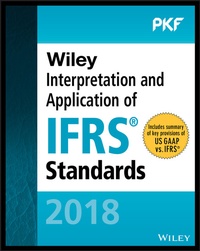
Wiley Interpretation and Application of IFRS Standards 2018
Beschreibung

Wiley IFRS 2018 offers a complete resource for the interpretation and application of the latest International Financial Reporting Standards (IFRS) as outlined by the International Accounting Standards Board (IASB). With up-to-date coverage and a host of practical tools, this book provides invaluable guidance on the expanding framework for unified financial reporting. Organised for easy navigation, each chapter includes general statement information followed by topic-specific discussion to facilitate both quick-reference and in-depth study. The expert team at PKF International provides authoritative insight from a practitioner's perspective: IFRIC interpretations and practical real-world guidance ensure full understanding of the newest standards, and the Disclosure Checklist helps verify compliance.
The IASB's efforts are paying off as more and more countries around the globe either adopt IFRS as their national standards, or adjust local standards in alignment. A working understanding of IFRS application is becoming essential, even as the rules continue to evolve. This book provides full coverage of the latest standards and thorough guidance for implementation.
- Review the latest IFRS rules and standards
- Apply guidelines and best practices appropriately
- Gain expert insight on IFRS interpretation and implementation
- Ensure compliance and verify completeness
Uniform financial reporting reduces the costs of financial statement preparation for multinational companies, and streamlines the assessment of business results. As the standards themselves evolve, so must practitioners' understanding of how to apply them correctly in real-world cases. Wiley IFRS 2018 offers a complete, up-to-date reference to help you apply and comply with the latest international standards.
PKF International is a global network of legally independent firms bound together by a shared commitment to quality, integrity and the creation of clarity in a complex regulatory environment.
With offices in 440 cities, PKF operates in 150 countries across 5 continents and specialises in providing high quality audit, accounting, tax, and business advisory services to international and domestic organisations in all of their markets.
PKF International member firms have an aggregate fee income of $2.52 billion, and the network is a member of the Forum of Firms - an organisation dedicated to consistent and high quality standards of financial reporting and auditing practices worldwide.
Weitere Details
Weitere Ausgaben
Andere Ausgaben
Inhalt
- Wiley 2018 Interpretation and Application of IFRS Standards
- Contents
- About the Authors
- 1: Introduction to International Financial Reporting Standards
- Introduction
- Origins and Early History of the IASB
- The Current Structure
- Process of IFRS Standard Setting
- Convergence: the IASB and Financial Reporting in the US
- The IASB and Europe
- Appendix A: Current International Financial Reporting Standards (IAS/IFRS) and Interpretations (SIC/IFRIC)
- Appendix B: Projects Completed Since Previous Issue (July2016 to June 2017)
- Appendix C: IFRS for SMEs
- Definition of SMEs
- IFRS for SMEs is a Complete, Self-Contained Set of Requirements
- Modifications of Full IFRS made in IFRS for SMEs
- Disclosure Requirements under IFRS for SMEs
- Maintenance of the IFRS for SMEs
- SME Implementation Group
- Implications of the IFRS for SMEs
- Application of the IFRS for SMEs
- 2: Conceptual Framework
- Introduction
- Conceptual Framework for Financial Reporting 2010
- Purpose and Status
- The Accounting Model
- The Objective of General-Purpose Financial Statements
- Qualitative Characteristics of Useful Financial Information
- The 1989 Framework: The Remaining Text
- Conceptual Framework Project
- 2013 Discussion Paper
- Exposure Draft-Conceptual Framework for Financial Reporting
- Chapter 1-The Objective of General Purpose Financial Reporting
- Chapter 2-Qualitative Characteristics of Useful Financial Information
- Chapter 3-Financial Statements and the Reporting Entity
- Chapter 4-The Elements of Financial Statements
- Chapter 5-Recognition and Derecognition
- Chapter 6-Measurement
- Chapter 7-Presentation and Disclosure
- Chapter 8-Concepts of Capital and Capital Maintenance
- Further Considerations Following the Issue of the Exposure Draft
- Chapter 1-The Objective of General Purpose Financial Reporting
- Chapter 2-Qualitative Characteristics of Useful Financial Information
- Chapter 3-Financial Statements and the Reporting Entity
- Chapter 4-The Elements of Financial Statements
- Chapter 5-Recognition and Derecognition
- Chapter 6-Measurement
- Chapter 7-Presentation and Disclosure
- Hierarchy of Standards
- IFRS Practice Statement Management Commentary
- Nature and Scope
- Principles
- Qualitative Characteristics
- Presentation
- Elements
- US GAAP Comparison
- 3: Presentation of Financial Statements
- Introduction
- Scope
- Definitions of Terms
- Financial Statements
- Objective
- Purpose of Financial Statements
- General Features
- Fair Presentation and Compliance with IFRSs
- Going concern
- Accrual basis of accounting
- Materiality and aggregation
- Offsetting
- Frequency of reporting
- Comparative information
- Consistency of presentation
- Structure and Content
- Complete Set of Financial Statements
- Notes
- Statement of compliance with IFRS
- Accounting policies
- Fairness exception under IAS 1
- Other disclosures required by IAS 1
- Future Developments
- Illustrative Financial Statements
- US GAAP Comparison
- 4: Statement of Financial Position
- Introduction
- Scope
- Definitions of Terms
- General Concepts, Structure and Content
- General Concepts
- Structure and Content
- Classification of Assets
- Current Assets
- Non-Current Assets
- Other Assets
- Classification of Liabilities
- Current Liabilities
- Non-Current Liabilities
- Offsetting Assets and Liabilities
- Classification of Shareholders' Equity
- Share Capital
- Retained Earnings
- Disclosure of Share Capital
- Future Developments
- US GAAP Comparison
- 5: Statements of Profit or Loss and Other Comprehensive Income, and Changes in Equity
- Introduction
- Future Developments
- Scope
- Definitions of Terms
- Elements of Financial Statements
- Other Terminology
- Concepts of Income
- Recognition and Measurement
- Income
- Expenses
- Gains and losses
- Statement of Profit or Loss and Other Comprehensive Income
- Presentation in the Profit or Loss Section
- Statement title
- Reporting period
- Comparative information
- Classification of expenses
- Aggregating items
- Offsetting items of revenue and expense
- Other Comprehensive Income
- Reclassification Adjustments: An Example
- Statement of Changes in Equity
- Us Gaap Comparison
- 6: Statement of Cash Flows
- Introduction
- Scope
- Definitions of Terms
- Background
- Benefits of Statement of Cash Flows
- Exclusion of Non-Cash Transactions
- Components of Cash and Cash Equivalents
- Presentation
- Classifications in the Statement of Cash Flows
- Reporting Cash Flows from Operating Activities
- Direct vs. indirect methods
- Other Requirements
- Gross vs. net basis
- Foreign currency cash flows
- Cash flow per share
- Net Reporting by Financial Institutions
- Reporting Futures, Forward Contracts, Options and Swaps
- Reporting Extraordinary Items in the Statement of Cash Flows
- Reconciliation of Cash and Cash Equivalents
- Acquisitions and Disposals of Subsidiaries and Other Business Units
- Disclosure and Examples
- Other Disclosures Required or Recommended by IAS 7
- Changes in Liabilities Arising from Financing Activities
- Consolidated Statement of Cash Flows
- US GAAP Comparison
- 7: Accounting Policies, Changes in Accounting Estimates, and Errors
- Introduction
- Scope
- Definitions of Terms
- Importance of Comparability and Consistency in FinancialReporting
- Accounting Policy
- Selecting Accounting Policies
- Changes in Accounting Policies
- Applying changes in accounting policies
- Retrospective application
- Impracticability exception
- Changes in amortisation method
- Changes in Accounting Estimates
- Correction of Errors
- Impracticability exception
- Future Developments
- US GAAP Comparison
- 8: Inventories
- Introduction
- Definitions of Terms
- Recognition and Measurement
- Basic Concept of Inventory Costing
- Ownership of Goods
- Goods in transit
- Consignment sales
- Right to return purchases
- Accounting for Inventories
- Valuation of Inventories
- Joint products and by-products
- Direct costing
- Differences in inventory costing between IFRS and tax requirements
- Methods of Inventory Costing Under IAS 2
- Specific Identification
- First-In, First-Out (FIFO)
- Weighted-Average Cost
- Net Realisable Value
- Recoveries of previously recognised losses
- Other Valuation Methods
- Retail method
- Standard costs
- Disclosure Requirements
- Examples of Financial Statement Disclosures
- US GAAP Comparison
- 9: Property, Plant and Equipment
- Introduction
- Definitions of Terms
- Recognition and Measurement
- Property, Plant and Equipment
- Initial measurement
- Decommissioning cost included in initial measurement
- Changes in decommissioning costs
- Initial recognition of self-constructed assets
- Exchanges of assets
- Costs incurred subsequent to purchase or self-construction
- Depreciation of property, plant and equipment
- Depreciation Methods Based on Time
- Partial-year depreciation
- Depreciation method based on actual physical use-units of production method
- Residual value
- Useful lives
- Tax methods
- Leasehold improvements
- Revaluation of Property, Plant and Equipment
- Fair value
- Revaluation applied to all assets in the class
- Revaluation adjustments
- Initial revaluation
- Subsequent revaluation
- Methods of adjusting accumulated depreciation at the date of revaluation
- Deferred tax effects of revaluations
- Derecognition
- Disclosures
- Non-Monetary (Exchange) Transactions
- Non-reciprocal transfers
- Transfers of Assets from Customers
- Examples of Financial Statement Disclosures
- US GAAP Comparison
- 10: Borrowing Costs
- Introduction
- Definitions of Terms
- Recognition and Measurement
- Capitalisation of Borrowing Costs
- When do we start capitalising?
- How much should we capitalise?
- When do we stop capitalising borrowing costs?
- Costs in excess of recoverable amounts
- Disclosure requirements
- Future Development
- US GAAP Comparison
- 11: Intangible Assets
- Introduction
- Scope
- Definitions of Terms
- Recognition and Measurement
- Background
- Nature of Intangible Assets
- Recognition Criteria
- Identifiability
- Control
- Future economic benefits
- Measurement of the Cost of Intangibles
- Intangibles acquired through an exchange of assets
- Intangibles acquired at little or no cost by means of government grants
- Internally Generated Intangibles other than Goodwill
- Recognition of internally generated computer software costs
- Costs Not Satisfying the IAS 38 Recognition Criteria
- Subsequently Incurred Costs
- Measurement Subsequent to Initial Recognition
- Cost model
- Revaluation model
- Development costs as a special case
- Amortisation Period
- Customer lists
- Patents
- Copyrights
- Renewable licence rights
- Residual Value
- Periodic review of useful life assumptions and amortisation methods employed
- Impairment Losses
- Derecognition of Intangible Assets
- Website Development and Operating Costs
- Disclosures
- Example of Financial Statement Disclosure
- US GAAP Comparison
- 12: Investment Property
- Introduction
- Definitions of Terms
- Identification
- Apportioning property between investment property and owner-occupied property
- Property leased to a subsidiary or a parent company
- Property interest held under operating lease
- Interrelationship between IFRS 3 and IAS 40
- Recognition and Measurement
- Recognition
- Subsequent expenditures
- Fair value vs. cost model
- Fair value model
- Inability to measure fair value reliably
- Cost model
- Transfers to or from investment property
- Disposal and retirement of investment property
- Presentation and Disclosure
- Presentation
- Disclosure
- Examples of Financial Statement Disclosures
- US GAAP Comparison
- 13: Impairment of Assets and Non-Current Assets Held for Sale
- Introduction
- Definitions of Terms: Impairment of Assets
- Impairment of Assets (IAS 36)
- Scope of IAS 36
- Principal requirements of IAS 36
- Identifying impairments
- Computing recoverable amounts-general concepts
- Determining fair value less costs to sell
- Computing value in use
- Cash-generating units
- Discount rate
- Corporate assets
- Accounting for impairments
- Reversals of impairments under the historical cost method of accounting
- Reversals of impairments under the revaluation method
- Insurance and other recoveries
- Disclosure requirements
- Examples of Financial Statement Disclosures
- Definitions of Terms: Non-Current Assets Held for Sale
- Non-Current Assets Held for Sale
- Held-for-sale classification
- Measurement of non-current assets held for sale
- Change of plans
- Presentation and disclosure
- Discontinued Operations
- Presentation and disclosure
- Examples of Financial Statement Disclosures
- US GAAP Comparison
- 14: Consolidations, Joint Arrangements, Associates and Separate Financial Statements
- Introduction
- Definitions of Terms
- Consolidated Financial Statements
- Scope
- Identification of a subsidiary
- Power
- Majority of voting rights
- Less than a majority of voting rights
- Exposure, or rights, to variable returns from an investee
- Link between power and returns
- Example of a fund manager
- Other arrangements
- Consolidation Procedures
- Intercompany transactions and balances
- Non-controlling interests
- Changes in the proportion of non-controlling interests
- Uniformity of accounting policies
- Measurement
- Reporting date
- Ownership interest
- Indirect interest
- Subsidiaries to be disposed of or acquired with a view to resale
- Changes in ownership interest resulting in loss of control
- Investment Entities
- Definition
- Investment management services
- Business purpose
- Exit strategies
- Earnings from investments
- Fair value measurement
- More than one investment
- More than one investor
- Unrelated investors
- Change in status
- Examples of Financial Statement Disclosures
- Joint Arrangements
- Scope
- Joint Arrangements
- Types of Joint Arrangements
- Assessment Questions
- Accounting for Joint Operations
- Basic principles
- Accounting for acquisitions of interests in joint operations in which the activity constitutes a business
- Conclusion
- Accounting for Joint Ventures
- Separate Financial Statements
- Associates
- Identification of an Associate
- Accounting for an Associate
- Equity Method of Accounting
- Scope and Application
- The Equity Method
- Basic principles
- Accounting at acquisition
- Intercompany transactions between investor and investee
- Contribution of non-monetary assets
- Accounting for Changes in Ownership Interest
- Loss of significant influence
- Discontinuing the equity method
- Acquisition of an associate in stages
- Increasing a stake in an associate while continuing the equity method
- Dilution losses
- Examples of Financial Statement Disclosures
- Impairment of the Value of Equity-Method Investments
- Other Requirements of IAS 28
- Separate financial statements
- Consistency of accounting policies
- Coterminous year-end dates
- Treatment of cumulative preferred shares
- Share of losses exceeding the interest
- Separate Financial Statements
- Investment entities
- Disclosure in separate financial statements
- Disclosure Requirements
- Main objective
- Significant judgements and assumptions
- Interests in subsidiaries
- Interests in joint arrangements and associates
- Interests in unconsolidated structured entities
- Investment entities
- Transition Guidance
- Consolidations
- Joint venture
- Joint operation
- Investment entities
- Disclosure
- US GAAP Comparison
- 15: Business Combinations
- Introduction
- Background
- Definitions of Terms
- Business Combinations and Consolidations
- Objectives
- Scope
- Business Combinations
- Determining Fair Values
- Transactions and Events Accounted for as Business Combinations
- Qualifying as a Business
- Techniques for Structuring Business Combinations
- Accounting for Business Combinations under the Acquisition Method
- Step 1-Identify the acquirer
- Step 2-Determine the acquisition date
- Step 3-Recognise and measure the identifiable tangible and intangible assets acquired and liabilities assumed
- Step 4-Identify assets and liabilities requiring separate accounting
- Step 5-Classify or designate identifiable assets acquired and liabilities assumed
- Step 6-Recognise and measure any non-controlling interest in the acquiree
- Step 7-Measure the consideration transferred
- Step 8-Recognise and measure goodwill or gain from a bargain purchase
- Acquisition-related costs
- Post-combination measurement and accounting
- Disclosure Requirements
- Recognising and measuring the identifiable assets acquired and liabilities assumed
- Determining what is part of the business combination transaction
- Goodwill and Gain from a Bargain Purchase
- Goodwill
- Deferred income tax-fair value adjustments
- Impairment of goodwill
- Reversal of previously recognised impairment of goodwill
- Gain from a bargain purchase
- Business combinations achieved in stages (step acquisitions)
- Footnote Disclosure: Acquisitions
- Examples of Financial Statement Disclosures
- Future Developments
- US GAAP Comparison
- 16: Shareholders' Equity
- Introduction
- Definitions of Terms
- Recognition and Measurement
- Presentation and Disclosure
- Types of Shares
- Presentation and Disclosures Relating to Share Capital
- Presentation and Disclosures Relating to Other Equity
- Classification between Liabilities and Equity
- Puttable shares
- Compound financial instruments
- Share Issuances and Related Matters
- Additional Guidance Relative to Share Issuances and Related Matters
- Accounting for the issuance of shares
- Share capital issued for services
- Issuance of share units
- Share subscriptions
- Distinguishing additional contributed capital from the par or stated value of the shares
- Donated capital
- Compound and Convertible Equity Instruments
- Retained Earnings
- Dividends and Distributions
- Cash dividends
- Liquidating dividends
- Taxation impact
- Accounting for Treasury Share Transactions
- Members' Shares in Co-operative Entities
- Examples of Financial Statement Disclosures
- US GAAP Comparison
- 17: Share-Based Payment
- Introduction
- Scope
- Definitions of Terms
- Overview
- Recognition and Measurement
- Recognition When There are Vesting Conditions
- Equity-Settled Share-Based Payments
- Goods and Services
- Employees
- Service Conditions
- Market and Non-Market Performance Conditions
- Measurement of Fair Value
- Modifications and Cancellations to the Terms and Conditions
- If the Modification Increases the Fair Value
- If the Modification Decreases the Fair Value
- Cancellations and Settlements
- Employee share options with graded vesting characteristics and service conditions
- Cash-Settled Share-Based Payments
- Measurement
- Treatment of Vesting and Non-Vesting Conditions
- Share-Based Payment Transactions with a Net Settlement Feature for Withholding Tax Obligations
- Modifications to the Terms and Conditions of a Cash-Settled Share-Based Payment
- Share-Based Payment Transactions With Cash Alternatives
- Share-Based Transactions Among Group Entities
- Disclosure
- Financial Statement Presentation under IFRS
- Examples of Financial Statement Disclosures
- US GAAP Comparison
- Appendix: Employee Share Options Valuation Example
- Employee share options: Valuation models
- 18: Current Liabilities, Provisions, Contingencies and Events After the Reporting Period
- Introduction
- Definitions of Terms
- Recognition and Measurement
- Current Liabilities
- Classification
- Nature of current liabilities
- Offsetting current assets against related current liabilities
- Types of liabilities
- Amount and Payee Known
- Short-term obligations expected to be refinanced
- Long-term debt subject to demand for repayment
- Payee Known but Amount May Need to Be Estimated
- Provisions
- Disclosures
- Practical Examples
- Dry-docking costs
- Unlawful environmental damage
- Onerous contracts
- Decommissioning costs
- Levies
- Payee Unknown and the Amount May Have to Be Estimated
- Contingent Liabilities
- Assessing the likelihood of contingent events
- Remote contingent losses
- Litigation
- Financial Guarantee Contracts
- Contingent Assets
- Disclosures Prescribed by IAS 37 for Contingent Liabilities and Contingent Assets
- Reporting Events Occurring After the Reporting Period
- Authorisation date
- Adjusting and non-adjusting events (after the reporting period)
- Dividends proposed or declared after the reporting period
- Going concern considerations
- Disclosure requirements
- Examples of Financial Statement Disclosures
- Future Developments
- US GAAP Comparison
- 19: Employee Benefits
- Introduction
- Definitions of Terms
- Background
- Importance of Pension and Other Benefit Plan Accounting
- Basic Objectives of Accounting for Pension and Other Benefit Plan Costs
- Need for pension accounting rules
- Basic Principles of IAS 19
- Applicability: Pension plans
- Applicability: Other employee benefit plans
- Cost recognition distinguished from funding practices
- Post-Employment Benefit Plans
- General discussion
- Periodic measurement of cost for defined contribution plans
- Periodic measurement of cost for defined benefit plans
- Current service cost
- Interest on the accrued benefit obligation
- The expected return on plan assets
- Actuarial gains and losses
- Past service costs
- Transition adjustment
- Employer's Liability and Assets
- Minimum Funding Requirement
- IFRIC 14: IAS 19-The Limit on a De.ned Bene.t Asset, Minimum Funding Requirements and Their Interaction
- Economic benefit available as a refund
- The economic benefit available as a contribution reduction
- The effect of a minimum funding requirement on the economic benefit available as a reduction in future contributions
- When a minimum funding requirement may give rise to a liability
- Other Pension Considerations
- Multiple and multi-employer plans
- Business combinations
- Contributions from employees or third parties
- Disclosures for Post-Employment Benefit Plans
- Examples of Financial Statement Disclosures
- Other Employee Benefits
- Short-term employee benefits
- Other post-retirement benefits
- Other long-term employee benefits
- Termination benefits
- Future Developments
- US GAAP Comparison
- 20: Revenue From Contracts With Customer
- Introduction
- Definitions of Terms
- Scope
- The Revenue Model
- The Core Principle and Steps
- Step 1: Identify the contract with customers
- Identifying the contract
- Combination of contracts
- Contract modifications
- Step 2: Identify the performance obligations in the contract
- Distinct performance obligations
- A series of distinct goods and services
- Step 3: Determine the transaction price
- Variable consideration
- Constraining estimates of variable consideration
- The existence of a significant financing component in the contract
- Non-cash consideration
- Consideration payable to a customer
- Changes in the transaction price
- Step 4: Allocate the transaction price
- Allocation based on stand-alone selling prices
- Allocation of a discount
- Allocation of variable consideration
- Step 5: Recognise revenue when performance obligations are satisfied
- Performance obligations satisfied over time
- Criterion 1: Simultaneous receipt and consumption of benefits
- Criterion 2: Customer controls the asset as it is created or enhanced
- Criterion 3: Entity's performance does not create an asset with an alternative use
- Measuring progress towards complete satisfaction of a performance obligation
- Output methods
- Input methods
- Reasonable measures of progress
- Performance obligations satisfied at a point in time
- Customer acceptance
- Contract Cost
- Incremental Costs of Obtaining a Contract
- Costs to fulfil a contract
- Amortisation
- Impairment
- Presentation
- Statement of Financial Position
- Disclosure
- Transition
- Specific Transactions
- Sale with a right of return
- Warranties
- Principal versus agent considerations
- Customer options for additional goods or services
- Customers' unexercised rights
- Non-Refundable Upfront Fees (and Some Related Costs)
- Licensing
- Determining the nature of the entity's promise
- Sales-based or usage-based royalties
- Repurchase agreements
- A forward or a call option
- A put option
- Consignment arrangements
- Bill-and-hold arrangements
- Service concession arrangements
- Example of Financial Statement Disclosures
- US GAAP Comparison
- 21: Government Grants
- Introduction
- Scope
- Government Grants
- Definitions of Terms
- Recognition of Government Grants
- Criteria for recognition
- Recognition period
- Non-Monetary Grants
- Presentation and Disclosure
- Presentation of Grants Related to Assets
- Presentation on the statement of financial position
- Presentation in the statement of cash flows
- Presentation of Grants Related to Comprehensive Income
- Disclosures
- Other Issues
- Repayment of Government Grants
- Impairment of Assets and Government Grants
- Government Assistance
- Service Concessions
- Service concession arrangements
- Accounting under the financial asset model
- Accounting under the intangible asset model
- Operating revenue
- Accounting by the government (grantor)
- US GAAP Comparison
- 22: Leases
- Introduction
- Definitions of Terms
- Minimum Lease Payments (MLP)
- Classification of Leases
- Classification of Leases-Lessee
- Leases Involving Land and Buildings
- Classification of Leases-Lessor
- Different Types of Finance Leases
- Recognition and Measurement
- Accounting for Leases-Lessee
- Operating leases
- Impairment of leased asset
- Accounting for Leases-Lessor
- Operating leases
- Finance leases
- Sales-type leases
- Direct financing leases
- Leveraged leases
- Sale-Leaseback Transactions
- Other leasing guidance
- Disclosure Requirements Under Ias 17
- Lessee Disclosures
- Lessor Disclosures
- Examples of Financial Statement Disclosures
- Future Developments
- US GAAP Comparison
- Appendix A: Special Situations Not Addressed By Ias 17 But Which Have Been Interpreted Under Us Gaap
- Sale-Leaseback Transactions
- Sale-leaseback involving real estate
- Leases Involving Real Estate-Guidance Under US GAAP
- Leases Involving Land Only
- Leases Involving Land and Building
- Leases Involving Real Estate and Equipment
- Leases Involving Only Part of a Building
- Termination of a Lease
- Renewal or Extension of an Existing Lease
- Leases between Related Parties
- Accounting for Leases in a Business Combination
- Sale or Assignment to Third Parties-Non-Recourse Financing
- Money-Over-Money Lease Transactions
- Acquisition of Interest in Residual Value
- Accounting for a Sublease
- Appendix B: Leveraged Leases Under US GAAP
- 23: Foreign Currency
- Introduction
- Definitions of Terms
- Scope, Objectives and Discussion of Definitions
- Functional Currency
- Monetary and Non-Monetary Items
- Foreign Currency Transactions
- Translation of Foreign Currency Financial Statements
- Translation of functional currency financial statements into a presentation currency
- Translation (remeasurement) of financial statements into a functional currency
- Net investment in a foreign operation
- Consolidation of foreign operations
- Guidance Applicable to Special Situations
- Non-controlling interests
- Goodwill and fair value adjustments
- Exchange differences arising from elimination of intragroup balances
- Different reporting dates
- Disposal of a foreign operation
- Change in functional currency
- Reporting a Foreign Operation's Inventory
- Translation of Foreign Currency Transactions in Further Detail
- Disclosure
- Hedging
- Hedging a Net Investment in a Foreign Operation or Foreign Currency Transaction
- Hedges of a net investment in a foreign operation
- Hedges of foreign currency transactions
- Currency of Monetary Items Comprising Net Investment in Foreign Operations
- Examples of Financial Statement Disclosures
- US GAAP Comparison
- 24: Financial Instruments
- Introduction
- Introduction to IFRS 9
- Significant Differences Between IFRS 9 and IAS 39
- Objective
- Scope
- Definitions of Terms
- Recognition, Measurement and Derecognition OfFinancialInstruments
- Initial Recognition
- Initial Measurement
- Initial Measurement: Transaction Costs
- Fair Value on Initial Recognition?
- Contracts to buy or sell a non-financial item
- Financial Assets
- Regular-way purchase or sale of financial assets
- Classification of financial assets
- Classification of Financial Assets-Decision Tree
- The business model
- Cash Flow Characteristics
- Fair value through profit or loss (FVTPL)
- Elimination or reduction of accounting mismatches (also applies to financial liabilities classified as FVTPL)
- Managing performance of financial instruments and evaluating its performance on a fair value basis
- Fair Value Through Other Comprehensive Income (FVTOCI)
- Amortised Cost
- Business model for assets classified as amortised cost
- Cash flow characteristics for assets classified as amortised cost
- Changes to contractual terms
- Subsequent Measurement of Financial Assets
- Investments in Equity Instruments
- Reclassification of Financial Assets
- Derecognition of Financial Assets
- Transferring of Financial Assets
- Transferring of Financial Assets that Qualify for Derecognition
- Transferring of Financial Assets that do Not Qualify for Derecognition
- Continuing Involvement in Transferred Financial Assets
- Financial Liabilities
- Classification of Financial Liabilities
- Subsequent Measurement of Financial Liabilities
- Liabilities Designated as at Fair Value Through Profit or Loss and Recognition of Own Credit Risk Related Fair Value Changes
- Own credit risk
- Determining the effects of changes in credit risk
- Reclassification of Financial Liabilities
- Derecognition of financial liabilities
- Embedded Derivatives
- Financial Instruments Measured At Amortised Cost
- Dealing with changes in cash flows subsequent to the initial calculation of the effective interest rate
- Modification of contractual cash flows
- Write-off
- Fair Valuation Gains and Losses
- Recognition of Foreign Exchange Gains and Losses
- Exchange differences arising on translation of foreign entities
- Interaction between the standards
- Statement of financial position
- Impairment of Financial Instruments
- A Simplified Decision Tree
- The general approach
- Determining Significant Increases in Credit Risk Since Initial Recognition
- Instruments Determined to have Low Credit Risk at the Reporting Date
- Collective and Individual Assessment Basis for Determining Significant Increases in Credit Risk
- Reasonable and Supportable Forward-Looking Information
- Modified Financial Assets
- Purchased or Originated Credit-Impaired Financial Assets
- Simplified Approach for Trade Receivables, Contract Assets and Lease Receivables
- Measurement of Expected Credit Losses and Applying Probabilities
- Impact of Collateral
- Hedge Accounting
- Derivatives
- Identifying whether certain transactions involve derivatives
- Forward contracts
- Future contracts
- Options
- Swaps
- Derivatives that are not based on financial instruments
- Objective and Scope of Hedge Accounting
- Qualifying Criteria for Hedge Accounting
- Designation of Hedging Instruments
- Designation of Hedged Items
- Components of a Nominal Amount
- Relationship Between Components and the Total Cash Flows of an Item
- Designation of Financial Items as Hedged Items
- Hedge Effectiveness
- Rebalancing the Hedging Relationship and Changes to the Hedge Ratio
- Discontinuation of Hedge Accounting
- Fair Value Hedges
- Cash Flow Hedges
- Hedges of a Net Investment in a Foreign Operation
- Accounting for the Time Value of Options
- Accounting for the Forward Element of Forward Contracts
- Hedges of a Group of Items
- Designation of a Component of a Nominal Amount
- Layers of Groups of Items Designated as the Hedged Item
- Nil net positions
- Effective Date and Transition Requirements of Ifrs 9
- Impracticability
- Impairment
- Classification and Measurement
- Business model
- Solely payments of principal and interest on principal
- Hybrid contracts
- Financial liabilities
- Unquoted equity instruments
- Transition for hedge accounting
- Presentation of Financial Instruments Under Ias 32
- Distinguishing Liabilities from Equity
- Puttable Financial Instruments
- Settlement in the Entity's Own Equity Instruments
- Interests in Cooperatives
- Convertible Debt Instruments
- Features of Convertible Debt Instruments
- Classification of Compound Instruments
- Debt Instruments Issued with Share Warrants
- Instruments Having Contingent Settlement Provisions
- Treasury Shares
- Reporting Interest, Dividends, Losses and Gains
- Offsetting Financial Assets and Liabilities
- Disclosures
- Disclosures Required under IFRS 7
- Applicability of IFRS 7
- Classes of Financial Instruments and Level of Disclosure
- Disclosures Relating to Reclassifications
- Offsetting Financial Assets and Financial Liabilities
- Collateral
- Loss Allowances for Financial Assets Measured at FVTOCI
- Certain Compound Instruments
- Defaults and Breaches
- Disclosures in the Statements of Comprehensive Income and Changes in Equity
- Accounting Policies Disclosure
- Example: Note 2. Accounting Policies
- Sub-note 2.8 financial instruments
- 2.8.1 Financial assets measured at amortised cost
- 2.8.2 Financial assets at fair value through other comprehensive income
- 2.8.3 Financial assets at fair value through profit or loss
- 2.8.4 Financial liabilities
- 2.8.5 Effective interest method
- 2.8.6 Net investment in foreign operation
- 2.8.7 Impairment of financial assets
- 2.8.8 Offsetting financial instruments
- Hedging Disclosures
- Risk management strategy
- The amount, timing and uncertainty of future cash flows
- The effects of hedge accounting on financial position and performance
- Fair Value Disclosures
- Example: Note 3.8 financial instruments and financial risk management
- 3.8.2 Classes and fair value of financial instruments
- 3.8.3 Fair value hierarchy and measurements
- 3.8.3.1 Financial assets and liabilities that are measured at fair value on a recurring basis
- Level 1
- Level 2
- Level 3
- 3.8.3.2 Financial assets and liabilities that are not measured at fair value on a recurring basis
- Disclosures About the Nature and Extent of Risks Flowing from Financial Instruments
- Qualitative disclosures
- Quantitative disclosures
- Credit Risk Disclosures
- The credit risk management practices
- Quantitative and qualitative information about amounts arising from expected credit losses
- Credit risk exposure
- Collateral and other credit enhancements obtained
- Liquidity risk disclosures
- Market Risk Disclosures
- Disclosures Required on Initial Application of IFRS 9
- 25: Fair Value
- Introduction
- The Debate over the Use of Fair Value Measurements
- Scope
- Definitions of Terms
- Fair Value Measurement Principles and Methodologies
- Item identification and unit of account
- The principal or most advantageous market
- Market participants
- Selection of the valuation premise for asset measurements
- Risk assumptions when valuing a liability
- Liabilities and equity instruments held by other (third) parties as asset
- Liabilities and equity instruments not held by other (third) parties as asset
- Restriction preventing the transfer of a liability or an entity's own equity instrument
- Financial liability with a demand feature
- Shareholders' equity
- Fair value for net exposures
- Inputs
- Valuation techniques
- Measurement Considerations
- Fair Value Disclosure
- Education Material
- Future Developments
- US GAAP Comparison
- 26: Income Taxes
- Introduction
- Scope
- Definitions of Terms
- Identification
- Recognition and Measurement of Current Tax
- Recognition of Current Tax
- Measurement of Current Tax
- Recognition and Measurement of Deferred Tax
- Recognition of Deferred Tax
- Measurement of Deferred Tax Assets
- Recognition in Profit or Loss
- Calculation of Deferred Tax Asset or Liability
- Identification of Temporary Differences
- Identification of Exemptions
- Goodwill
- Initial recognition exemption
- Identification of Unused Tax Losses or Tax Credits
- Calculation and Measurement of Deferred Tax Assets and Liabilities
- Limitation on the Recognition of Deferred Tax Assets
- Future temporary differences as a source for taxable profit to offset deductible differences
- Tax-planning opportunities that will help realise deferred tax assets
- Subsequently revised expectations that a deferred tax benefit is recoverable
- Effect of Changed Circumstances
- Uncertainties over Income Tax Treatments
- Clarification of application
- Disclosure
- Effect of Tax Law Changes on Previously Recorded Deferred Tax Assets and Liabilities
- Reporting the Effect of Tax Status Changes
- Implications of Changes in Tax Rates and Status Made in Interim Periods
- Specific Transactions
- Income Tax Consequences of Dividends Paid
- Accounting for Business Combinations at the Acquisition Date
- Accounting for Business Combinations after the Acquisition
- Temporary Differences in Consolidated Financial Statements
- Assets Carried at Fair Value
- Tax on Investments in Subsidiaries, Associates and Joint Ventures
- Tax Effects of Compound Financial Instruments
- Share-Based Payment Transactions
- Presentation and Disclosure
- Presentation
- Disclosures
- Statement of financial position disclosures
- Statement of profit or loss and other comprehensive income disclosures
- Example of Financial Statement Disclosures
- Proposed Amendments
- US GAAP Comparison
- 27: Earnings Per Share
- Introduction
- Scope
- Definitions of Terms
- Concepts, Rules and Examples
- Simple Capital Structure
- Computational guidelines
- Numerator
- Denominator
- Complex Capital Structure
- Determining Dilution Effects
- Options and warrants
- Convertible instruments
- Contingent Issuances of Ordinary Shares
- Contracts Which May Be Settled in Shares or for Cash
- Written put options
- Sequencing of Dilution Effects
- Presentation and Disclosure Requirements Under IAS 33
- Example of Financial Statement Disclosures
- US GAAP Comparison
- 28: Operating Segments
- Introduction
- Scope
- Definitions of Terms
- Identification
- Concepts and Requirements Under Ifrs 8
- Operating Segments and Reportable Segments
- Operating segments
- Chief operating decision maker
- Reportable segments
- Disclosure Requirements
- Entity-wide disclosure requirements
- Example of Financial Statement Disclosures Under IFRS
- US GAAP Comparison
- 29: Related Party Disclosures
- Introduction
- Definitions of Terms
- Identification
- The Need for Related Party Disclosures
- Scope of the Standard
- Applicability
- Substance over Form
- Significant Influence
- Disclosures
- Financial Statement Disclosures
- Disclosure of Parent-Subsidiary Relationships
- Disclosures to Be Provided
- Arm's-length transaction price assertions
- Aggregation of disclosures
- Compensation
- Comparatives
- Government-Related Entities
- Example of Financial Statement Disclosures
- US GAAP Comparison
- 30: Accounting and Reporting By Retirement Benefit Plans
- Introduction
- Definitions of Terms
- Scope
- Defined Contribution Plans
- Defined Benefit Plans
- Disclosures
- US GAAP Comparison
- 31: Agriculture
- Introduction
- Scope
- Definitions of Terms
- Identification
- Recognition and Measurement
- Basic Principles of IAS 41
- Determining Fair Values
- Recognition and Measurement
- Agricultural Produce (Measurement)
- Presentation and Disclosures
- Financial Statement Presentation
- Statement of financial position
- Statement of profit or loss and other comprehensive income
- Additional disclosures
- Examples of Financial Statement Disclosures
- Other Issues
- Agricultural Land
- Intangible Assets Related to Agriculture
- US GAAP Comparison
- 32: Extractive Industries
- Introduction
- Definitions of Terms
- Exploration and Evaluation of Mineral Resources
- Background
- IFRS 6 in Greater Detail
- Cash-Generating Units for Exploration and Evaluation Assets
- Assets Subject to IFRS 6
- Categorisation
- Availability of Cost or Revaluation Models
- Financial Statement Classification
- Disclosure Requirements Under IFRS 6
- Example of Financial Statement Disclosures
- IFRIC 20 Stripping Cost in the Production Phase of a SurfaceMine
- Example of Financial Statement Disclosures
- Future Developments
- Extractive Industry Discussion Paper
- US GAAP Comparison
- 33: Accounting for Insurance Contracts
- Introduction
- Definitions of Terms
- Insurance Contracts
- Insurance risk
- Recognition and Measurement Guidance
- Adequacy of insurance liabilities
- Impairment testing of reinsurance assets
- Selection of accounting principles
- Unbundling
- Recognition
- Discretionary participation features in insurance contracts
- Embedded derivatives
- Disclosure
- Applying IFRS 9 with IFRS 4
- Temporary exemption from IFRS 9
- Disclosures about the temporary exemption from IFRS 9
- The overlay approach
- Disclosures about the overlay approach
- Interaction with other requirements
- Transitional Provisions
- Temporary exemption from IFRS 9
- The overlay approach
- Future Developments
- IFRS 17 Insurance Contracts
- US GAAP Comparison
- 34: Interim Financial Reporting
- Introduction
- Scope
- Definitions of Terms
- Alternative Concepts of Interim Reporting
- Objectives of Interim Financial Reporting
- Application of Accounting Policies
- Consistency
- Consolidated reporting requirement
- Materiality as Applied to Interim Financial Statements
- Presentation
- Content of an interim financial report
- Minimum components of an interim financial report
- Form and content of interim financial statements
- Significant events and transactions
- Other disclosures
- Comparative interim financial statements
- Recognition Issues
- General concepts
- Recognition of annual costs incurred unevenly during the year
- Revenues received seasonally, cyclically or occasionally
- Income taxes
- Multiplicity of taxing jurisdictions and different categories of income
- Tax credits
- Tax loss tax credit carrybacks and carryforwards
- Volume rebates or other anticipated price changes in interim reporting periods
- Depreciation and amortisation in interim periods
- Inventories
- Foreign Currency Translation Adjustments at Interim Dates
- Adjustments to Previously Reported Interim Data
- Restatement of Previously Reported Interim Periods
- Use of estimates in interim periods
- Impairment of assets in interim periods
- Interim financial reporting in hyperinflationary economies
- US GAAP Comparison
- 35: Hyperinflation
- Introduction
- Financial Reporting in Hyperinflationary Economies
- Severe Hyperinflation According to IFRS 1
- Restating Historical Cost Financial Statements under Hyperinflation Conditions
- Restating Current Cost Financial Statements under Hyperinflation Conditions
- Comparative Financial Statements
- Consolidated Financial Statements
- Other Disclosure Issues
- Economies which Cease Being Hyperinflationary
- Guidance on Applying the Restatement Approach
- US GAAP Comparison
- Appendix: Monetary Vs. Non-Monetary Items
- 36: First-Time Adoption of International Financial Reporting Standards
- Introduction
- Definitions of Terms
- First-Time Adoption Guidance
- Objective and Scope of IFRS 1
- Key Dates
- Steps in Transition to IFRS
- Selection of Accounting Policies
- Opening IFRS Statement of Financial Position
- Mandatory Exceptions to the Retrospective Application of Other IFRS
- Estimates
- Derecognition of financial assets and financial liabilities (IFRS 9)
- Hedge accounting (IFRS 9)
- Non-controlling interests (IFRS 10)
- Optional Exemptions
- Business combinations
- Insurance contracts
- Deemed cost
- Leases
- Below market rate government loans
- Cumulative translation differences
- Investments in subsidiaries, jointly controlled entities and associates
- Assets and liabilities of subsidiaries, associates and joint ventures
- Compound financial instruments
- Designation of previously recognised financial instruments
- Fair value measurement of financial assets or financial liabilities at initial recognition
- Decommissioning liabilities included in the cost of property, plant and equipment
- Service concession arrangements
- Borrowing costs
- Severe hyperinflation
- Presentation and Disclosure
- Explanation of transition to IFRS
- Comparative information
- Reconciliations
- Other disclosures
- Interim reporting
- Options With and Within the Accounting Standards
- Transition from US GAAP to IFRS: The Case of DaimlerChrysler
- Index
- End User License Agreement
1
Introduction to International Financial Reporting Standards
- Introduction
- Origins and Early History of the IASB
- The Current Structure
- Process of IFRS Standard Setting
- Convergence: The IASB and Financial Reporting in the US
- The IASB and Europe
- Appendix A: Current International Financial Reporting Standards (IAS/IFRS) and Interpretations (SIC/IFRIC)
- Appendix B: Projects Completed Since Previous Issue (July 2016 to June 2017)
- Appendix C: IFRS for SMEs
Introduction
The mission of the IFRS Foundation and the International Accounting Standards Board (IASB) is to develop International Financial Reporting Standards (IFRS) that bring transparency, accountability and efficiency to financial markets around the world. They seek to serve the public interest by fostering trust, growth and long-term stability in the global economy.
The motivation for the convergence of historically dissimilar financial reporting standards has been, in the main, to facilitate the free flow of capital so that, for example, investors in the US would become more willing to finance business in, say, China or the Czech Republic. Access to financial statements which are written in the same "language" would help to eliminate a major impediment to induce investor confidence, sometimes referred to as "accounting risk," which adds to the more tangible risks of making such cross-border investments. Additionally, permission to list a company's equity or debt securities on an exchange has generally been conditional on making filings with national regulatory authorities. These regulators tend to insist either on conformity with local Generally Accepted Accounting Practice (GAAP) or on a formal reconciliation to local GAAP. These procedures are tedious and time-consuming, and the human resources and technical knowledge to carry them out are not always widely available, leading many would-be registrants to forgo the opportunity of broadening their investor bases and potentially lowering their costs of capital.
There were once scores of unique sets of financial reporting standards among the more developed nations ("national GAAP"). The year 2005 saw the beginning of a new era in the global conduct of business, and the fulfilment of a 30-year effort to create the financial reporting rules for a worldwide capital market. During that year's financial reporting cycle, the 27 European Union (EU) member states plus many other countries, such as Australia, New Zealand and South Africa, adopted IFRS.
Since then, many countries, such as Argentina, Brazil, Korea, Canada, Mexico and Russia, have adopted IFRS. Indeed, at the time of writing, more than 130 countries now require or permit the use of IFRS. China has moved its national standards significantly towards IFRS. All other major economies, such as Japan and the United States, have either moved towards IFRS in recent years or established time lines for convergence or adoption in the near future.
2007 and 2008 proved to be watershed years for the growing acceptability of IFRS. In 2007, one of the most important developments was that the US Securities and Exchange Commission (SEC) dropped the reconciliation (to US GAAP) requirement, which had formerly applied to foreign private registrants. Since then, those reporting in a manner fully compliant with IFRS (i.e., without any exceptions to the complete set of standards imposed by IASB) have no longer been required to reconcile net income and shareholders' equity to the amounts which would have been presented under US GAAP. In effect, the SEC was acknowledging that IFRS was fully acceptable as a basis for accurate, transparent, meaningful financial reporting.
This easing of US registration requirements for foreign companies seeking to enjoy the benefits of listing their equity or debt securities in the US led understandably to a call by domestic companies to permit them also to choose freely between financial reporting under US GAAP and IFRS. By late 2008 the SEC appeared to have begun the process of acceptance, first for the largest companies in those industries having (worldwide) the preponderance of IFRS adopters, and later for all publicly held companies. However, a new SEC chair took office in 2009, expressing a concern that the move to IFRS, if it were to occur, should perhaps take place more slowly than had previously been indicated.
It had been highly probable that non-publicly held US entities would have remained restricted to US GAAP for the foreseeable future, both from habit and because no other set of standards would be viewed as being acceptable. However, the American Institute of Certified Public Accountants (AICPA), which oversees the private-sector auditing profession's standards in the US, amended its rules in 2008 to fully recognise IASB as an accounting standard-setting body (giving it equal status with the Financial Accounting Standards Board (FASB)), meaning that auditors and other service providers in the US could now issue opinions (or provide other levels of assurance, as specified under pertinent guidelines) which affirmed that IFRS-based financial statements conformed with "generally accepted accounting principles." This change, coupled with the promulgation by IASB of a long-sought standard providing simplified financial reporting rules for privately held entities (described later in this chapter), might be seen as increasing the likelihood that a more broadly-based move to IFRS will occur in the US over the coming years.
The historic 2002 Norwalk Agreement-embodied in a Memorandum of Understanding (MoU) between the US standard setter, FASB, and the IASB-called for "convergence" of the respective sets of standards, and indeed a number of revisions of either US GAAP or IFRS have already taken place to implement this commitment. The aim of the Boards was to complete the milestone projects of the MoU by the end of June 2011.
Despite this commitment by the Boards, certain projects such as financial instruments (impairment and hedge accounting), revenue recognition, leases and insurance contracts were deferred due to their complexity and the difficulty in reaching consensus views. The converged standard on revenue recognition, IFRS 15, was finally published in May 2014, although both Boards have subsequently deferred its effective date to annual periods beginning on or after 1 January 2018. The standard on leasing, IFRS 16, was published in January 2016, bringing to completion the work of the Boards on the MoU projects. Details of these and other projects of the standard setters are included in a separate section in each relevant chapter of this book.
Despite the progress towards convergence described above, the SEC dealt a blow to hopes of future alignment in its strategic plan published in February 2014. The document states that the SEC "will consider, among other things, whether a single set of high-quality global accounting standards is achievable," which is a significant reduction in its previously expressed commitment to a single set of global standards. This leaves IFRS and US GAAP as the two comprehensive financial reporting frameworks in the world, with IFRS gaining more and more momentum.
The completed MoU with FASB (and with other international organisations and jurisdictional authorities) has been replaced by a MoU with the Accounting Standards Advisory Forum (ASAF). The ASAF is an advisory group to the IASB, which was set up in 2013. It consists of national standard setters and regional bodies with an interest in financial reporting. Its objective is to provide an advisory forum where members can constructively contribute towards the achievement of the IASB's goal of developing globally accepted high-quality accounting standards. FASB's involvement with the IASB is now through ASAF.
Origins and Early History of the IASB
Financial reporting in the developed world evolved from two broad models, whose objectives were somewhat different. The earliest systematised form of accounting regulation developed in continental Europe in 1673. Here a requirement for an annual fair value statement of financial position was introduced by the government as a means of protecting the economy from bankruptcies. This form of accounting at the initiative of the state to control economic participants was copied by other states and later incorporated into the 1807 Napoleonic Commercial Code. This method of regulating the economy expanded rapidly throughout continental Europe, partly through Napoleon's efforts and partly through a willingness on the part of European regulators to borrow ideas from each other. This "code law" family of reporting practices was much developed by Germany after its 1870 unification, with the emphasis moving away from market values to historical cost and systematic depreciation. It was used later by governments as the basis of tax assessment when taxes on business profits started to be introduced, mainly in the early...
