

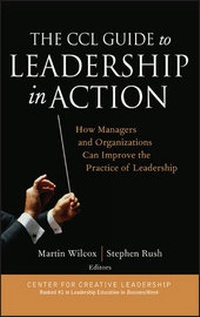
The CCL Guide to Leadership in Action
Beschreibung

Weitere Details
Weitere Ausgaben
Andere Ausgaben
Personen
Martin Wilcox is the Director of Publications at CCL and the Editor of Leadership in Action. He lives in Greensboro, NC.
Steve Rush is the Managing Editor of Leadership in Action. He lives in Greensboro, NC.
Inhalt
Chapter One
Skills for Leaders
Probably the most discussed and thoroughly researched question among people concerned with leadership is this: What skills (or behaviors or personal attributes) are necessary for a leader to be effective? Thousands of skill lists have been assembled, frequently as part of a definition of leadership, and this continues to be a fundamental question. What is significant, as this chapter illustrates, is how these lists increasingly focus on skills that allow leaders to enhance the effectiveness of others.
Making the Connection: Leadership Skills and Emotional Intelligence
Marian N. Ruderman, Kelly Hannum, Jean Brittain Leslie, and Judith L. Steed
Stuart is a senior manager at a well-known pharmaceutical company. He is brilliant, and everyone who knows him believes he has the potential to achieve great things. His primary strength is strategic thinking; colleagues say he has an uncanny ability to predict and plan for the future. As Stuart has advanced in the organization, however, his dark side has become increasingly apparent: he often lashes out at people, and he is unable to build relationships based on trust. Stuart knows he is intelligent and tends to use that knowledge to belittle or demean his co-workers. Realizing that Stuart has extraordinary skills and much to offer the company in terms of vision and strategy, some of his colleagues have tried to help him work past his flaws. But they're beginning to conclude that it's a hopeless cause; Stuart stubbornly refuses to change his style, and his arrogant modus operandi has offended so many people that Stuart's career may no longer be salvageable.
Every company probably has someone like Stuart-a senior manager whose IQ approaches the genius level but who seems clueless when it comes to dealing with other people. These types of managers may be prone to getting angry easily and verbally attacking co-workers, often come across as lacking compassion and empathy, and usually find it difficult to get others to cooperate with them and their agendas. The Stuarts of the world make you wonder how people so smart can be so incapable of understanding themselves and others.
What Stuart is lacking is emotional intelligence. There may be little hope of salvaging Stuart's career, but there is good news for managers who are similarly deficient in emotional intelligence capacities but willing to try to change their ways: emotional intelligence can be developed and enhanced.
Dealing with Emotions
In articles published in 1990, psychologists Jack Mayer of the University of New Hampshire and Peter Salovey of Yale University coined the term emotional intelligence, referring to the constellation of abilities through which people deal with their own emotions and those of others. Mayer and Salovey later went on to define emotional intelligence as the ability to perceive emotional information and use it to guide thought and actions; they distinguished it from cognitive intelligence, which is what determines whether people will be successful in school and is measured through IQ tests.
The concept of emotional intelligence was popularized by psychologist Daniel Goleman in his books Emotional Intelligence and Working with Emotional Intelligence, among other writings. Goleman broadened the notion of emotional intelligence to include an array of noncognitive abilities that help people adapt to all aspects of life. He focused on four basic competencies-self-awareness, social awareness, self-management, and social skills-that influence the way people handle themselves and their relationships with others. He argued that these human competencies play a bigger role than cognitive intelligence in determining success in life and in the workplace.
Mayer, Salovey, and Goleman were not the first to recognize the significance of the attributes now collectively called emotional intelligence. For years before, managers, educators, human resource professionals, and others had seen evidence that these attributes-known then by more generic, colloquial terms such as people skills-seemed to play an important role in separating the average from the first-rate performers. Like Goleman, many of these observers believed these skills were more important than intellect or technical skills in determining success.
Throughout CCL's more than thirty-year history, one of its primary approaches to leadership development has been to help managers and executives to understand themselves and others better, to increase their self-awareness, self-management, and interpersonal skills-in other words, to expand their emotional intelligence, although CCL has not used that term. CCL has done this through a range of programs, simulations, publications, and tools-including Benchmarks, a 360-degree assessment instrument that measures leaders' strengths and development needs as compared with those of other leaders. Although CCL and others have long believed that people's levels of emotional competency are related to their effectiveness as leaders, little had been done to scientifically examine and document whether specific elements of emotional intelligence are linked to specific behaviors associated with leadership effectiveness and ineffectiveness-and if they are, how they are linked. With this goal, CCL designed and conducted a study that correlated Benchmarks results with scores from an assessment instrument through which people gauge their own emotional intelligence abilities. Although the findings are not sufficient to state conclusively that leaders with high levels of emotional intelligence are better leaders, they do show that there are clear and basic connections between the higher ranges of emotional intelligence and the possession of skills and abilities associated with leadership excellence. Knowing and understanding these connections can give managers and executives additional ammunition in their efforts to enhance their leadership performance.
Note
To explore whether specific behaviors associated with leadership effectiveness are connected to particular elements of emotional intelligence, CCL designed and conducted a study in which 302 managers took part. The managers, who were participants in CCL's Leadership Development Program, were assessed through Benchmarks, a 360-degree feedback instrument that gives managers insights into how their bosses, peers, direct reports, and they themselves perceive their leadership strengths and development needs. The managers also completed the BarOn Emotional Quotient Inventory (EQ-i), with which people assess themselves on fifteen components of emotional intelligence. The BarOn EQ-i was developed through nineteen years of research conducted around the world by clinical psychologist Reuven Bar-On and is published by Multi-Health Systems of North Tonawanda, New York. The results from Benchmarks and the BarOn EQ-i were correlated to reveal associations between leadership skills, perspectives, and derailment factors and aspects of emotional intelligence.
The senior-level managers in the study averaged just under forty-three years old. Seventy-three percent were male, 81 percent were white, and 90 percent had a minimum of a bachelor's degree.
Strongest Links
The study comparing Benchmarks results with scores from the BarOn Emotional Quotient Inventory, an assessment of emotional intelligence, found that ten of the sixteen skills and perspectives assessed by Benchmarks were strongly associated with one or more emotional intelligence measures. In other words, higher levels of certain emotional intelligence components appear to be connected to better performance in those ten areas. Benchmarks is also designed to identify potential problem areas that can contribute to derailment, which occurs when a manager who has previously been seen as successful and full of potential for continued advancement is instead fired, demoted, or held on a career plateau. Associations were also found between two of these career-threatening flaws and certain aspects of emotional intelligence.
Let's look first at the connections between emotional intelligence and leadership skills and perspectives:
Participative management. Of all the skills and perspectives measured by Benchmarks, participative management had the highest number of meaningful correlations with measures of emotional intelligence. The essence of participative management is getting buy-in from colleagues at the beginning of an initiative by involving them, engaging them through listening and communicating, influencing them in the decision-making process, and building consensus. It is an important relationship-building skill, especially in today's management environment, in which organizations value interdependency within and between groups. Depending on the Benchmarks rater (boss, peer, or direct report), scores in participative management were related to the emotional intelligence abilities of social responsibility (being a cooperative, contributing, and constructive member of one's social group), happiness (feeling satisfied with and deriving pleasure from life), interpersonal relationship (establishing and maintaining mutually satisfying relationships), impulse control (resisting impulsive behavior), emotional self-awareness (being in touch with one's own feelings), and empathy (understanding and appreciating the feelings of others). These correlations suggest that managers who are perceived as being skilled at listening to others and gaining their input before...
