

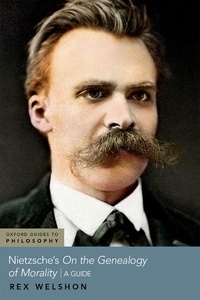
Nietzsche's On The Genealogy of Morality
A Guide
Erschienen am 11. August 2023
297 Seiten
978-0-19-761184-5 (ISBN)
Beschreibung
On the Genealogy of Morality is one of Nietzsche's greatest works. Taking recent scholarship on board and using it to inform its analysis of this challenging text, Rex Welshon's Guide introduces readers of all levels to the major arguments found in the Genealogy. Welshon also shows how arguments Nietzsche develops elsewhere clarify and buttress what he says in the Genealogy.
The guide begins by introducing the reader to Nietzsche's life, identifying some of his major intellectual influences, and tracking his influence on subsequent philosophers, artists, literary critics, social and political thinkers, and moral psychologists. Then, in four longer chapters, the Genealogy's Preface and three essays are investigated in detail. Each chapter is divided into two parts, the first dedicated to section-by-section examinations of Nietzsche's claims and arguments as they unfold in the book, the second to detailed analyses of the most important, intricate, and perplexing of those arguments. This structure permits readers to remain oriented through the Genealogy's unusual development and unique style. The guide then unpacks Nietzsche's arguments in greater detail, steering readers through arguments that sometimes lie behind the Genealogy's surface text and showing how recent scholarship has improved our understanding of some of its more cryptic claims.
Throughout, the guide strives to remain accessible and avoid technical jargon and to keep Nietzsche's fascinating, if disturbing, insights into moral evaluation, moral history, and moral psychology front and center. Having read the guide, readers will be prepared to appreciate the Genealogy's many merits and identify some of its gaps.
Weitere Details
Weitere Ausgaben
Person
Rex Welshon is Professor of Philosophy at the University of Colorado, Colorado Springs.
Inhalt
Preface and Acknowledgments
Citations and Abbreviations
Introduction
Genealogy and the revaluation of values
Overview of Genealogy and this book
Chapter I: Biography, Intellectual Development, and Legacy
1.1 Introduction
1.2 Biography
Childhood
The Basel years
The peripatetic years
Collapse, incapacitation, and death
1.3 Intellectual Development
Schopenhauer
Lange, Boscovich, and Drossbach
Roux and Rolph
1.4 Legacies
Chapter 2: Genealogy Preface
2.1 Introduction
2.2 The Preface by the sections
Sections 1-3
Sections 4-6
Sections 7-8
2.3 Discussion
Genealogy as a method
Naturalism and philosophy
Philosophical and theological psychology
Morality and moral evaluation
Chapter 3: Genealogy Essay I
3.1 Introduction
3.2 Essay I by the sections
Sections 1-3
Sections 4-5
Sections 6-9
Section 10
Sections 11-12
Sections 13-15
Sections 16-17
3.3 Discussion
Different kinds of morality and moral psychology
Drives and affects
Evolution, interpretation, and evaluation
Chapter 4: Genealogy Essay II
4.1 Introduction
4.2 Essay II by the sections
Sections 1-3
Sections 4-7
Sections 8-11
Sections 12-15
Sections 16-18
Sections 19-23
Sections 24-25
4.3 Discussion
Subjectivity, continuity, self-awareness, and self-control
Agency, free will, and willing
Power and willing power
Chapter 5: Genealogy Essay III
5.1 Introduction
5.2 Essay III by the sections
Sections 1-5
Sections 6-10
Sections 11-14
Sections 15-16
Sections 17-22
Sections 23-25
Sections 26-28
5.3 Discussion
Perspectival perception, interoception, and knowledge
Relativism and paradox
Asceticism, decadence, and nihilism
Defending life against anti-life morality
