

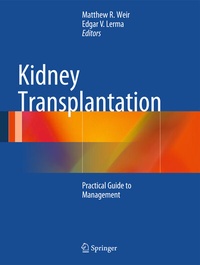
Kidney Transplantation
Beschreibung

With the increased prevalence of kidney transplantation, transplant recipients are being treated in a variety of clinical settings - often beyond the transplant center. There is a greater need for clinicians and allied healthcare professionals to have appropriate guidance on managing these patients. Kidney Transplantation offers the latest evidence-based information on the full range of dilemmas in the medical management of kidney transplant recipients before, during and after transplantation. Beginning with the selection of patients who are candidates for transplantation, this authoritative guide covers the care of the patient on the waiting list and evaluation of donors, preoperative care, induction and immunosuppression maintenance. This wealth of new information and guidelines will serve as an important resource for the best possible care for transplant patients.
Rezensionen / Stimmen
From the reviews:
"The purpose is to help healthcare providers in all settings understand health issues unique to kidney transplant recipients and how to best provide quality care for this patient population. The authors successfully accomplish this with a timely and relevant book. The audience is all providers of healthcare to kidney transplant recipients, including those in non-transplant settings." (Kendra D. Conzen, Doody's Book Reviews, June, 2014)Weitere Details
Weitere Ausgaben
Andere Ausgaben
Inhalt
PART 1
Chapter 1: Graft and Patient Survival
Machaiah M. Madhrira, Karl L. Womer, Bruce Kaplan
Chapter 2: Immunological Assessment of the Transplant Patient
Rowena Delos Santos, Eric D. Langewisch, Douglas J. Norman
Chapter 3: Recipient Evaluation
Didier A. Mandelbrot, Eliyahu V. Khankin
Chapter 4: Wait list management
John J. Friedewald, Darshika Chhabra, Baris Ata
Chapter 5: Approach to the Highly Sensitized Patient
Nadia Chaudhri, Joseph M. Nogueira
PART 2
Chapter 6: Simultaneous Paired Kidney Exchange
Jennifer E Verbesey, Matthew Cooper
Chapter 7: Ethical issues and transplant tourism
Dominique E. Martin, Francis L. Delmonico
Chapter 8: Live Donor Transplantation
Scott Reule, Arthur Matas, Hassan N. Ibrahim
Chapter 9: Extended Criteria Donors in Renal Transplantation
Todd E. Pesavento
Chapter 10: Preoperative Cardiovascular Evaluation and Management
Krista L. Lentine, Todd C. Villines, Kevin C. Abbott, Salvatore P. Costa
PART 3
Chapter 11: Surgical Issues in the Transplant Recipient
Sunil S. Karhadkar, David B. Leeser
Chapter 12: Mechanisms of Immunosuppressive Drugs
Adam Weltz, Joseph Scalea, Mihaela Popescu, Jiangnan Xu, Jonathan S. Bromberg
Chapter 13: Delayed Graft Function and Kidney Transplantation
Sunita K. Singh, Edward H. Cole, S. Joseph Kim
Chapter 14: Evaluation and Initial Management of Graft Dysfunction
Alexander C. Wiseman and James E. Cooper
Chapter 15: Recurrent and De Novo Diseases after Renal Transplantation
Geoffrey K. Dube, David J. Cohen
Chapter 16: Psychosocial Issues in Renal Transplantation
Charles Cangro
Chapter 17: Risks of Pregnancy in Renal Transplant Recipients
Dianne B. McKay, Michelle A. Josephson
Chapter 18: The Prevention and Treatment of Coronary Artery Disease in Kidney Transplant Recipients
Deborah B. Adey
Chapter 19: Dyslipidema after Kidney Transplantation
Darshika Chhabra, Anil Vamsi Doppalapudi, Anurag Kumbham, Edgar Lerma
Chapter 20: Hypertension in the kidney transplant recipient
Hani M. Wadei, Stephen C. Textor
Chapter 21: Evaluation and Management of Transplant Associated Hyperglycemia
Roy D. Bloom, Charles Moussallem
Chapter 22: Hematologic Complications of Transplantation
Marissa M. Brokhof, David Hager, Arjang Djamali, Vijay Vidyasagar
Chapter 23: Liver disease in renal transplant recipients
Andres F. Carrion, Fabrizio Fabrizi, Paul Martin
Chapter 24: Management of Transplantation Renal Bone Disease: Interplay of Bone Mineral Density and Decisions Regarding Bisphosphonate Use
Hala M. Alshayeb, Stuart M. Sprague, Michelle A. Josephson
Chapter 25: Malignancies after Transplantation and Post-Transplant Lymphoproliferative Disorder
Ahmed I. Kamal, Roslyn B. Mannon
Chapter 26: Antibody-mediated Rejection in Kidney Transplantation
Richard Ugarte, Kiangkitiwan Boonsong, Abdolreza Haririan
Chapter 27: Prevention and Management of Infectious Complications in Kidney Transplant Recipients
Rowena Delos-Santos, Daniel C. Brennan
Chapter 28: Human Polyomavirus (HPyV) and Organ Transplanation
Sabine Karam, Ravinder Wali
Chapter 29: Post-Transplant Proteinuria: Differential Diagnosis and Management
Ayub Akbari, Greg A. Knoll
Chapter 30: Urologic Issues in the Renal Transplant Patient
Michael Phelan, Andrew Kramer, Richard Bryson
Chapter 31: Practical Renal Allograft Pathology
Cinthia B. Drachenberg, John C. Papadimitriou
Chapter 32: Imaging of the Renal Transplant Recipient
Maria Manning, Jade Wong-You-Cheong
Chapter 33: Kidney and Pancreas Transplantation
David K. Klassen
Chapter 34: Drug Interaction in Solid Organ Transplant Recipients
Wana Manitpisitkul, Nikita S. Wilson, Sabrina Lee, Matthew R. Weir
