

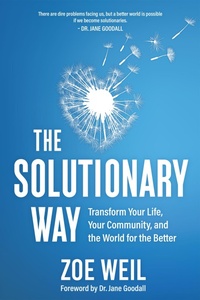
The Solutionary Way
Beschreibung
Forges a path away from polarization toward ethical problem solving and a more humane, equitable, and healthy society
From tackling injustice to protecting the environment to ending animal cruelty to improving the strength of our communities, deep divisions in our society often prevent us from working collaboratively to solve the problems we face.
Based on Zoe Weil's decades of work as a humane educator, The Solutionary Way provides clear, achievable methods to bridge divides, address the causes of seemingly intractable challenges, and create positive change. Grounded in evidence-based optimism and illustrated with dozens of real-world examples, this book provides:
- A guide to the primary components of a solutionary mindset-critical, systems, strategic, and creative thinking
- A comprehensive articulation of the solutionary framework (Identify, Investigate, Innovate, and Implement)
- A compelling argument for the MOGO principle-to do the most good and least harm for people, animals, and the environment
- An overview of emerging solutions to a variety of systemic, rather than solitary, problems
- The personal benefits associated with becoming a solutionary, from a greater sense of purpose to deeper compassion and reduced feelings of apathy and isolation.
This exciting and empowering book will appeal to a broad audience, including changemakers, activists, advocates for social justice, environmental sustainability, and animal protection, business and political leaders, and anyone who yearns to contribute to a healthy, equitable, and humane world.
Weitere Details
Weitere Ausgaben
Person
Zoe Weil is the co-founder and president of the Institute for Humane Education (IHE), where she launched the Solutionary Way - a groundbreaking approach leveraging critical, systems, strategic, and creative thinking to create positive change. She created the first graduate program linking human rights, environmental sustainability, and animal protection, currently offered through Antioch University. A frequent speaker across the US and around the world, Zoe's acclaimed TEDx talk, The World Becomes What You Teach has been viewed nearly 150,000 times. She was named one of Maine Magazine's 50 independent leaders transforming their communities, and is the recipient of the Unity College Women in Environmental Leadership award. She holds masters' degrees from Harvard Divinity School and the University of Pennsylvania. Zoe blogs about Becoming a Solutionary for Psychology Today and is the author of seven books, including The World Becomes What We Teach, Most Good, Least Harm, and Above All, Be Kind. Zoe lives in Surry, Maine.
Inhalt
Foreword
Preface: A Better World Is Possible
Introduction: Bad and Better at the Same Time
Chapter 1: A Solutionary Mindset for Next-Level Change
What I've Learned from Improv Comedy
Build relationships
Embrace "Yes, and..."
Bring the love
Help others shine
Cultivating a Solutionary Mindset
What Is a Solutionary Lens?
Solutionary = Next-level Changemaker
Solutionaries take problem-solving to the next level
Solutionaries take humanitarianism to the next level
Solutionaries take problem-identification to the next level
Solutionaries take activism to the next level
Chapter 2: Most Good, Least Harm (MOGO)
Would You Kill a Cousin for a Full Head of Hair?
The MOGO Principle
Do Our Personal Choices Really Matter?
Why the Superlative?
The 3 I's
Inquiry
Introspection
Integrity
MOGO for Whom?
Which birds?
Which sea animals?
Which people?
Make MOGO Choices, But Don't Stop There
Chapter 3: Thinking Like a Solutionary
Be Aware of Assumptions and Judgments
Resist Judgmentalness
What Is Solutionary Thinking?
Critical thinking
Systems thinking
Strategic thinking
Creative thinking
Challenge the Ten Instincts
Chapter 4: Preparing for Your Solutionary Practice
What Is the Story and Path that Led You to This Process?
What Are You Good At? What Do You Love to Do?
Did You Know?
Strive to Be a Campfire Rather than a Forest Fire
Chapter 5: The Four Phases of the Solutionary Process
Phase I: Identify
Select an issue to learn more about
Identify the problem you want to solve
Write down a problem statement
Phase II: Investigate
Connect with everyone you can who has a stake in the problem
Determine the causes of the problem
Research what has succeeded and failed at solving the problem
Phase III: Innovate
Develop solutions that address the causes of the problem, avoid unintended negative consequences, and do the most good and least harm to people, animals, and the environment
Determine which solutions are most solutionary and most feasible for implementation
Draft a plan to implement your solution
Phase IV: Implement
Implement your solution
Assess and share your solution
Celebrate and iterate
Chapter 6: Solutions
Food Solutions
Population Solutions
Economic Solutions
Production Solutions
Political Solutions
Criminal Justice Solutions
Biomedical Research and Drug Testing Solutions
Education Solutions
Conclusion: The Solutionary Way Is Good for You
Notes
Appendix 1: The Solutionary Framework and Solutionary Scale
Appendix 2: The Five Key Questions
Appendix 3: The MOGO Questionnaire
Appendix 4: Chart of Problems, Impacts, and Local Manifestations
Acknowledgments
About the Institute for Humane Education
Index
About the Author
About New Society Publishers
