

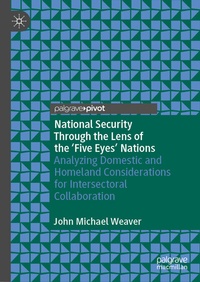
National Security Through the Lens of the 'Five Eyes' Nations
Beschreibung
This book analyzes the 'Five Eyes' nations' concerns and policies relating to national security threats through an interdisciplinary theoretical engagement with the Political, Information, Security and Economic (PISE) Model. Through the analysis of secondary data sources such as scholarly and government reports, policy documents, press releases and interviews, the author analyzes the five case studies-Australia, Canada, New Zealand, UK, and the USA-to determine how and why nations use the PISE variables to shape favorable homeland security outcomes, to determine what the points of homeland intersectoral collaboration are among the 'Five Eyes' nations. In so doing, Weaver determines that although the 'Five Eyes' countries have concerns about homeland security and each, individually, identifies threats and hazards, they do also employ collaborative measures to build resilience and increase efforts to prepare for anticipated security breaches.
Weitere Details
Weitere Ausgaben
Person
John Weaver is an associate professor of Intelligence Analysis at York College of Pennsylvania (USA), a retired DOD civilian from the United States' Intelligence Community, and has served as an officer in the US Army (retiring at the rank of lieutenant colonel). He has lived and worked on four continents and in 19 countries respectively, spending nearly eight years overseas (on behalf of the US government). His experience includes multiple combat deployments, peace enforcement, peacekeeping, humanitarian relief and disaster assistance support in both conventional and unconventional/non-traditional units. John has trained and certified multinational NATO reconnaissance teams based in the Netherlands, Germany and Spain for worldwide deployment in full-spectrum mission sets. He has also personally led several reconnaissance missions throughout Europe, the Middle East, and Asia (including multiple missions in Afghanistan).
Inhalt
Chapter 1: Introduction.- Chapter 2: Research questions, methodology and limitations.- Chapter 3: Relationships.- Chapter 4: Australia.- Chapter 5: Canada.- Chapter 6: New Zealand.- Chapter 7: United Kingdom.- Chapter 8: United States.- Chapter 9: Analysis and Findings.- Chapter 10: Conclusion.
