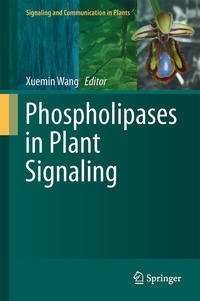
This volume focuses on recent advances in the biochemical and molecular analysis of different families of phospholipases in plants and their roles in signaling plant growth, development and responses to abiotic and biotic cues.
The hydrolysis of membrane lipids by phospholipases produces different classes of lipid mediators, including phosphatidic acid, diacylglycerol, lysophospholipids, free fatty acids and oxylipins. Phospholipases are grouped into different families and subfamilies according to their site of hydrolysis, substrate usage and sequence similarities. Activating one or more of these enzymes often constitutes an early, critical step in many regulatory processes, such as signal transduction, vesicular trafficking, secretion and cytoskeletal rearrangements. Lipid-based signaling plays pivotal roles in plant stress responses, cell size, shape, growth, apoptosis, proliferation, and reproduction.
Reihe
Auflage
Sprache
Verlagsort
Verlagsgruppe
Illustrationen
16
4 s/w Abbildungen, 16 farbige Abbildungen
VIII, 228 p. 20 illus., 16 illus. in color.
Dateigröße
ISBN-13
978-3-642-42011-5 (9783642420115)
DOI
10.1007/978-3-642-42011-5
Schweitzer Klassifikation
PART I: Plant Phospholipase Families and Derived Messengers.- PLD: Phospholipase D and Phosphatidic Acid.- PI-PLC: Phosphoinositide-phospholipase Cs in Plant Signalling.- NPC: Non-specific Phospholipase Cs in Plant Functions.- pPLA: Patatin-Containing Phospholipase A in Plant Signalling.- sPLA2 and PLA1: Phospholipase A2 and Phospholipase A1 in Plant Signalling.- Biophysical Properties of Lipid Mediators and the Effects on Molecular Interactions.- PART II: Phospholipase Signalling in Response to Environmental Stresses.- Phospholipases in Plant Response to Reactive Oxygen Species and Hyperosmotic Stress.- Phospholipase Ds in Plant Response to Hyperosmotic Stresses.- Phospholipases in Plant Response to Nitrogen and Phosphorus Status.- PART III: Phospholipases in Plant Biotic Interactions.- Lipases in Signalling Plant Defense Responses.- Phospholipase A in Plant Immunity.- Phospholipases in Regulating Plant-herbivore Interaction.- PART IV: Phospholipases in Plant Growth and Development.- Phospholipases in Cytoskeleton Dynamics and Plant Growth.- Phospholipases and Lipid Signalling in Cytoskeleton and Pollen Tube Growth.- Phospholipases and Lipid Signalling in Secretory Pathways.- Phospholipase A in Carbon Partitioning and Anisotropic Plant Cell Growth.