

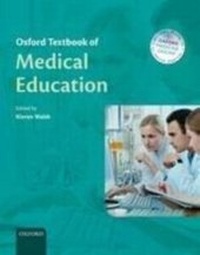
Oxford Textbook of Medical Education
1. Auflage
Erschienen am 31. Oktober 2013
775 Seiten
978-0-19-150562-1 (ISBN)
Beschreibung

Providing a comprehensive and evidence-based reference guide for those who have a strong and scholarly interest in medical education, the Oxford Textbook of Medical Education contains everything the medical educator needs to know in order to deliver the knowledge, skills, and behaviour that doctors need. The book explicitly states what constitutes best practice and gives an account of the evidence base that corroborates this. Describing the theoretical educational principles that lay the foundations of best practice in medical education, the book gives readers a through grounding in all aspects of this discipline. Contributors to this book come from a variety of different backgrounds, disciplines and locations, producing a book that is truly original and international.
Weitere Details
Weitere Ausgaben
Andere Ausgaben
Kieran Walsh
Oxford Textbook of Medical Education
Buch
10/2013
Oxford University Press
256,78 €
Artikel ist vergriffen; siehe andere Ausgabe
Inhalt
- Cover
- Contents
- About the editor
- Contributors
- Abbreviations
- PART 1 Introduction
- 1. Introduction
- PART 2 Curriculum
- 2. Curriculum design in context
- 3. Problem-based learning
- 4. Interprofessional education: learning together in health and social care
- 5. Student choice in the undergraduate curriculum: student-selected components
- 6. Integrated learning
- 7. Instructional design for medical education
- 8. Using concept maps in medical education
- 9. Creating the learning environment
- PART 3 Identity
- 10. Identities, self and medical education
- 11. Personality and medical education
- 12. Medical education and its context in society
- PART 4 Delivery
- 13. Small group learning
- 14. Large group teaching
- 15. E-learning
- 16. Simulation-based medical education
- 17. Simulated patients in medical education
- 18. Work-based learning
- 19. Learning in ambulatory care
- 20. The humanities in medical education
- 21. Study skills
- PART 5 Supervision
- 22. Educational supervision
- 23. Mentoring
- 24. Professionalism
- 25. The resident as teacher
- 26. Students learning to teach
- 27. Patient involvement in medical education
- PART 6 Stages
- 28. Undergraduate medical education
- 29. Postgraduate medical education
- 30. Continuing professional development
- 31. Remediation
- 32. Transitions in medical education
- PART 7 Selection
- 33. Selection into medical education, training and practice
- 34. Study dropout in medical education
- PART 8 Assessment
- 35. Principles of assessment
- 36. Setting standards
- 37. Choosing instruments for assessment
- 38. Test-enhanced learning
- 39. Assessing learners' needs
- 40. Self-regulated learning in medical education
- 41. Formative assessment
- 42. Technology enhanced assessment in medical education
- 43. Assessing professionalism
- 44. Assessment in the context of relicensure
- 45. Objective structured clinical examinations
- 46. Workplace-based assessment
- 47. Written assessment
- 48. Successful feedback: embedded in the culture
- PART 9 Quality
- 49. Evaluation
- 50. Continuous quality improvement
- 51. Cost and value in medical education
- PART 10 Research and scholarship
- 52. Theoretical perspectives in medical education research
- 53. Quantitative research methods in medical education
- 54. Qualitative research in medical education
- 55. Publishing in medical education
- 56. Scholarship in medical education
- PART 11 Global medical education
- 57. Medical education in developing countries
- 58. Medical education in the emerging market economies
- PART 12 The future
- 59. The future of health professional education
- 60. Faculty development for teaching improvement: from individual to organizational change
- 61. Educational leadership
- Index
- A
- B
- C
- D
- E
- F
- G
- H
- I
- J
- K
- L
- M
- N
- O
- P
- Q
- R
- S
- T
- U
- V
- W
- Z
