

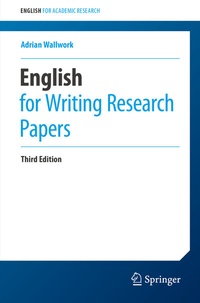
English for Writing Research Papers
Beschreibung
Publishing your research in an international journal is key to your success in academia. This guide is based on a study of over 1000 manuscripts and reviewers' reports revealing why papers written by non-native researchers are often rejected due to problems with English usage and poor structure and content.
With easy-to-follow rules and tips, and examples taken from published and unpublished papers, you will learn how to:
- prepare and structure a manuscript
- increase readability and reduce the number of mistakes you make in English by writing concisely, with no redundancy and no ambiguity
- write a title and an abstract that will attract attention and be read
- decide what to include in the various parts of the paper (Introduction, Methodology, Discussion etc)
- highlight your claims and contribution
- avoid plagiarism
- discuss the limitations of your research
- choose the correct tenses and style
- satisfy the requirements of editors and reviewers
This edition has two completely new chapters covering machine translation and using AI tools (e.g. chatbots, paraphrasers, editing tools) to improve and correct the English of a text.
Other titles in this series:
Grammar, Usage and Style
Grammar, Vocabulary, and Writing Exercises (three volumes)
100 Tips to Avoid Mistakes in Academic Writing and Presenting
English for Presentations at International Conferences
English for Academic Correspondence
English for Interacting on Campus
English for Academic CVs, Resumes, and Online Profiles
English for Academic Research: A Guide for Teachers
Adrian Wallwork is the author of more than 40 English Language Teaching (ELT) and English for Academic Purposes (EAP) textbooks. He has trained several thousand PhDstudents and researchers from 50 countries to write papers. He edits research manuscripts through his own proofreading and editing agency.
